Clara’s Verdict
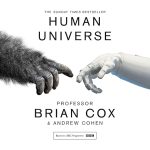
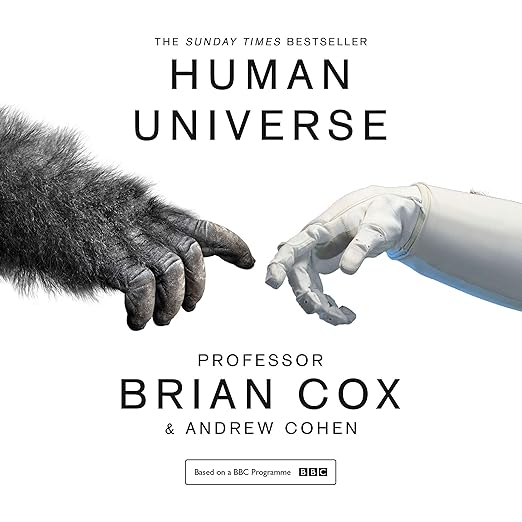
There is a particular kind of intellectual pleasure that comes from listening to someone who is genuinely excited by what they know. Brian Cox is one of the better exemplars of that quality in popular science writing, and Human Universe, which accompanies his acclaimed BBC television series of the same name, captures that enthusiasm at something close to its best. The questions it sets out to address are not modest: where are we, are we alone, who are we, why are we here, and what is our future? Cox does not pretend to have definitive answers to any of them, but he makes the attempt with enough rigour and wonder to justify the ambition. I listened to the second half during a long train journey one autumn afternoon, watching the countryside flatten out toward the horizon, and found the combination of scale, covering the cosmic, the geological, and the evolutionary in rapid succession, genuinely affecting.
A word on the Audible UK ratings: there are only two at the time of writing, both five stars. That number is too small to be statistically meaningful, but it is consistent with what you find when you look at broader reader responses to Cox’s published work. His books attract readers who are already sympathetic to his project, and their responses tend to confirm his reputation rather than complicate it. The absence of a larger review base should not be read as a quality signal.
About the Audiobook
Published by William Collins in May 2016 and running to seven hours and twenty-seven minutes, Human Universe covers an extraordinary range of territory within a relatively contained runtime. Cox draws on physics, evolutionary biology, palaeontology, and cosmology, weaving between disciplines with the ease of someone who has thought seriously about the connections between them over many years. The book addresses the origins of complex life, the physics of consciousness, the anthropic principle, the Fermi paradox, the history of scientific thought, and the extraordinary improbability that any of it, any of us, exists at all. One reviewer, a former MBA professor who retrained as a secondary science and A-level physics teacher, describes the book as integrated into his teaching and offering an excellent platform for explaining humanity’s story from its African origins to its potential future across the Milky Way. That range of applicability, from secondary school science to academic context, speaks to the book’s accessible-but-substantive balance, which Cox at his best achieves consistently.
The Narration
Samuel West narrates, and it is a very good fit. West has a precise, warm baritone that carries scholarly authority without the slight self-congratulatory edge that Cox’s own voice sometimes acquires on television. West reads as if he is genuinely interested in what he is delivering, which matters enormously for science writing of this kind: the prose needs a voice that can hold the listener through passages of technical explanation without either rushing or flattening the ideas into a kind of reassuring background noise. West achieves that calibration well. One reviewer notes the absence of the television series’ visual elements, the dramatic landscapes and demonstrations that punctuate the TV episodes, and that absence is real. But West’s narration compensates with a clarity of diction that arguably makes the more complex passages easier to follow than they can be when surrounded by the spectacular imagery of the television production.
What Readers Say
Listeners consistently praise the book’s depth and its intellectual ambition. Reviewers use words like brilliant, profound, and extraordinary. One response describes Cox weaving the known laws governing everything in the universe and considering every angle, which captures the structural approach accurately. The critical note that surfaces in a more measured response concerns the book’s function as a companion to the television series: without the visual elements, some of the demonstrations and scenic sequences referenced in the text are absent, and for listeners who have seen the series, the text functions as a rich companion rather than a standalone experience. For those coming cold, it works independently. Another reviewer describes the book as not having the visuals, which is simply factually true and a useful expectation to calibrate before listening.
Who Should Listen?
This audiobook is well suited to curious generalists who are comfortable with scientific ideas but do not require mathematical depth or academic rigour in the technical sense. It will appeal to fans of Cox’s television work who want to spend more time with his thinking than a television episode allows, and to listeners interested in big-picture questions about human existence, consciousness, and the cosmos. It is not a rigorous academic text; Cox writes for a broad audience and that is a deliberate choice rather than a limitation. Specialists in the relevant fields may find the treatment necessarily superficial. At seven and a half hours, it is a manageable commitment for the extraordinary range of territory it covers, and it rewards sustained rather than fragmented listening.