Clara’s Verdict
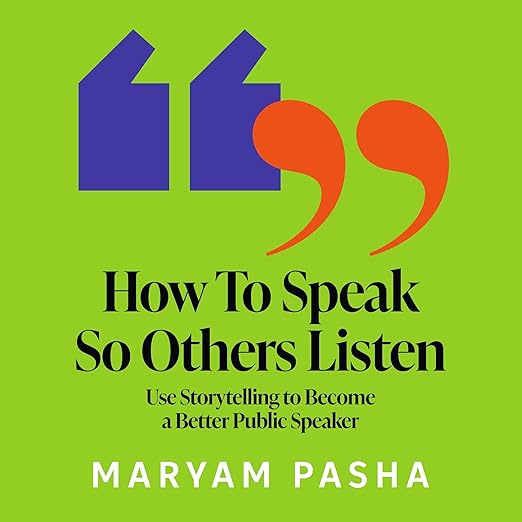
Public speaking books are extraordinarily prone to a particular kind of corporate blandness – the kind that gives you “five steps to confidence” while quietly forgetting that confidence without something worth saying is just performance. Maryam Pasha is not that kind of author. As storytelling coach and curator for TEDxLondon, she has spent years helping real people – academics, philanthropists, business leaders, activists – find their voice and learn how to use it. At five hours and forty-seven minutes, How To Speak So Others Listen is compact, practical, and consistently grounded in the idea that what you say matters at least as much as how you say it. Released in March 2026, it doesn’t yet have listener ratings, but the endorsements from Sarah Ellis of Squiggly Careers and comedian Sofie Hagen speak to a genuinely broad appeal that extends well beyond the corporate speaking circuit.
About the Audiobook
Pasha’s starting point is a simple but frequently undervalued truth: stories are how human beings communicate meaning, build empathy, and change minds. Data and facts can establish a case; it’s the story that makes someone feel it, remember it, and act on it. Her book is structured as a practical toolkit for public speaking in the broadest sense – presentations, pitches, community meetings, difficult conversations, TED-style talks – but it’s not the kind of toolkit that assumes all speakers are starting from the same place or facing the same barriers.
She is particularly attentive to the specific obstacles faced by people who have been told, implicitly or explicitly, that their voice doesn’t belong in public spaces: women, activists, people from communities underrepresented on stages and in boardrooms. She treats the development of a public voice as inseparable from the development of genuine self-worth and a belief that what you have to say deserves to be heard. This is not the standard confidence-coaching line, and it makes the book considerably more useful for the majority of people who have struggled, at some point, with exactly that question.
The framework draws on her work with hundreds of high-profile TEDxLondon speakers, but the techniques are designed to be applicable across contexts. Roman Krznaric, a TED speaker himself, calls it something that “cuts through and clarifies exactly what you need to know to deliver a talk that makes a difference.”
The Narration
Pasha reads her own book, which makes particular sense here – a book about finding your voice would be somewhat undermined by someone else’s voice delivering it. Her narration is warm and direct, with the unhurried confidence of someone who has spent years coaching others on a stage and in one-to-one sessions. She speaks as she presumably coaches: with patience, clarity, and a genuine interest in the listener’s development rather than in demonstrating her own expertise. The conversational register of the prose translates naturally to audio, and the practical exercises she describes are easy to follow without a visual reference.
What Readers Say
As a March 2026 release, listener reviews are still accumulating. The pre-publication endorsements are unusually detailed and credible. Sarah Ellis of Squiggly Careers – whose TEDx talk, which Pasha helped shape, has been watched by more than two million people – writes: “Now everyone can benefit in the way that we did. Having Maryam’s book by your side means you will speak in a way that makes people sit up and take notice.” Sofie Hagen, who has been a public speaker for sixteen years, notes that “even I learned a lot from this book.” Julia Shaw calls it “a practical and masterful guide to effective communication.” These are specific claims from people with genuine standing in their fields, and they carry proportionate weight.
Who Should Listen?
This is for anyone who needs to communicate in public and wants to do it better – which, depending on how broadly you define “public,” is most of us at some point. It is particularly useful for those who feel they have something worth saying but lack the technical confidence to say it effectively, for activists and community organisers who rely on storytelling to build support, and for anyone facing a presentation, pitch, or difficult conversation they want to handle with more skill. Five hours and forty-seven minutes is a practical investment that most working adults can make comfortably. Listen to How To Speak So Others Listen on Audible UK and start treating your own voice as the instrument it is.