Clara’s Verdict
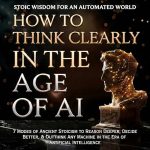
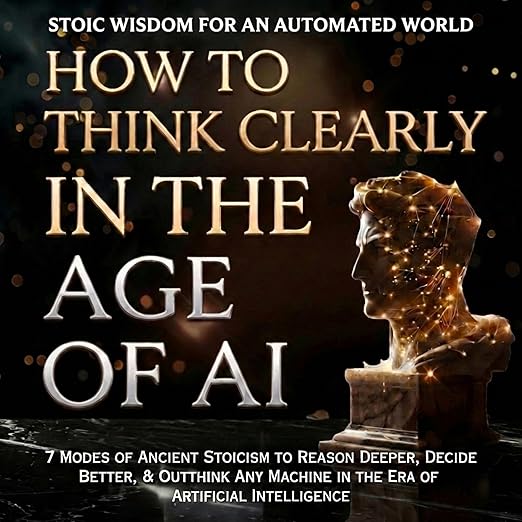
The publishing world is currently awash with books about artificial intelligence, and the majority of them fall into one of two camps: breathless enthusiasm about what AI will enable, or breathless anxiety about what it will destroy. Austin Chen’s How to Think Clearly in the Age of AI occupies a third position, which is its most interesting quality. The argument is essentially this: AI is already performing many cognitive tasks faster and more reliably than humans can, so the question is not how to compete with it at those tasks but how to develop the forms of cognition that AI cannot replicate. And Chen’s answer draws not from technology culture or Silicon Valley frameworks but from Stoic philosophy, specifically from Marcus Aurelius, Seneca, and Epictetus, none of whom anticipated artificial intelligence but all of whom, in Chen’s reading, mapped the terrain of human judgment, ambiguity, and values-based reasoning with extraordinary precision across two millennia ago.
There are no Audible ratings for this title as of the time of writing, which reflects its February 2026 release date rather than any quality signal. The publisher is Blackstone Publications, and the series context places it within a strand of AI-adjacent business and leadership thinking that has generated considerable reader interest in the current moment.
About the Audiobook
At four hours and thirty-eight minutes, this is a compact listen, the kind of book that can occupy a single long commute or be absorbed comfortably over two or three evenings. Chen structures his argument around seven what he calls trainable modes of thinking: discernment, meaning-making, ethical reasoning, negative capability, presence, perspective, and integration. Each is grounded in Stoic philosophy and illustrated with contemporary applications. The framework is called the Unautomated Mind Method, which is a slightly corporate-sounding name for an idea that is genuinely more philosophically grounded than most business books of this type. The critical concept is negative capability, which Chen borrows from the poet John Keats to describe the rare ability to hold uncertainty without collapsing into premature conclusions. He cites it as the single most underrated professional trait of the coming decade, arguing that AI can generate confident-sounding answers quickly precisely where human tolerance of genuine ambiguity would serve better. That framing is the book’s most unexpected and most intellectually interesting move, and it is more stimulating than the Stoic scaffolding alone.
The Narration
Ted Kettler narrates, bringing a measured, professional delivery to material that benefits from a calm and authoritative voice. Business and self-improvement titles of this kind live or die by narration pacing: too fast and the ideas blur past before they can be absorbed, too slow and the listener loses the thread of the argument. Kettler manages the balance well. His is not a particularly distinctive voice, but it is a reliable one, and for a book designed to be listened to in relatively concentrated sessions where the ideas matter more than the performance, reliability serves better than personality. The seven-section structure of the argument provides natural pause points in the listening experience, which suits an approach of absorbing one mode of thinking at a time.
What Readers Say
No listener reviews are available at the time of writing, consistent with the book’s recent release date. Listeners interested in the intersection of AI, philosophy, and professional development who come to this title early will be making a judgment call based on the author’s argument, the quality of the publisher, and the clarity of the framework on offer. Blackstone Publications is a reputable audio-first imprint with a track record in accessible non-fiction of this kind, which is a reasonable quality signal in the absence of specific listener data.
A final note on the framing: Chen argues that the most important professional differentiator of the coming decade will not be which AI tools you master but what kind of thinker you become in relation to them. That argument is not obviously wrong, and it connects to a broader current in professional development thinking that positions depth of judgment and values-based reasoning as the hardest things to automate and therefore the most durable things to cultivate. For listeners who are experiencing genuine anxiety about AI’s impact on their work, this book offers something more grounding than most: a framework rooted in a philosophy that has survived two thousand years of disruption and change.
Who Should Listen?
This is best suited to knowledge workers, managers, and leaders who are thinking seriously about what cognitive skills to develop as AI becomes more embedded in professional and daily life, and who want a framework that is philosophically grounded rather than purely tactical or tool-focused. Readers who already have a Stoic philosophy background will find the application to AI genuinely fresh and thought-provoking. Readers new to Stoicism will find this a practical and accessible introduction to several key Stoic concepts via a contemporary context. Those looking for a technical overview of AI capabilities, a how-to guide for using specific tools, or a political argument about AI’s social impact will not find any of that here. This is entirely about human cognition and its relationship to machine intelligence, not about the technology itself.