Clara’s Verdict
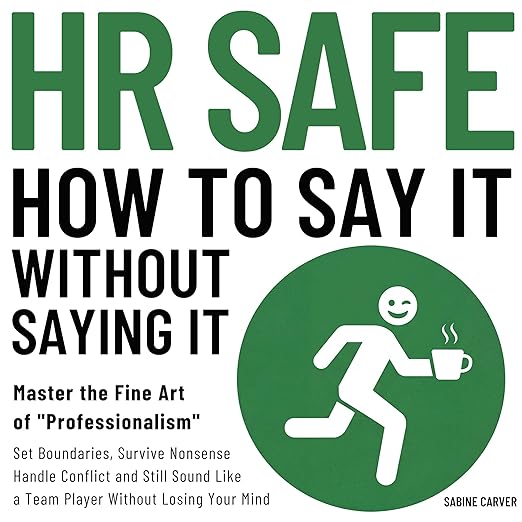
The workplace humour and professional self-help genres have a complicated relationship: the best books in this space use comedy as a Trojan horse for genuinely useful advice, while the worst mistake a funny premise for actual substance. HR Safe: How to Say It Without Saying It lands firmly in the former category. Sabine Carver has written something genuinely sharp – a corporate survival manual that translates internal screaming into polished, defensible workplace communication without ever losing the joke or condescending to its audience.
I have recommended this to at least four people since first listening to it, which is, in my experience, the most honest measure of whether a book actually works. It does.
About the Audiobook
The premise is precise and painfully relatable: the gap between what you think in response to a workplace request and what you are able to say without professional consequences. Carver – who describes herself as a field anthropologist of Homo Corporatus Exhaustus – has assembled a series of scripts for the situations that break most professional people at least once a week: the vague email that requires a concrete commitment before you respond to it; the ambush question from a colleague who has just made your calendar a hostage; the twelve-person meeting you could escape without attending if anyone would let you; the dreaded “quick chat” from your manager that threatens to end in bathroom tears.
Each chapter is built around a specific scenario, with field notes explaining the psychology behind common workplace dynamics and a practical script that allows you to say exactly what you mean while remaining professionally unimpeachable. The scripts range from managing “ASAP” requests (“Panic is not a scheduling system – make them pick a date”) to declining praise in lieu of a raise (“‘Rockstar’ doesn’t pay rent – turn the compliment into a negotiation”). The tone is sharp and funny throughout, without tipping into the cynicism that makes some corporate satire feel ultimately exhausting. The bonus PDF included in Audible purchases provides the scripts in written form for immediate deployment.
The Narration
Val Caruso narrates with excellent comic timing and precisely the right register – amused, knowing, not quite incredulous, as though she has personally sat through every meeting this book describes and is now in a position to find it funny at appropriate distance. At two hours and twenty minutes, this is among the shorter audiobooks I’ve reviewed recently, which suits the format perfectly. It is a collection of practical tools, not a philosophical meditation. You can listen to it across a couple of commutes and immediately begin deploying what you’ve learned, which is quite the return on a modest time investment.
What Readers Say
The audiobook holds a 4.6-star average from ten early listeners, and the reviews are notably detailed and enthusiastic. One reader, describing themselves as a long-time corporate world veteran, praised the book for addressing “the need to choose words carefully and professionally while dealing with people from all different disciplines” – calling Carver’s authority evident from the book’s structure. Another described it as “wickedly funny, surgically practical” – a Rosetta Stone for translating internal screams into HR-safe diplomacy. A listener outside the corporate sector noted its applicability well beyond office settings: useful for anyone who tends towards either excessive bluntness or excessive accommodation in professional contexts. Several reviewers specifically named the scripts as worth the price of admission alone.
Who Should Listen?
There is a structural intelligence to how Carver has organised the material. Rather than proceeding chronologically through the working day or hierarchically through the corporate org chart, she has sequenced the scenarios by the type of professional anxiety they produce: vagueness, ambush, extraction, criticism, recognition. This means the listener can identify, within the first few chapters, which chapters are most urgently relevant to their current situation and return to those sections when the relevant crisis arises. The book functions as a reference tool as much as a narrative listen.
The bonus PDF deserves specific mention, because it transforms the audiobook from a passive listening experience into an active tool. The scripts, rendered in written form, become reference material you can pull out when you need them – a practical resource rather than something you have to try to remember from audio. This kind of supplementary material is underutilised in audiobook publishing, and Carver and her team have made genuinely good use of it here.
Anyone who works in a professional environment and has ever typed “Happy to help!” while thinking something quite different. The book is marketed at corporate workers but functions equally well for freelancers, service professionals, anyone who navigates institutional communication regularly, and people early in their professional lives who haven’t yet developed the instincts for managing upwards and sideways without causing offence or becoming a doormat. At under two and a half hours, there is genuinely no reason not to listen to this – the time investment is trivial and the return, for many listeners, will be immediate and ongoing.
Listen to HR Safe on Audible UK – the professional communication guide you will actually use, probably within the week.