Clara’s Verdict
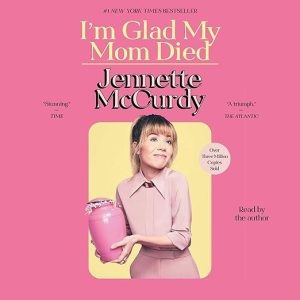
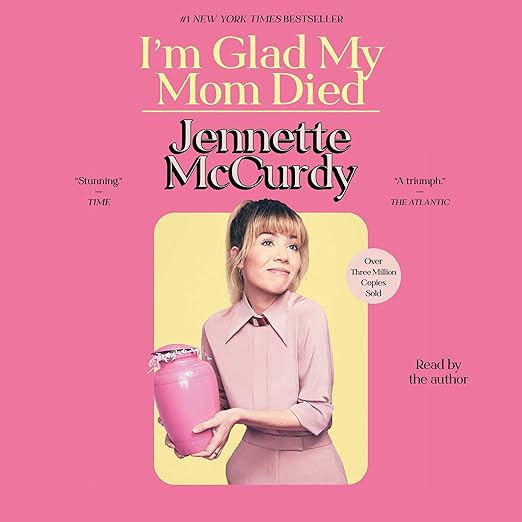
The title is designed to shock, and it does, and that is precisely the point. Jennette McCurdy spent her childhood acting out someone else’s dream, her adolescence developing the disorders that survival of that childhood required, and her early adulthood in the strange aftermath of her mother’s death – the event that finally, and horrifyingly, set her free. I’m Glad My Mom Died is the kind of memoir that arrives and immediately becomes unavoidable: over three million copies sold worldwide, number one in both the US and internationally, and narrated by McCurdy herself in a performance so precisely calibrated and so emotionally exposed that it feels less like an audiobook than a conversation she needed to have, out loud, for the first time. Rated 4.7 from 85 UK listeners. I don’t usually start reviews with instructions, but: read it.
The dark humour in the title, and throughout the book, is not a defence mechanism. It is a survival skill that McCurdy spent years developing in response to circumstances that would otherwise have been unbearable, and understanding that distinction is central to understanding what the book achieves. She is funny. She is also devastatingly honest. Both things are true simultaneously, and neither undermines the other.
About the Audiobook
McCurdy tells her story from the beginning: six years old and sent to her first acting audition by a mother who had conflated her daughter’s career with her own identity and survival. What follows – described in unflinching and precisely observed detail – is a childhood organised entirely around the management of someone else’s needs: calorie restriction framed as health advice, intensive monitoring framed as closeness, diaries and emails and income all shared with a mother who could not tolerate the existence of a daughter with separate desires. McCurdy was cast in iCarly as a teenager, became genuinely famous, and found that success intensified rather than resolved the damage. The eating disorders, the anxiety, the addiction, the series of relationships patterned on the only template she had been given – all of it runs through the book with the clarity of someone who has done serious therapeutic work and found the words to make sense of what the work uncovered.
The structural choice to write the early chapters in the voice and perspective of the child Jennette – breathless, credulous, unironically devoted – is one of the book’s most effective decisions. The gap between what that child understood and what the adult narrator and reader understand grows more uncomfortable as the book progresses, and McCurdy uses it with great skill. By the time the death arrives, and the liberation that follows it, the reader has been prepared to hold the complexity of the title without flinching.
The Narration
McCurdy narrating her own memoir is both the obvious choice and the only viable one. The writing style shifts to match the age she is describing – young and slightly breathless in the childhood sections, more controlled and harder as she ages – and what reads as a stylistic choice on the page becomes, in audio, something visceral and immediate. There are moments where the vocal performance communicates things the words alone could not: the timing of a pause, the quality of a laugh, the particular texture of a sentence delivered by someone who lived the thing it describes. Reviewer Adam described her as “a voice I’d unknowingly been waiting for.” At six and a half hours, it is exactly the right length – no padding, nothing withheld.
What Readers Say
Eighty-five ratings at 4.7 stars, with UK reviewers noting in particular how the book lands differently for those who grew up watching McCurdy on Nickelodeon. S, reviewing from the UK in 2026, described it as “truly eye-opening” – the story behind the face they knew being nothing like what they had imagined. Adam called it “the truth behind a voice I’d unknowingly been waiting for.” Pomegranate praised it as “a fascinating insight into unhealthy family dynamics and the unfolding of emotional abuse.” Katie called it “a page turner, which I find isn’t always the case with non-fiction.” The four-star response from Thirteenth Monkey is worth noting for its honesty: the early chapters’ stylistic choices initially alienated them before they fully engaged – a response that the author herself might appreciate as an accurate reflection of the experience of being the child in the story.
Who Should Listen?
Readers who grew up with Nickelodeon and want to understand what was happening behind the screen. Anyone interested in enmeshment, emotional abuse, and what recovery from a family system built around one person’s needs actually looks and feels like. Readers of memoirs about childhood, addiction, and eating disorders who want a voice that is genuinely funny even while it is genuinely devastating. This is also, quietly and without announcing itself, a book about what therapy can achieve when a person finally, firmly chooses themselves. Available on Audible UK.