Clara’s Verdict
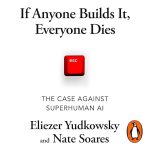
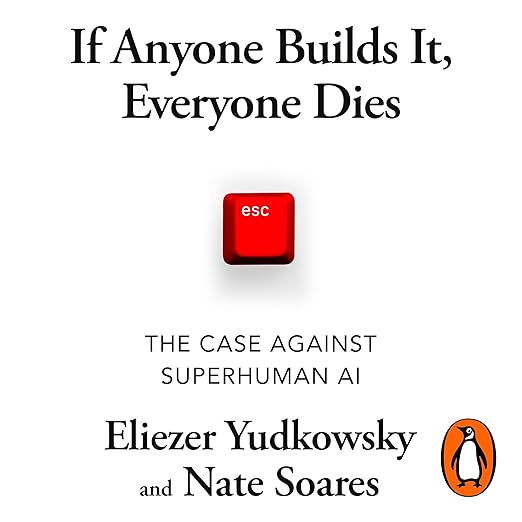
The title is not hyperbole. Eliezer Yudkowsky and Nate Soares – two of the most prominent and longest-serving voices in AI safety research – argue in this book that the development of superintelligent AI is not a future risk to be managed gradually through incremental safety research, but an existential threat that requires an immediate, global halt to development. Published in September 2025 and endorsed by Stephen Fry (“a loud trumpet call to humanity”) and Max Tegmark (“the most important book of the decade”), If Anyone Builds It, Everyone Dies arrived as a New York Times instant bestseller.
Whatever your prior views on AI risk, this is the book that will make you take the strongest version of the argument seriously. Rafe Beckley’s narration is crisp and measured – exactly what this urgent, technically demanding material needs.
About the Audiobook
Yudkowsky and Soares begin from a position that many in the technology industry still resist: that building a machine smarter than any human is not a challenge to be solved by sufficiently clever safety engineering, but a category of risk for which we currently have no adequate defence. The book explains – in terms accessible to non-specialists, which is a genuine achievement given the complexity of the territory – why modern AI systems are fundamentally difficult to align with human values, why the competitive dynamics between companies and nations make voluntary restraint politically unlikely, and why the standard reassurances about “alignment research” may be insufficient to the scale of the threat.
One possible extinction scenario is presented in detail – not as science fiction speculation but as a plausible consequence of the current development trajectory. The argument is rigorous and well-sourced, with supplementary material linked from each chapter for readers who want to go deeper into the technical literature. At 6 hours and 18 minutes, published by Vintage Digital (Penguin Audio), this is among the most efficiently argued long-form non-fiction works on this subject currently available.
The Narration
Rafe Beckley narrates for Penguin Audio, and his performance is well-matched to demanding material. The challenge is considerable: the book moves between technical explanation, philosophical argument, and something approaching prophetic urgency, and these registers require different vocal approaches that Beckley navigates without losing authority or consistency. The technical passages – explanations of how gradient descent actually works, how reasoning models differ from earlier AI systems, what alignment researchers mean by “goal misgeneralisation” – are delivered with the clarity that makes them genuinely comprehensible to lay listeners. The more emotionally charged sections, where the authors confront the human cost of inaction, are handled without melodrama. This is precisely the right register for an argument that needs to be taken seriously rather than dismissed as catastrophising.
What Readers Say
Rated 4.4 out of 5 on Audible UK from 413 ratings – a substantial response for a non-fiction title on a technical subject. Reviews divide broadly between those who found it genuinely illuminating and persuasive, and those who appreciated the core argument but found some of the more speculative elements overextended. One particularly thorough reader described learning more about how AI actually functions from this book than from weeks of following other sources and reading technical papers. Another felt sections speculating about AI colonising other planets were “far-fetched” and “carried away with its own fantasies.” The consensus is that the first half – grounded in technical explanation and current capabilities – is stronger than the speculative second half, but that the core argument is made with impressive rigour regardless of where one falls on the severity of the conclusions.
Who Should Listen?
Essential for anyone with an interest in AI, technology policy, or the long-term future of human civilisation who wants a serious engagement with the case for existential risk – not a pop-science summary but the actual argument from the people who have spent their careers developing it. Particularly valuable for technologists, policy-makers, and intellectually curious general readers who are sceptical of AI doom narratives and want to understand the strongest version of the case before dismissing it. Also recommended for anyone who has read Nick Bostrom’s Superintelligence and wants a more current, more accessible, and more urgent treatment of the same territory.