Clara’s Verdict
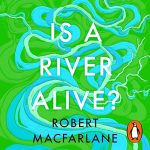
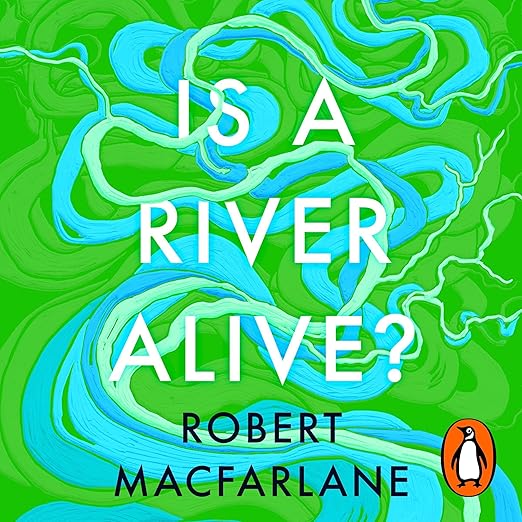
Robert Macfarlane reads his own books, and that fact alone tells you something important about the nature of the work. These are not texts that happen to be available in audio form; they are pieces of writing conceived with a profound relationship to spoken language that is evident on every page. Is a River Alive? – published in May 2025 and narrated by Macfarlane himself – may be his most urgently necessary book yet, and it is certainly his most explicitly political. After the interior landscapes of Underland and the etymological wonder of The Landmarks, this is Macfarlane turning outward towards the world’s wounds with something that feels very much like carefully shaped fury. Among the audiobooks I’ve listened to in 2025, this is one I keep thinking about weeks afterwards. That, for me, is the real measure.
About the Audiobook
The premise sounds, at first encounter, like something from the edges of environmental philosophy: that rivers are not merely resources or geographical features for human use, but living beings deserving of recognition in both imagination and law. By the end of this book, the argument feels not only reasonable but obvious, and the journey from scepticism to conviction is one of the great intellectual pleasures of the listening experience.
Macfarlane structures the book as three distinct journeys. The first takes him to northern Ecuador, where a miraculous cloud-forest and its rivers face destruction from industrial goldmining. The second goes to southern India, where communities are engaged in a legal and political battle to preserve the lives of local waterbodies against encroachment and pollution. The third journey leads to north-eastern Quebec, where the Mutehekau – the Magpie River – is the subject of a remarkable legal campaign to establish river rights and prevent its death by damming.
In each location, the river-rights movement is not abstract or theoretical. It is embodied in specific, named people whose stories Macfarlane tells with the combination of lyrical precision and deep human respect that characterises his best work. He does not stand aside and observe; he implicates himself, and by extension the listener, in what is happening to the world’s water.
The book also argues something specific and important about language: that how we speak about rivers – whether we say a river “runs” or a river “is running”, whether we refer to a river as “it” or as “who” – shapes whether we can imagine it as a living entity deserving of protection. This linguistic dimension gives the book a depth that pure campaigning non-fiction often lacks. This is also, Macfarlane says, his most personal book, and that sense of genuine personal stakes is present throughout in the prose, creating a different emotional register from the more coolly aesthetic register of some of his earlier work.
The Narration
Macfarlane’s voice is, by now, well-known to readers of his audiobooks: measured, scholarly, attentive to the music of sentences, with a quality of genuine feeling that surfaces at moments of particular intensity without overwhelming the careful intellectual structure of the prose. At ten hours and forty-one minutes, the book’s three-part structure gives the listen a satisfying, journeying rhythm. He reads the way he writes – with close attention to sound and cadence – and in a book this deeply concerned with the language we use to describe and thereby treat the natural world, that attentiveness carries real weight.
What Readers Say
Is a River Alive? has accumulated 472 ratings on Audible UK and holds 4.6 out of 5 – a remarkable number for a work of literary non-fiction on a specialist subject. Martyn, who admits arriving with initial scepticism about the premise, says he “couldn’t put the book down” across all three expeditions, and particularly praises Macfarlane’s method of letting his subjects tell the story rather than preaching. D.P.W. calls it “beautifully written and engaging.” James Choles, a longtime Macfarlane reader since his Common Ground essays, says it didn’t move him quite as profoundly as Underland in its middle section but that the concluding section was genuinely powerful. Susan Craig calls it “exquisitely written” and says it has changed the way she thinks about rivers entirely. This is the kind of review record that suggests a book doing exactly what its author hoped.
Who Should Listen?
If you’ve read any Macfarlane and been moved by it, this is essential – do not skip it. If you haven’t encountered his work before, Is a River Alive? is an excellent starting point, more urgently engaged with the present moment than some of his earlier titles. More broadly, this is for anyone who cares about environmental law, about the language we use to describe nature, about rivers and the communities that depend on them. It sits naturally alongside Robin Wall Kimmerer’s Braiding Sweetgrass and Roger Deakin’s Waterlog. Available on Audible UK, Kobo, Scribd, and Storytel. Listen on Audible UK: Get Is a River Alive? on Audible UK