Clara’s Verdict
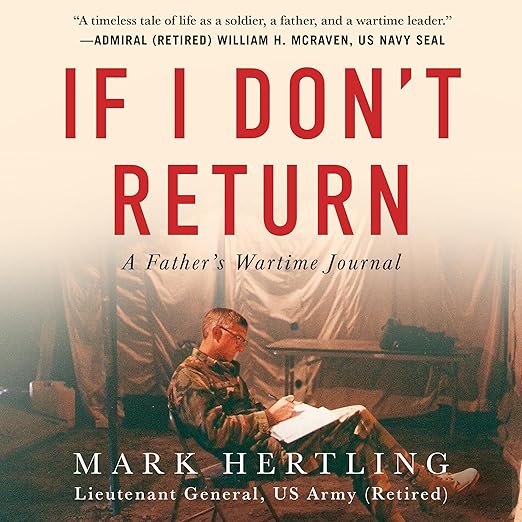
There is a particular kind of military memoir that transcends its genre – one that is not really about war at all, but about what a man chooses to believe, value, and pass on when he confronts the possibility that he may not return home. If I Don’t Return by Mark Hertling is that kind of book. It began as a private journal, written by a young officer in an army-issued green notebook at the start of Operation Desert Storm when his unit was told casualties could approach fifty per cent. It ends as something considerably richer: a meditation on character, leadership, and the strange gift of a life reconsidered.
About the Audiobook
Hertling deployed to Iraq in 1990 as operations officer of an armoured cavalry squadron. Told his unit would likely sustain serious casualties, and with two small sons at home, he began writing. The journal entries – covering combat in Desert Storm, the long waiting periods, the camaraderie and grief of operational life, and the lessons he hoped his boys might carry if he did not return – form the structural core of the book.
What makes this more than a conventional war memoir is what happened afterwards. Hertling survived, returned, and watched his sons grow into adult combat veterans themselves. One of them eventually typed out the original handwritten pages as a gift to his father. In revisiting the journal, Hertling added retrospective reflections spanning his subsequent career: further deployments to Iraq over two decades, his post-retirement work as a cable news analyst, healthcare executive, and professor of leadership. The result is a layered document – the young officer’s raw voice alongside the older man’s hard-won perspective – that illuminates how character is tested and formed over time rather than in a single decisive moment.
The Narration
Mark Chaet reads with measured gravity, and the choice to use a professional narrator rather than the author himself proves sound. Chaet brings consistent emotional restraint to material that could easily tip into sentimentality – he conveys the weight of the journal entries without straining for effect, and handles the shift between the younger Hertling’s voice and the retrospective additions with clarity. At eleven hours and eleven minutes, the pacing is unhurried but never slow.
What Readers Say
Early listeners have responded with striking warmth, awarding this 4.6 stars from ten reviews. The consensus is nearly unanimous: “one of the best memoirs I have ever read,” wrote one reader. “Every person who aspires to leadership should read this.” Another praised its relevance beyond the military context: “filled with truths that all of us can learn from.” Reviewers have noted the book’s authenticity – that the journal entries carry the immediacy of a man who genuinely feared he would not see his family again – and found the reflections added decades later thought-provoking rather than self-congratulatory.
Who Should Listen?
Readers drawn to leadership memoir and military history will find this essential, but the book’s reach extends well beyond those categories. Anyone interested in how values are formed and transmitted across generations – parents, educators, professionals in positions of responsibility – will find it genuinely useful. It is also a compelling document of what the Gulf War felt like from the inside, for those whose knowledge of that conflict is limited to its historical headlines. If you admire books like Gates of Fire by Steven Pressfield or Sebastian Junger’s Tribe, this belongs on your list.
Listen to If I Don’t Return on Audible UK – find it here. Also available on Kobo, Scribd, and Storytel.