Clara’s Verdict
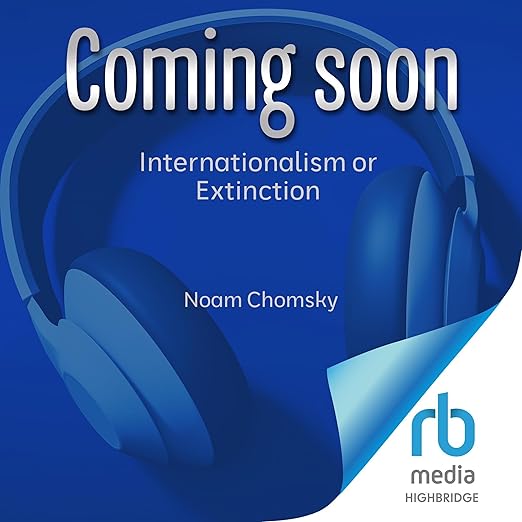
Noam Chomsky has been making versions of this argument for decades, and the remarkable and dispiriting thing about reading Internationalism or Extinction in 2026 is how little the urgency has diminished and how much the evidence has accumulated. At two hours and eleven minutes, narrated by Christopher Ragland for Highbridge Audio, this is a short and concentrated work — part essay, part interview transcript — that frames the dual threats of nuclear weapons and climate change within what Chomsky calls an era of unprecedented corporate global power. He is not, in this book, being polemical for the sake of it. He is being systematic about a problem he has spent a career documenting, and the compression here is a virtue: in two hours, the core argument is clearer and more accessible than it sometimes is across three hundred pages of academic prose.
About the Audiobook
The book is structured in two connected parts. The text itself traces the emergence and evolution of existential threats since the dawn of the Anthropocene after World War II — Chomsky identifies this as the moment when human extinction became a genuine and foreseeable possibility rather than a distant speculation. He draws a direct and careful connection between the development of nuclear weapons and the trajectory of climate change, arguing that these are not separate crises to be addressed by separate political movements but interlocking dimensions of a single civilisational failure. The logic of the argument is that both crises share the same structural cause: the subordination of long-term human welfare to short-term institutional interests.
The accompanying interviews expand the argument into the framework of corporate global power that has, Chomsky contends, overtaken nation states’ ability to control the future. This is the more contested part of the book. Chomsky’s analysis of corporate power is consistent with his broader political framework, and those who find that framework uncongenial will engage with this section differently from those who find it illuminating. But the factual claims — about the rate of nuclear risk, about the pace of climate change, about the inadequacy of current international agreements — are not seriously disputed, and they stand independently of the political argument surrounding them.
The release date of May 2026 makes this a timely re-entry into debates that have only intensified. No listener ratings are available at the time of writing.
The Narration
Christopher Ragland handles the material with clear, unhurried authority. Chomsky’s prose can be dense, written with the habits of an academic who expects readers to work, and Ragland’s measured delivery gives the argument room to land rather than racing through it. The interview sections, which have a slightly different texture from the main text, are negotiated cleanly. This is not a narration designed to charm; it is one designed to convey, and for Chomsky’s purposes, that is the correct choice.
What Readers Say
No listener ratings are available at the time of writing. Chomsky’s broader body of work has a substantial and engaged readership, and his arguments on these subjects — developed across Manufacturing Consent, Requiem for the American Dream, and various interview collections — are well documented in the critical literature. This audiobook should be approached in that wider context. Listeners who have read Chomsky before will find a focused and concentrated statement of the argument. Those new to his thinking will find the format — short, structured, and interview-enriched — a more accessible entry point than some of his longer academic works, where the density can be an obstacle for the uninitiated.
Who Should Listen?
At just over two hours, this is an accessible entry point into Chomsky’s thinking on existential risk for listeners who are curious but not yet committed to his longer works. It is also a useful concentrated statement for those already familiar with his arguments and wanting a focused version of the nuclear-climate interconnection thesis. Those who find his political framework uncongenial will read the same evidence differently, but the evidence itself is presented with Chomsky’s characteristic precision and is not easily dismissed. Essential for anyone engaging seriously with questions of international governance, planetary survival, and the structural obstacles that prevent adequate political response to threats that science has already identified as urgent.