Clara’s Verdict
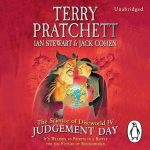
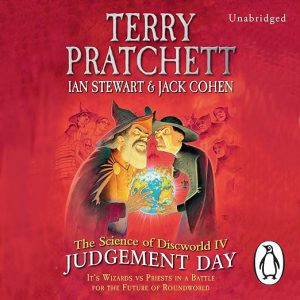
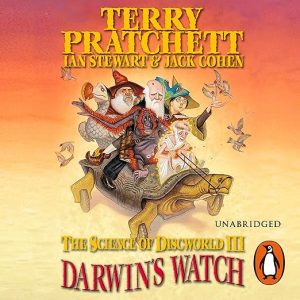
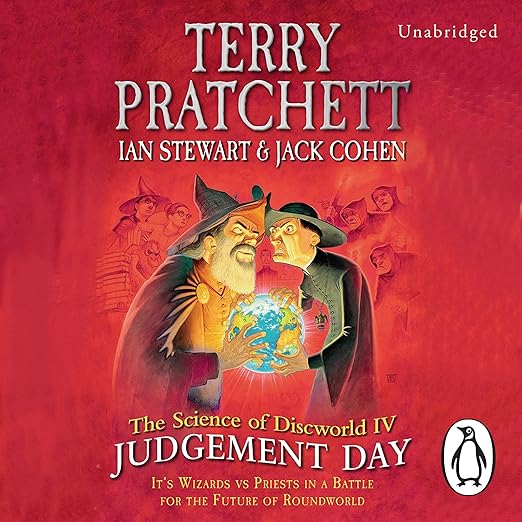
Terry Pratchett’s Science of Discworld series is one of the genuinely original experiments in science communication – a collaboration between a comic novelist of genius and two working scientists (mathematician Ian Stewart and biologist Jack Cohen) that deploys Pratchett’s Discworld as an allegorical lens through which to examine the actual science of our world. The fourth and final instalment, subtitled Judgement Day, is the most philosophically ambitious, tackling nothing less than THE REALLY BIG QUESTIONS: the existence of God, the origin of consciousness, the relationship between scientific and religious ways of knowing. All conducted via a librarian called Marjorie Daw and a lawsuit about the Wizards’ inadvertent creation of Roundworld. It is, as its predecessors have been, both extremely funny and genuinely educational – which is a harder combination to achieve than it looks.
About the Audiobook
The format is the series’ defining innovation: Pratchett’s new Discworld narrative alternates with chapters by Stewart and Cohen that use the fictional events as springboards for actual science, explained accessibly and at genuine depth. The two modes illuminate each other – fiction makes the science feel consequential and alive; science makes the fiction feel grounded in something real. The combination creates something that neither pure science writing nor pure fiction could achieve alone.
In this volume, the Wizards of Unseen University find themselves taken to court by a religious sect called the Omnians, who argue that the Wizards’ godlike creation of Roundworld – our universe, accidentally brought into existence by a bungled experiment in Quantum ThaumoDynamics – is an offence against their faith. The legal battle, conducted by a zombie solicitor and a priest of uncertain conviction, frames a serious examination of how science and religion approach questions of origins, meaning, and truth.
It is more nuanced than you might expect. Pratchett was not a simple science-triumphalist, and the book takes religious experience seriously even while subjecting its epistemological claims to rigorous scrutiny. The treatment of faith is thoughtful rather than dismissive – which is why readers with scientific backgrounds and readers with religious commitments both tend to find it worth engaging with.
The science chapters address quantum gravity, eternal inflation, dark matter, the fine-tuning argument, evolutionary design, and “disbelief systems” – and Stewart and Cohen are excellent at building from accessible analogies rather than assuming prior knowledge. The Pratchett chapters are reliably magnificent: the legal proceedings in Discworld, the Great Big Thing in the High Energy Magic Laboratory, and the figure of librarian Marjorie Daw navigating the multiverse with the composed authority of a good librarian who has seen stranger things in the stacks. It’s also, in retrospect, a bittersweet listen: Pratchett was diagnosed with early-onset Alzheimer’s in 2007, and this fourth volume was among his final significant works. The awareness of that context – a brilliant mind’s engagement with the biggest questions of existence, knowing what was coming – adds a layer of poignancy that Pratchett himself would probably have found both appropriate and amusing. He was not a man who flinched from difficult realities.
The Narration
Michael Fenton Stevens is a Pratchett veteran who understands the rhythms of the prose and the deadpan register required. The Pratchett sections demand comedic timing of a specific kind – the flat delivery that makes absurdism land – and Stevens has it exactly right. The science chapters require a different mode: clearer, more pedagogical, slightly slower. Moving between these registers across alternating chapters is a demanding narration challenge, and Stevens makes the transitions feel natural throughout twelve-plus hours.
What Readers Say
Rated 4.5 out of 5 from 731 reviews – the largest review count of any title in this collection, reflecting both the book’s age and the depth of Pratchett readership loyalty. “Very good, typical Pratchett,” wrote one listener succinctly. Others offer more elaborate praise for the science treatment: one reader with degrees in Chemistry and Physics found it “excellent,” whilst acknowledging the material might be challenging for readers without some science background. The treatment of religion draws thoughtful commentary: “I don’t always agree… but these scientists are always respectful,” noted one reader – a generous assessment of a book that is, in places, quite pointed about the relationship between faith and evidence.
Who Should Listen?
Pratchett fans who haven’t encountered the Science of Discworld series should start at the beginning – but this fourth volume is a worthy culmination of a remarkable project. Also ideal for science enthusiasts who enjoy their physics delivered via cosmic comedy, and for anyone interested in the science-religion debate conducted at a higher intellectual level than the usual culture-war shouting match.
For listeners who find the science chapters occasionally challenging – the material on eternal inflation and quantum gravity does assume some baseline familiarity with physics concepts – Stewart and Cohen have a consistent strategy: they use accessible analogies first, then develop the more technical explanation, and then step back to the Discworld narrative before the complexity becomes overwhelming. It’s a pedagogical structure that respects the reader’s intelligence whilst acknowledging that not everyone arrives with a physics degree. If you find yourself occasionally lost in the science, trust the fictional chapters to pull you back into the flow.
Complete your collection on Audible UK. Also available on Kobo and Scribd.