Clara’s Verdict
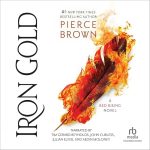
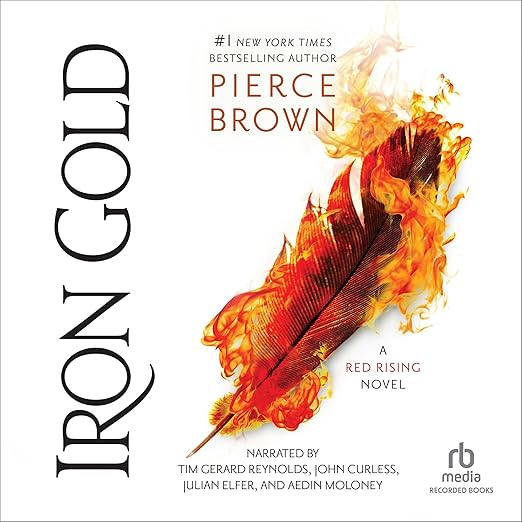
Pierce Brown’s Red Rising trilogy ends with Morning Star in a place that feels conclusive – the revolution achieved, the colour-caste system broken, Darrow’s arc complete. That Iron Gold exists at all is a testament to Brown’s confidence that his universe contains more story worth telling, and for the most part, he’s right. Book 4 of Red Rising is a different kind of novel from its predecessors: slower to start, deliberately disorienting in its multi-perspective structure, and darker in its view of what victory actually costs. If you’ve loved the first three books, you’ll want this. But go in prepared for a longer walk to the payoff.
Audible rating: 4.4/5 (28 ratings)
About the Audiobook
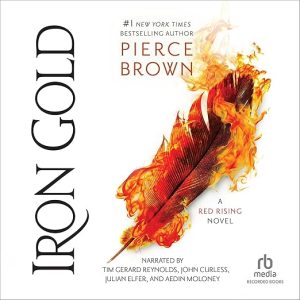
Ten years after Morning Star. Darrow and the Rising have won the revolution, but winning has not resolved the contradictions that drove it. New enemies emerge from the margins of power; old allies diverge on the question of what the Republic should become; and Darrow, who has spent his adult life as a weapon, is proving less capable of being a statesman than a soldier. The story is told from four perspectives – Darrow, Lysander au Lune (heir to the old Gold order), Lyria (a Red from the mines), and Ephraim (a former Rising operative now working mercenary angles) – which expands the moral complexity considerably.
The multi-POV structure is both the book’s greatest strength and its most significant challenge. Lyria and Ephraim are new characters who require investment before they pay off, and some readers find those early sections slow going. Lysander, however, is exceptional – a Gold who believes in the old order, written with genuine complexity rather than as a simple antagonist. The last quarter of the book is as tense and propulsive as anything in the original trilogy.
The Narration
Tim Gerard Reynolds returns to narrate, and his presence is one of the most significant continuity assets the Red Rising audiobooks possess. Reynolds has been with this series since the beginning, and his command of the world – the voices, the rhythms, the emotional register – is exceptional. The multi-POV structure gives him more to do here than in the first three books, and he handles the character differentiation well: Lysander sounds different from Darrow sounds different from Lyria, without the exaggeration that can make multi-voice narration feel theatrical. At twenty-three hours twenty-three minutes, this is a major commitment, and Reynolds is the reason it holds together.
What Readers Say
Rated 4.4/5 across 28 Audible ratings, the response reflects the novel’s divided character. One reader called it “the weakest book so far” – noting that Darrow’s recklessness in this volume felt out of character – but still gave it four stars and singled out Lysander as “the real winner.” Another described the series as “one of the best to come out of the science fiction genre for a long time – intelligently written with lots of surprises.” A third who came to it expecting more of Morning Star found it refreshingly different: “I like seeing how relationships and people have changed over time – the multi-POV style really worked for me.”
Who Should Listen?
Readers who’ve completed the original Red Rising trilogy – this is emphatically not a starting point, and would be nearly incomprehensible without that context. For those listeners, this is an essential continuation that deepens the moral world Brown has built and introduces a generation of new characters who carry the later books. Those who found the original trilogy’s pacing relentless may need patience for the first third of this instalment. Those who found Darrow’s heroism a little too perfect will find his deterioration here an interesting counterweight. If you’re already a Red Rising reader, the question isn’t whether to read this – it’s when.
Listen to Iron Gold on Audible UK – book 4 in the Red Rising series.