Clara’s Verdict
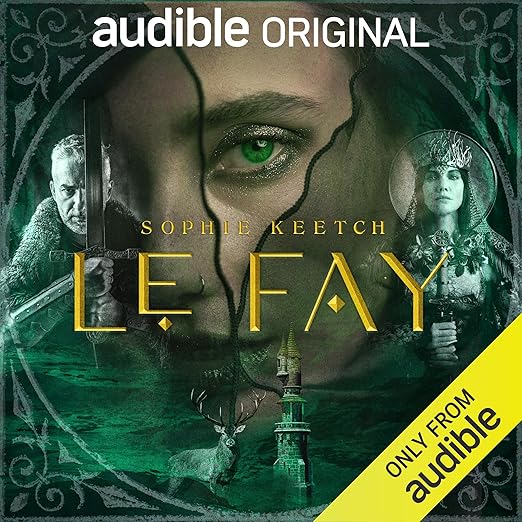
Sophie Keetch’s retelling of the Morgan Le Fay story is one of the better pieces of Arthurian revisionism currently being written, and Le Fay – the second book in The Morgan Le Fay Trilogy – deepens and complicates the work begun in Morgan Is My Name (Keetch’s number one bestseller) with impressive and sustained ambition. Morgan at Camelot is a different proposition from Morgan in her earlier life: here she has power, or at minimum the proximity to it, and the novel’s central drama is the precise and frustrating gap between that proximity and the full autonomy she requires. Rated 4.6 from 631 reviews, this is a series that has found a large, devoted, and critically engaged readership.
Miranda Raison’s narration is exceptional – she has grown with the character across the series – and Keetch’s Morgan is a figure I find genuinely compelling: intelligent, flawed, capable of self-deception in ways that are painful to witness, and determined in ways that serve her both well and catastrophically. This is fantasy that takes its heroine’s interiority seriously, which is still rarer than it ought to be.
About the Audiobook
Having escaped her deeply unhappy marriage at the end of the first book, Morgan arrives at Camelot – Arthur’s city of dreams and peace – where her brother treats her as a valued advisor and intellectual equal. For the first time in her life, her intelligence has a recognised and legitimate place in a powerful world. But Camelot’s apparent welcome comes with conditions and complications that accumulate throughout the novel: the entrenched rivalry with Guinevere, who sees Morgan as a threat to her own influence over Arthur; the jealousy of Merlin, who recognises in Morgan a potential rival for his position as Arthur’s most trusted counsel; and the ongoing legal and personal threat from her vindictive husband, who wants their son returned and has the power to pursue that demand.
The novel’s central dramatic arc concerns Morgan’s development as a practitioner of magic – specifically her enforced acceptance of tutorage under Merlin, an arrangement that comes at significant personal cost she cannot fully calculate in advance. As her knowledge deepens and pushes toward the boundaries of what can be done with it, she begins to confront the temptation of the darker possibilities of power. Keetch handles this question of corruption with real sophistication: this is not a simple story of a good woman becoming villainous under pressure, but of a woman navigating a world that offers her genuinely limited options and making choices with consequences she cannot fully anticipate or control.
The dual themes of power and sacrifice are developed throughout with subtlety and consistency. A romance subplot is present and emotionally resonant without dominating or undermining the political and moral stakes. At thirteen hours and twenty-nine minutes this is a substantial and wholly satisfying listen, and an Audible Original with the production quality that designation implies.
The Narration
Miranda Raison is outstanding, and the depth she brings to Morgan’s interior life – the intelligence, the controlled frustration beneath court politeness, the occasional grief that she cannot afford to display – feels earned through genuine understanding of the character rather than surface rendering of the text. She handles Camelot’s ensemble – Arthur’s warmth, Guinevere’s compressed coldness, Merlin’s slippery calculation – with distinct and entirely convincing voices, and the magical sequences are given the appropriate weight of mystery without tipping into overwrought performance. This is a narrator who has grown with the material across the series, and the sustained relationship between performer and character is audible in every scene.
What Readers Say
Rated 4.6 from 631 reviews. UK readers are consistently enthusiastic about both the character and Keetch’s approach to familiar Arthurian material. One reviewer described the retelling as presenting Morgan as “very different from the character often portrayed in Arthurian legends – much more human and sympathetic, yet also haunted by character flaws.” Another UK reader called it “a book that captivated me in the world of Morganna,” praising the treachery, intrigue, and heartbreak of the court dynamics, and noting that it worked for them despite its feminist perspective being clearly foregrounded – a remark that actually speaks to the book’s accessibility beyond its core readership. Several readers are eagerly awaiting Book 3, which is the best measure of a middle volume’s success.
Who Should Listen?
Essential for those who have finished Morgan Is My Name – this is a continuation and the trilogy’s arc rewards the accumulated context. For those coming to the series fresh, begin with Book 1 first; the investment takes on greater meaning with the full picture. Fans of Madeline Miller’s Circe, Naomi Novik’s work, Lavinia Collins’s Arthurian novels, or the feminist fantasy tradition more broadly will find Keetch’s approach both congenial and accomplished. The emphasis on a woman’s intelligence and agency within a world structurally designed to suppress both gives the series a distinctive political dimension without ever sacrificing the pleasure and momentum of the story itself.
Book 2 of The Morgan Le Fay Trilogy is available on Audible UK via the link below. Also available on Kobo, Scribd, and Storytel.