Clara’s Verdict
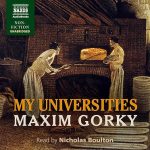
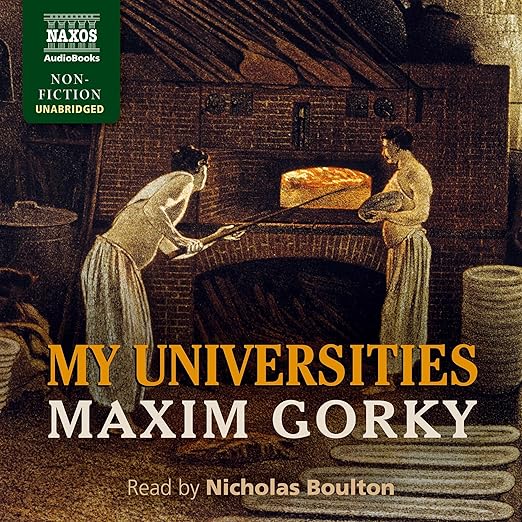
Maxim Gorky is not read enough in Britain. His autobiographical trilogy – My Childhood, In the World and now My Universities, its final instalment – is among the great works of twentieth-century memoir, sitting alongside Orwell and Dickens in its capacity to render poverty, social cruelty and human resilience with unflinching clarity and unexpected warmth. This new Naxos audiobook edition, narrated by Nicholas Boulton, is a superb way to encounter it. My Universities covers Gorky’s early twenties: his failed attempt to enter the University of Kazan and his subsequent education in the streets, bakeries and revolutionary circles of late Tsarist Russia. It is fiercely intelligent, unexpectedly funny in places, and shot through with a young man’s furious engagement with the question of how to live an honest life in a dishonest world. At five hours and forty-three minutes, this is immersive rather than demanding. Boulton makes Gorky’s prose breathe.
About the Audiobook
Published in 1923 and newly translated for this Naxos production, My Universities describes Gorky’s encounters in Kazan with an extraordinary array of characters: revolutionaries, religious fanatics, theological students, eccentric schoolteachers, bakers, and a wide assortment of what he calls “curiously alien and solitary outsiders.” Unable to afford formal education, he educates himself through reading – snatching books between exhausting shifts in a bakery, staying up through nights that he might have spent sleeping – and through the intensity of his social experience in a city teeming with political energy and spiritual hunger.
The backdrop is Russia in accelerating decay: politically unstable, socially fractured, closing in on the revolution that Gorky would live through, support, partly disillusion with, and eventually chronicle with the same honesty he brought to everything. The proximity to revolution is palpable throughout the book – not as historical backdrop but as the air the characters breathe, the argument they are all having with themselves and each other about what the country is, and what it might become.
What makes the book remarkable, and what distinguishes it from mere historical testimony, is Gorky’s analytical intelligence. He does not simply describe; he interprets. He is already, even in these early years, thinking clearly about what human beings owe each other and what structures – political, religious, cultural – deform that obligation. The encounters with revolutionary circles are particularly vivid, capturing both the idealism and the egotism of men who believe they are making history. Gorky himself is never entirely comfortable in any camp, which gives the memoir an honesty that hagiography never achieves. Released March 2026 by Naxos AudioBooks.
The Narration
Nicholas Boulton brings exactly the right balance of gravity and animation to Gorky’s prose. He has extensive experience in classical literary audio, and his control of rhythm and register is excellent throughout. He captures the young Gorky’s outrage and confusion without sentimentalising them, and handles the descriptive passages – Gorky’s fierce, vivid depictions of physical labour, social squalor, and the small acts of kindness that punctuate both – with appropriate directness. At under six hours, this is a complete and deeply satisfying listening experience.
What Readers Say
The audiobook holds a 4.7 rating from 20 reviews. Long-term admirers of Gorky’s work describe it as “a fantastic conclusion to the trilogy” in which Gorky delivers “an unsentimental description of daily lives, historical conditions, nurture and his own youthful anguish – a very rewarding autobiographical narrative and social history.” One reader, reviewing an earlier print edition, quoted Gorky’s own words back to him to explain the book’s effect: “life unfolded itself before me as an endless chain of hostility and cruelty.” Another simply noted, “it’s a book that has always moved me.” The consistent thread is that this work does something to readers that they find difficult to articulate and impossible to dismiss or forget.
Who Should Listen?
Readers interested in Russian literature, social history, memoir or autobiography will find this essential and deeply rewarding. It pairs naturally with the earlier volumes of Gorky’s trilogy, and ideally you will listen to all three in sequence – but My Universities also stands independently as a portrait of a young man’s self-making in the face of considerable institutional indifference. Those who have enjoyed the autobiographical writing of Orwell, particularly Down and Out in Paris and London, will find the same moral seriousness applied with equal precision to equally difficult circumstances. Listen to My Universities on Audible UK.
This is also recommended for anyone interested in the roots of Soviet literature and the relationship between political upheaval and literary form: Gorky is one of the indispensable writers for understanding how the twentieth century’s catastrophes were experienced and processed by those who lived inside them.