Clara’s Verdict
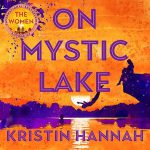
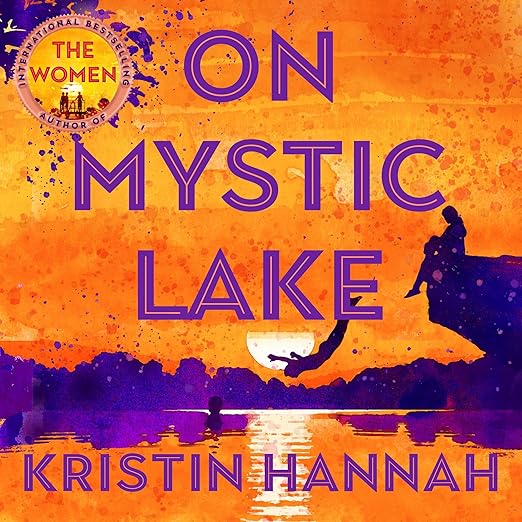
There is a particular pleasure in going back to an early novel by a writer who later became enormous, and On Mystic Lake offers exactly that. This is Kristin Hannah before The Nightingale and before The Women, and one perceptive reviewer put her finger on it precisely, calling it “a superior romance and obviously a precursor to this author’s later success with The Nightingale and The Women, both books with strong female characters.” That is the correct frame. Come to it as an origin point rather than a new release.
The other reason to come to it is on the very first line of the publisher’s copy: “Beautifully read by Julia Whelan, narrator of The Women by Kristin Hannah and Atmosphere by Taylor Jenkins Reid.” Whelan and Hannah is one of the most reliable pairings in contemporary audio fiction, and eleven hours and twelve minutes in her company is not a small part of what you are buying here. It occupies a high position in the Audible UK charts just now.
About the Audiobook
Annie Colwater has one very bad day. Her only child leaves for school in England, and on that same afternoon her husband of twenty years tells her he is in love with a younger woman. Alone in the beautiful California house that has stopped being a home, she arrives at the painful recognition that two decades have quietly eroded not only her confidence but her sense of who she is. That opening is brutal in its efficiency, and it is the reason the rest works.
She retreats to Mystic, the remote lakeside town in the Pacific Northwest where she grew up, and there she finds Nick Delacroix, her first love, recently widowed and struggling with a young daughter badly damaged by her mother’s death. The three of them begin to heal, and if that sounds tidy, the description makes plain that a reversal is coming. Delia Owens has called Hannah “One of the greatest storytellers of our time”, and the structural nerve on display here shows why the reputation was coming.
One thing to know before you start, because a reviewer flagged it and I think she was right to: “I believe this is a reissue of a book written quite a few years ago- no mobile phones – and it does have a dated feel to it.” She is correct. This is an earlier novel returning in a new audio edition, and the absence of mobile phones is genuinely noticeable.
The Narration
Julia Whelan is among the small handful of narrators whose name on a listing changes my expectations before I press play, and she is a particularly good match for Hannah’s emotional register. Her defining quality is restraint at the moments where restraint is hardest. When Annie’s husband makes his announcement, a lesser performance would reach for devastation immediately. Whelan lets the sentence land flat and allows the listener to arrive at what it means a beat later, which is far more painful.
She is also unusually good at not preempting discovery. In a novel that turns on a late reversal, there is a constant temptation for a narrator who knows the ending to shade earlier scenes with foreknowledge. Whelan does not. The Annie of hour three sounds like a woman who genuinely does not know what is coming, and that discipline is worth more than any amount of vocal characterisation.
Nick’s daughter is the technical challenge, a small child rendered close to mute by grief, and Whelan resists both the cartoon child voice and the temptation to make the damage audible in every line. It is a careful, patient performance across eleven hours that never draws attention to its own difficulty.
What Readers Say
The rating stands at 4.4 from 21,098 ratings, which for a novel returning from an author’s back catalogue is a genuinely healthy figure, and the reviews split into two useful camps. There are readers arriving from The Women, and readers who are placing this book in context.
The first group is uncomplicated in its pleasure. One five-star reader who had also read The Women reported losing herself in it on holiday, to the point that her husband was left to be social on his own:
Just WOW, fantastic read, fantastic author.
The second group is more useful for making a decision. A four-star reviewer laid out the premise plainly and stopped short of full enthusiasm, and the reissue-aware reviewer quoted earlier balanced the dated texture against a real appreciation of the central character, noting that Annie manages to find a strength that had always been within her. That is a fair verdict. The book is not competing with Hannah’s later work and does not need to.
Who Should Listen?
Come for Whelan and for Annie. If you read The Nightingale or The Women and want to understand how that writer was built, this is a rewarding place to look, and the emotional machinery is recognisably the same even if the scale is smaller. It also stands perfectly well as a self-contained story of a woman rebuilding, and readers of Jojo Moyes or Elizabeth Berg will find it immediately hospitable.
The dated texture is the honest caveat and it cuts both ways. A world without mobile phones makes the isolation of Mystic function, and a small town you cannot escape by text is dramatically useful. But the gender politics of the marriage and some of the emotional vocabulary belong to their moment, and if that grates you will feel it early. Those wanting the historical sweep of Hannah’s later novels should know that this is a domestic story on a domestic scale.