Clara’s Verdict
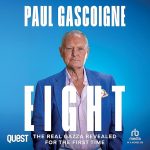
Sports memoirs are a genre I approach with caution. Too many are ghost-written hagiographies that manage to say nothing substantive about the person they claim to reveal – a series of anecdotes shaped to protect a reputation rather than examine a life. Eight is different in every way that matters. Paul Gascoigne reading his own story, 35 years on from Italia 90, is a genuinely moving and uncomfortably honest audiobook. Rated 4.4 stars from 332 Audible listeners, it is one of the most candid self-portraits by a British public figure in recent memory. This is not the Gazza of tabloid legend, the figure who was managed and mythologised for three decades. This is a man attempting – with evident effort and evident sincerity – to make sense of his own life on his own terms. The listening experience is richer for every moment of that struggle.
About the audiobook
Paul Gascoigne was once described as the most gifted English footballer of all time, a judgement that still invites little serious argument. His tears at the end of England’s semi-final defeat to West Germany at Italia 90 remain among the most iconic images in the history of British sport: a young man of extraordinary natural talent confronting, live on global television, the weight of what he was carrying. The decades that followed brought extraordinary professional highs – a European Cup winner’s medal with Lazio, a European Championship Golden Boot campaign with England, the most celebrated season by an Englishman in the Scottish Premier League at Rangers – and very prolonged, very public lows: addiction, mental health crises, and a life conducted under the most unforgiving media scrutiny imaginable.
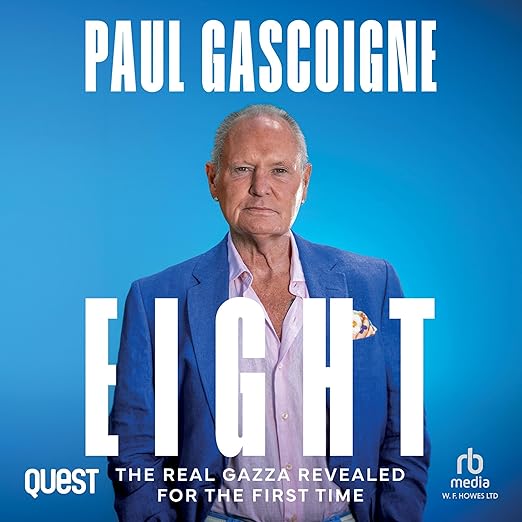
Eight, published by QUEST from W. F. Howes in October 2025, is the audiobook Gascoigne has spent thirty years building towards. At 8 hours and 16 minutes, it covers his meteoric rise from Gateshead, the pressure of international football at its highest level, and his battles with alcohol and mental health with a honesty that his previous public statements carefully withheld. The title refers to his shirt number at Tottenham and carries private resonances that the book explores at length. The narrative arc is ultimately one of a renewed sense of self: a man in his mid-fifties who finally, with the benefit of decades of reflection, has a clearer grasp of what was actually happening to him at the time.
The narration
Gascoigne reads his own story, and this is not just the obvious choice – it is the only version that could work. The Gateshead accent, the laughter that breaks through when he recalls something absurd from a dressing room thirty years ago, the halting quality when he approaches the most difficult material: none of this could be replicated by a professional narrator, however skilled. There is an authenticity to hearing the man himself work through these memories – in some cases apparently in real time, finding the words as he goes – that gives the eight-plus hours an intimacy that print cannot achieve. His tribute to Sir Bobby Robson, mentioned by several reviewers as particularly affecting, earns that emotional weight in audio in a way that text alone would not.
What readers say
The 4.4-star average from 332 ratings reflects a readership that came expecting a football memoir and received something considerably more significant. One UK reviewer wrote: “In this book he is honest and open about his problems – past comments such as ‘I like an occasional glass of wine’ were clearly not accurate. In this novel, he is frank, making it a fantastic read.” Another called it “entertaining and honest – one of the best football books I’ve read.” A third described it as “an excellent insight into Paul Gascoigne the person rather than just the footballer – the poem to Sir Bobby Robson is an outstanding fine tribute.” One reviewer captured the word-of-mouth dynamic neatly: “My son finished reading it and passed it back to me to read, as he said it was a really good read.”
Who should listen?
Football fans of a certain generation – those who remember Italia 90, who watched Gazza at Rangers, who followed the turbulent years at Lazio – will find this emotionally essential. But Eight reaches well beyond sport. It is a genuinely useful document for anyone interested in addiction and recovery, the specific pressures of celebrity and public life on mental health, and the particular difficulty of self-knowledge when your entire adult life has been lived under the scrutiny of millions. Listeners who valued Tony Adams’s Addicted, Clarke Carlisle’s mental health memoir, or the later, reflective work of Ronnie O’Sullivan will find Gascoigne’s account belongs in the same serious company. It is a difficult listen at times – but that difficulty is earned, and it is honest.
Listen to Eight by Paul Gascoigne on Audible UK – and hear the man the world knows as Gazza finally speak about his life without flinching.