Clara’s Verdict
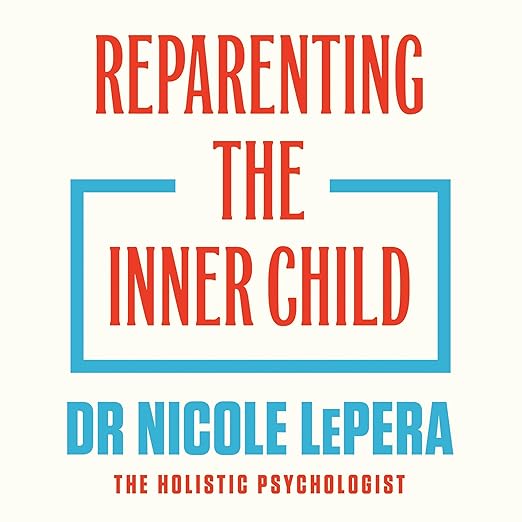
Dr Nicole LePera has built something genuinely unusual in the self-help space: a body of work grounded in clinical psychology that has managed to reach a popular audience without dumbing down its science or resorting to motivational platitudes. Reparenting the Inner Child – her third major book, following How to Do the Work and How to Be the Love You Seek – is her most ambitious and, I think, her most mature. At thirteen and a half hours it is substantial, and it earns every minute. Rated 5.0 from four early listeners – a small sample but a striking one in its unanimity – it is still gathering its full audience, but the responses it has generated are of a kind that suggests this book lands differently from most of what sits beside it on the shelf.
The “inner child” framework can sound whimsical, even slightly embarrassing. LePera takes it seriously without being precious about it, grounding the concept firmly in attachment theory, somatic neuroscience, and developmental psychology. The result is a book that explains things you have probably felt and struggled to articulate – the way old emotional patterns ambush you at inconvenient moments, the way you can know perfectly well that you are overreacting and still be unable to stop – and then gives you something concrete to do about them.
About the Audiobook
LePera’s central premise is that the patterns adults find most bewildering in themselves – shutting down in conflict, lashing out without apparent cause, compulsive people-pleasing, self-sabotage at precisely the moments when things are going well – are not character flaws but learned survival strategies. They were developed in childhood, when nervous systems were still forming, in response to environments that couldn’t consistently provide safety, love, or appropriate boundaries. The strategies that helped us survive childhood become, in adulthood, the patterns that undermine our relationships, our careers, and our sense of ourselves.
The practical dimension is unusually strong. The book offers specific exercises, breathing and somatic techniques, and guided reflective prompts at each stage of the framework. What distinguishes it from similar titles is the integration of body-based, somatic work alongside the cognitive reframing that most self-help content stops at. LePera’s framework addresses not just thinking patterns but the physical, felt experience of emotional dysregulation – the way the body holds old responses and how it can be helped to release them. This dual register makes the book more comprehensive than its genre peers, and more immediately applicable to people who have found cognitive approaches alone insufficient. The chapters on emotional maturity, on responding rather than reacting, and on the stories we tell ourselves about who we have to be are particularly strong.
The Narration
Courtney Patterson delivers a warm, grounded narration that suits LePera’s voice beautifully. The material requires a reader who can handle both clinical explanation and deeply personal territory without losing coherence or emotional register, and Patterson manages both dimensions with considerable skill. The guided exercises are voiced with the right quality of calm authority – present and reassuring without tipping into the slightly cloying manner that plagues some wellness audio. At over thirteen hours, the pacing is well-managed; the book never drags despite its length, and Patterson sustains attention by modulating her tone in response to the material’s own shifts between analysis and practice.
What Readers Say
Four five-star ratings from early US listeners, all noting something similar: this book made them stop. Brittany Schryvers, writing just days after the US release, described a book that “doesn’t talk at you – it talks with you,” and praised it as “the most honest, practical, and compassionate book I’ve read on healing.” Cindy Cousi, who had spent years in therapy, said LePera “understands human behaviour on a deeper level” and that the book showed her things that made the hair on her neck stand up. Jason, a reader of LePera’s previous work, praised the updated insights on stress and relationships and declared it “HIGHLY RECOMMENDED.” These are not casual endorsements; they have the quality of people describing a genuine shift in how they understand themselves.
Who Should Listen?
Anyone who has found themselves in repetitive patterns they cannot seem to break – in relationships, at work, or in the private hours when nobody else is watching – will find something directly useful here. It is also valuable for those who have done therapeutic work and want a framework to continue that work independently between sessions, or after a course of therapy has ended. LePera writes for adults who are ready to engage seriously with their own history, which means the book asks something of its listeners rather than simply offering comfort. It is not an easy listen in that sense, but it is a genuinely kind one. Available on Audible UK.