Clara’s Verdict
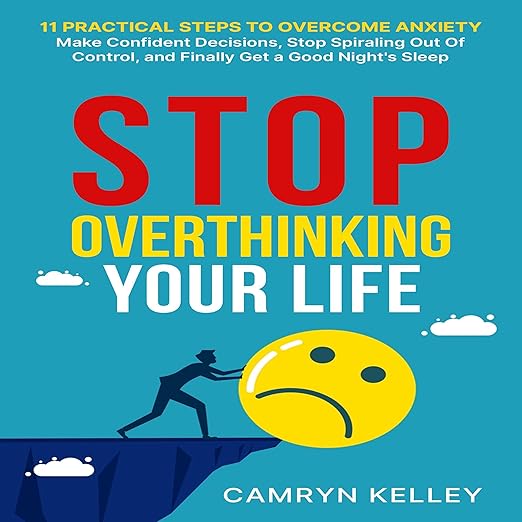
Self-help audiobooks about overthinking exist in considerable quantity, and many of them are approximately useful in the way a generic vitamin supplement is approximately useful – not harmful, unlikely to produce transformation. Camryn Kelley’s Stop Overthinking Your Life is genuinely a cut above that, for reasons that become apparent quickly. She grounds the material in neuroscience without becoming pedantic or inaccessible. The techniques she offers are practical and specific rather than vaguely aspirational. And she writes with a warmth that makes the book feel like advice from an intelligent friend who has thought carefully about this subject – not a wellness industry product dressed up in approachable language. At 4.7 stars from 84 UK listeners, it earns its rating. At under four hours, it respects your time in a way that not every self-help title manages.
About the Audiobook
Kelley’s central metaphor – that our brains are survival machines that sometimes need a tune-up rather than perfectly optimised computers running temporarily corrupted code – is a useful corrective to the tech-brained view of human cognition that pervades so much contemporary mental health writing. The book begins with the neuroscience of overthinking: why it happens (broadly, because we feel unsafe or threatened by something in our environment, even when that something is abstract or social rather than physical), what function the rumination originally served when threats were immediate and concrete, and why the pattern becomes maladaptive when it persists in circumstances where it cannot resolve anything.
From there, Kelley moves through practical interventions with specificity and without padding. Sleep hygiene grounded in behavioural science rather than generalities about relaxing before bed. Techniques for identifying accurately when thinking has crossed the line from useful cognitive processing into harmful cycling – because not all active thinking is overthinking, and the distinction matters for how you address it. Methods for managing overwhelming anxiety in real time, when you are in the middle of it rather than safely distant from it in a calm moment. An evening routine built on principles that actually work rather than aspirational wellness aesthetics that look compelling on Instagram but dissolve under contact with real tiredness.
The section on water – its role in physiological calming, the grounding value of deliberate hydration as an anchor for present-moment attention – is one of the more counter-intuitive and genuinely illuminating passages in the book. Kelley connects the sensory experience of water with physiological responses in ways that are both scientifically grounded and immediately usable. The book also draws on Zen concepts of self-compassion, maitri, and mindfulness without becoming either preachy or inaccessible, positioning these not as spiritual practices requiring prior commitment but as cognitive tools available to anyone willing to try them. This makes them significantly more adoptable for listeners sceptical of more explicitly spiritual approaches to mental health.
The Narration
Janah Jay reads the book with a quality of calm that is, given the subject matter, precisely right. There is no sense of performance or urgency – Jay’s delivery mirrors the mental state the book is trying to cultivate, which creates a kind of implicit demonstration of the text’s central proposition. She handles the practical sections – numbered techniques, step-by-step routines, exercises – with a clarity that makes the information genuinely usable after the fact rather than evaporating once the recording ends. At under four hours, this is a lean recording without padding, and Jay sustains the right tone throughout without it ever becoming monotonous.
What Readers Say
UK listeners offer some of the most thoughtful short reviews I’ve encountered for a self-help audiobook. One reader called the book a “Swiss army knife for your mental health,” noting the range of tools on offer for different manifestations of the same underlying problem. Another praised the full breadth of coverage – from maitri to mindfulness, overwhelm to clarity – and specifically highlighted the evening routine as something practically useful rather than gesturally aspirational, noting the step-by-step approach to replacing passive screen time with something restorative. A third reader, who had not considered herself an overthinker before reading the book, found the self-identification passages illuminating and was struck by how much of the material applied directly. The consistent theme across reviews is genuine appreciation for specific, actionable techniques rather than vague encouragement to simply think more positively.
Who Should Listen?
Anyone who lies awake cataloguing tomorrow’s hypothetical disasters, or finds themselves mentally rehearsing difficult conversations that will probably never happen, or spends significant energy on scenarios that exist only in their own imagination. It works particularly well for people who have tried meditation apps or mindfulness courses and found them either too abstract or too disconnected from the specific texture of their anxiety to be practically useful. Kelley keeps everything grounded and actionable rather than aspirational. The book also works well alongside professional therapy rather than as a replacement for it – the frameworks are compatible with most therapeutic approaches. Available on Audible UK, Kobo, Scribd, and Storytel.
Listen to Stop Overthinking Your Life on Audible UK – narrated by Janah Jay, running 3 hours and 49 minutes.