Clara’s Verdict
This is a niche audiobook, and it knows it. The Baofeng Radio Family Lifeline is not for casual readers – it’s for the household that has already purchased a Baofeng radio as part of some level of emergency preparedness and has discovered, as many do, that owning the device and knowing how to use it effectively are quite different things. Morse Code Publishing has produced a focused, practical manual that addresses exactly that gap, and narrated by Luke Oldham, it makes a surprisingly purposeful listen for its target audience.
The military-adjacent framing – “command and control,” “tactical reality,” “head of household” – will appeal to some readers and put others off immediately. My advice is to set aside the marketing register and focus on what the book actually delivers: a structured guide to a device that is genuinely useful and genuinely under-explained by its manufacturer.
About the Audiobook
The audiobook format raises a specific question for instructional technical content: can you actually learn radio programming from audio alone? For some of this material – the conceptual framework, the channel architecture principles, the strategic thinking – yes, absolutely. For the specific menu navigation and CHIRP software instructions, you will almost certainly want the physical manual or online resources alongside the audio. Oldham’s narration is clear, but step-by-step software instructions benefit from visual reference. The audiobook is best understood as a conceptual foundation and strategic guide; the hands-on technical steps will require supplementary resources when you sit down with the actual device.
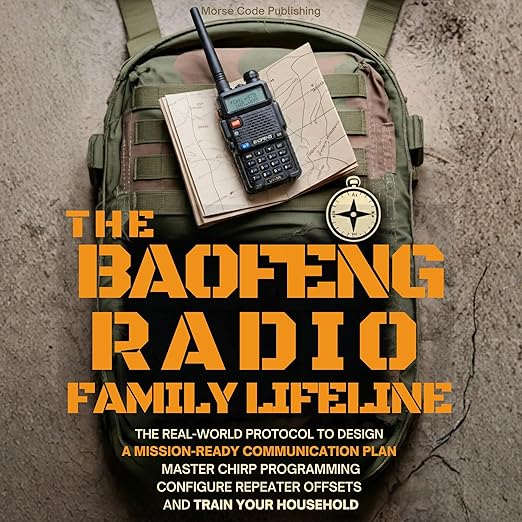
The book’s premise is direct and honest: most people who buy Baofeng radios for emergency use end up with a device they cannot operate confidently under pressure. The gap between ownership and competence is the problem this book sets out to close, through what it calls “Real-World Protocol” – a systematic approach to setting up, programming, and using the radio for family communication when conventional networks fail.
The content is structured around five core areas, each addressing a specific failure mode. First: the critical menu settings – squelch, tone, and others – that cause the majority of communication failures straight out of the box. Second: a three-layer channel plan covering simplex, repeater, and travel zones, designed to ensure coverage across different scenarios. Third: the CHIRP software for programming and backing up radio configurations, enabling the creation of redundant “known-good” setups. Fourth: repeater access protocols and how to extend the radio’s effective range dramatically. Fifth: honest assessment of antenna quality and which upgrades actually improve performance.
This is practical, specific, and actionable – exactly what a manual should be and what the Baofeng’s own documentation conspicuously isn’t. Published in March 2026, running to 4 hours – manageable as a single focused listening session.
The Narration
Luke Oldham narrates with a clear, matter-of-fact delivery suited to instructional content. Technical material of this kind can be difficult to make engaging on audio – the instruction-set quality doesn’t always translate to a listening experience – but Oldham keeps the pace moving and the tone practical without becoming robotic. He handles the acronym-heavy content of radio communication with clarity, which is genuinely important when the listener needs to retain and apply the information rather than simply absorb it passively.
What Readers Say
No Audible UK reviews have accumulated at time of writing for this March 2026 release. As a self-published title in a specialist niche, its reach will depend primarily on the preparedness and amateur radio communities where Baofeng guides already circulate. For that audience, this book addresses a well-acknowledged pain point: the device is capable, affordable, and widely owned; the documentation is poor. A guide that bridges that gap in audio format is a sensible addition to the available resources.
Who Should Listen?
One broader observation about this genre: the emergency preparedness audiobook market has expanded significantly in recent years, driven by increased awareness of infrastructure fragility and the very real experience of communication blackouts during natural disasters and severe weather events. The Baofeng radio occupies an interesting position in that market – affordable enough to be widely owned, capable enough to be genuinely useful, and complex enough that ownership without competence is a known problem. Books like this one serve a real purpose in addressing that gap, and the audio format is arguably well-suited to technical instruction that needs to be internalised, not merely read once and forgotten.
Households with Baofeng radios gathering dust because initial setup proved too confusing; emergency preparedness enthusiasts who want to upgrade their communication capability from theoretical to operational; anyone interested in off-grid communication who wants a practical guide rather than a theoretical overview of radio principles. Not recommended for general-interest listeners or those without any existing interest in radio communication – this is a specialist title and makes no pretence of being otherwise.
Find The Baofeng Radio Family Lifeline on Audible UK. Also available on Kobo, Scribd, and Storytel.