Clara’s Verdict
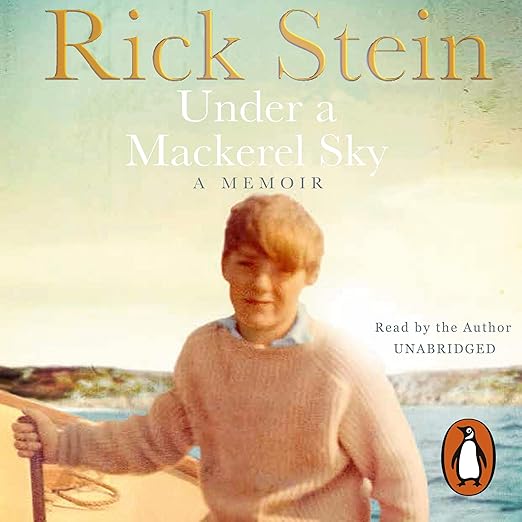
There is a reason Under a Mackerel Sky surprised people when it was first published. Rick Stein’s public persona is so thoroughly and pleasurably defined by food – the restaurants, the television series, the Padstow empire, the gentle enthusiasm for a really good piece of fish – that a memoir revealing a childhood shaped by a bipolar father, and then abruptly defined by his suicide, came as a genuine shock to readers who thought they already knew who Rick Stein was. What Stein has written is not a celebrity memoir in any comfortable sense of the term. It is an honest account of a life shaped by grief and the many complicated ways a person tries to run from it – told, across ten hours, in his own voice, with a directness that no professional narrator could have provided.
About the Audiobook
The memoir begins in a 1950s Oxfordshire childhood that looked, from the outside, like an idyllic one: charming parents, five children, much freedom, loud parties in the Cornish barn. Underneath ran the unpredictable current of his father’s illness, which directed its particular cruelties at the young Rick with some frequency. When his father died by suicide as Rick turned eighteen, the narrative fractures and accelerates: Australia, the outback, manual labour. America, Mexico, the adventures of a naive English public schoolboy who had been handed emotional devastation before he had any framework for understanding it.
Eventually Cornwall pulls him home. The sequence of the mobile disco (the Purple Tiger), the first nightclub – spent largely breaking up drink-fuelled fights – and the gradual, unlikely construction of a restaurant empire is told with wry humour and perceptive honesty. The food, when it arrives, feels less like a career choice than a form of self-assembly: a way of constructing something coherent to stand inside.
The business story, when it does emerge, is more interesting than it might sound on paper. Stein built the Padstow restaurant empire without a business plan, without investors, without any apparent strategy beyond cooking food he believed in and hoping people would come. They did. But the memoir is also frank about what the relentless demands of running a business cost him in his personal life – a cost he doesn’t minimise or excuse, which raises his standing as a memoirist considerably.
The Narration
Stein reads his own memoir, and this is not a neutral choice – it adds a layer of accountability to the material that a professional narrator could not provide. When he discusses his father, his first marriage, and the ways in which he has been difficult to know and to live with, you are listening to the man himself saying those things, which changes how they land. His television warmth is present but so is something quieter and more careful beneath it. Some reviewers found the sections on his romantic life disproportionately detailed; listening to him tell it, my sense was of someone trying to be fair to people he had hurt rather than merely candid about his own experience.
What Readers Say
Carrying a rating of 4.1, reader response reflects the genuine range of what the book contains. “This is much more than a tale of a successful restaurateur – the travels, exploits and escapades exceed that of most men,” wrote one admiring reader who appreciated the ambition and the frankness. Another called it “colourful and full of flavour, frank, funny and a struggle emotionally,” which captures the texture of the memoir accurately. A critical voice found it “a sad lonely man running from himself” – not a dismissal, really, but a description of exactly what the book is about and what Stein himself acknowledges. A fourth reviewer found the account of his romance with his second wife to tell only part of the story. The book earns its mixed response by being a genuinely complicated piece of self-examination.
The fact that the most critical review – three stars, “sad lonely man” – describes the book accurately rather than unfairly is perhaps the best evidence of its quality. Stein is writing a book about a sad, sometimes lost person trying to outrun his own history, and he knows that is what he is writing. The memoir doesn’t pretend to a tidier story than the one he actually lived.
Who Should Listen?
For anyone curious about what lies beneath the affable, food-loving exterior of one of Britain’s most familiar television personalities – the answer here is genuinely unexpected and worth the ten hours it takes to hear it. Fans of the television programmes will find the food almost incidental; this is for readers who enjoy memoirs about grief, displacement, and the long circuitous routes people travel to reach the lives they eventually live. The Cornish setting gives it a particular atmospheric quality that suits the audio format well – the mackerel sky of the title is a traditional weather sign of incoming storms, which as a metaphor for this book is almost uncomfortably well-chosen.
Listen to Under a Mackerel Sky on Audible UK – also available on Kobo, Scribd, and Storytel.