Clara’s Verdict
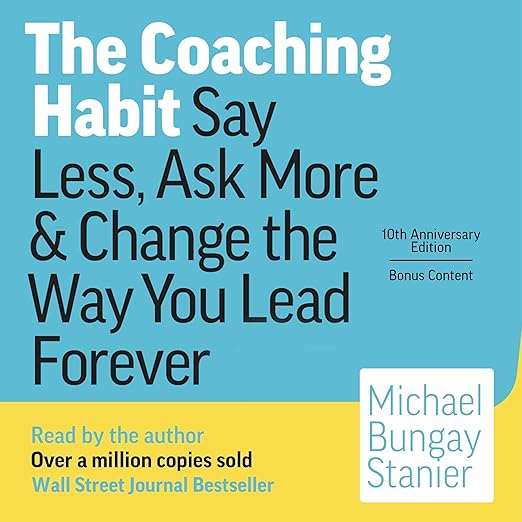
Ten years after its first publication, The Coaching Habit remains one of the most sensible books about human interaction I have come across. Michael Bungay Stanier had the audacity to strip coaching down to seven questions – and the result is not a gimmick but a genuine shift in how you approach conversations. I was sceptical when the book first landed on my desk; the market is glutted with leadership titles that promise transformation and deliver platitudes. This one delivers. The 10th anniversary audio edition sweetens the deal considerably, bundling bonus conversations with the likes of Brené Brown and Oliver Burkeman alongside two entirely new chapters. At just over four hours, it asks very little of your time and returns a remarkable amount in kind.
What strikes me most on revisiting it is how the book resists the temptation to overcomplicate. Bungay Stanier was trained as a coach, spent years working with organisations, and arrived at a set of ideas that hold up to genuine use. That is rarer than it sounds in this genre.
About the Audiobook
The central argument is elegantly simple: most of us talk too much and ask too little. Bungay Stanier’s seven questions – among them the AWE Question (“And what else?”), the Focus Question (“What’s the real challenge here for you?”), and the Lazy Question (“How can I help?”) – are grounded in behavioural economics and neuroscience, though the author wears his research lightly. He is less interested in impressing you with citations than in changing how you behave on a Monday morning.
The book is aimed at managers and leaders, but its reach is broader than that. Parents, teachers, anyone who finds themselves in the exhausting position of being the person who always has the answer will find something useful here. The new chapter on coaching paradoxes – be confident and humble, fierce and loving, caring while not caring – adds genuine depth to what might otherwise have felt like a practical how-to manual. The paradoxes are counterintuitive in the most useful sense: they describe the actual texture of good conversations rather than a formula for having them.
The bonus interviews, particularly with Shaka Senghor and Liz Wiseman, push the ideas into contexts that business-speak rarely touches – incarceration, power dynamics, the way good questions can challenge systems as well as individuals. Joseph Nguyen and Jefferson Fisher bring perspectives that ground the abstract in the personal. These additions alone justify the anniversary edition for anyone who already owns the original.
The Narration
Bungay Stanier reads his own work, which is almost always a gamble. Here it pays off handsomely. He is a natural speaker – warm, unhurried, occasionally self-deprecating – and he brings exactly the curiosity he advocates on the page. There is no performative enthusiasm, no breathless urgency. He sounds like someone who has genuinely thought about what he is saying and is pleased to share it, which is precisely the right register for material about the virtues of staying curious. The bonus conversation recordings are seamlessly integrated. At four hours, the pacing feels judged rather than rushed.
What Readers Say
Listeners rate The Coaching Habit at 4.5 out of 5 stars across 15 reviews, with the majority praising its practical immediacy. One UK reader, who returned to the book years after first buying it, described it as “the book on coaching I’d been hoping for” – someone who had deferred coaching work in their accounting firm and found the book waiting, still relevant, when they were finally ready. Another noted that the grounding in research gave the questions genuine credibility: “I liked that it was underpinned by research findings, to demonstrate why these questions really work.” A more experienced reader – someone familiar with models like GROW and the Karpman Drama Triangle – found the coaching paradoxes chapter a useful counterpoint, while noting they wished the book had gone further in addressing the Empowerment Dynamic as a response to the rescuing trap. The consensus is that the book rewards re-reading, and that the audio format – with the author’s own voice – suits it particularly well.
Who Should Listen?
If you manage people and find yourself constantly fire-fighting – answering questions rather than asking them, solving problems before your team has had the chance to think – this audiobook will likely change how you work. It is equally useful for coaches seeking a practical framework stripped of mystification, for teachers who want to develop their students’ thinking rather than transmit their own, and for anyone who suspects their relationships, professional or otherwise, could benefit from more genuine curiosity and less well-intentioned advice. The short runtime means there is no excuse to defer it. Listen on your commute, finish it by Friday, and start asking better questions on Monday.
Listen to The Coaching Habit on Audible UK – the 10th anniversary edition, available now.