Clara’s Verdict
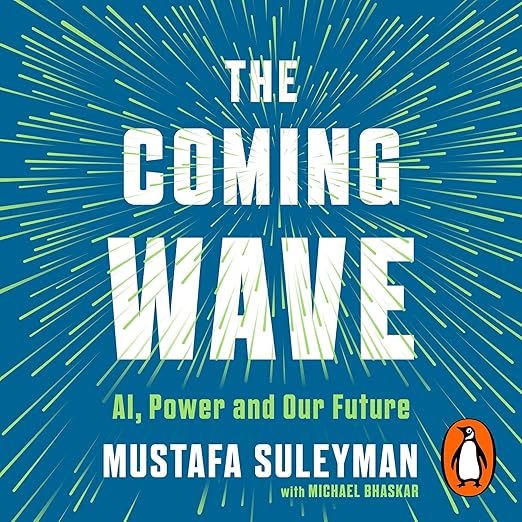
Mustafa Suleyman is one of the people who built the technology this book warns you about. That paradox sits at the heart of The Coming Wave, and to his credit, he doesn’t try to resolve it cheaply. As co-founder of DeepMind – the AI research lab that became part of Google – he has spent his professional life accelerating the very forces he now describes as potentially catastrophic. The result is a book with genuine insider authority and genuine intellectual honesty, even if it occasionally repeats its central arguments to the point of mild frustration. At 12 hours, with the author reading his own work, this is essential listening for anyone trying to understand what the coming decade of technological change might actually mean for society, governance, and human autonomy.
About the Audiobook
Suleyman’s central thesis is what he calls “the containment problem.” As artificial intelligence, synthetic biology, quantum computing, and related technologies become simultaneously more powerful and more accessible, the ability of any state or institution to control their proliferation diminishes toward zero. The result is the defining dilemma of our age: on one side, the potential for unprecedented harm as these tools spread to anyone who wants to use them badly; on the other, the risk of surveillance authoritarianism as governments attempt to contain that spread through means that threaten civil liberties as severely as the technologies they’re trying to manage.
The book moves in three broad sections: an account of the specific capabilities of current AI and biotech systems, grounded in Suleyman’s first-hand knowledge of the field; an analysis of why previous technological waves were or were not successfully contained (the history is more nuanced than either optimists or pessimists typically acknowledge); and a set of proposals for how the narrow path between catastrophe and dystopia might be navigated. Suleyman is at his most valuable in the middle sections, where his technical knowledge gives him a specificity that armchair commentators lack. He is somewhat less convincing in the solution chapters, where the proposals – while thoughtful – occasionally feel inadequate to the scale of the problem he has spent 300 pages establishing.
The repetitiveness that several reviewers note is real and worth flagging. Key arguments are returned to across multiple chapters, which can feel exhausting in audio form specifically. But the underlying ideas are worth the persistence.
The Narration
Suleyman reads his own book, which adds authority to a text that lives or dies on credibility. His delivery is calm and measured – occasionally verging on flatness – but he conveys the gravity of his subject without tipping into hysteria, which is exactly the right register for material this serious. The pacing is even across all 12 hours, and his technical passages are clear without being dumbed down. Yuval Noah Harari called it “fascinating, well-written, and important”; Stephen Fry described it as “deeply rewarding and consistently astonishing”; Bill Gates recommended it as “an excellent guide for navigating unprecedented times.” That is a hard endorsement panel to argue against.
What Readers Say
Listener response divides between those with and without prior tech industry knowledge. One UK reviewer called the book “exceptional merit, fascinating and awe-inspiring in equal measure,” citing AI and biotechnology as “immense threats” whose containment is “compelling albeit virtually impossible to achieve.” Another found it “very good, very repetitive” – enlightening and at times frightening, but “bludgeoning” in its return to key points. A third, writing from a technical background, felt the book stayed at the surface for those already in the industry, while offering genuine value for newcomers. The book holds a 4.3 rating from 4 listeners. Commercially and critically, the response at publication was considerably louder: this was a Sunday Times and New York Times bestseller, shortlisted for the FT Business Book of the Year 2023.
Who Should Listen?
One of the book’s less-remarked strengths is its treatment of biotechnology alongside AI – Suleyman argues convincingly that synthetic biology poses threats at least as serious as artificial general intelligence, and that the public conversation about the coming wave is dangerously AI-centric in a way that leaves us unprepared for the other transformations already in motion.
Essential for anyone interested in AI, technology policy, the ethics of emerging technologies, or the long-term future of democratic governance. Particularly valuable for listeners without a technical background who want a serious, credible account of what AI development actually looks like in practice, written by someone who has been inside it. Less essential for those already deeply embedded in the industry, though even specialists will find Suleyman’s ethical and political framing worth engaging with seriously. The book also makes a strong case for why this conversation belongs in the mainstream rather than in specialist journals – and listening to it, you feel the urgency of that argument acutely. Pairs well with Kai-Fu Lee’s AI Superpowers for a complementary perspective. Available on Audible UK, Kobo, Scribd, and Storytel.