Clara’s Verdict
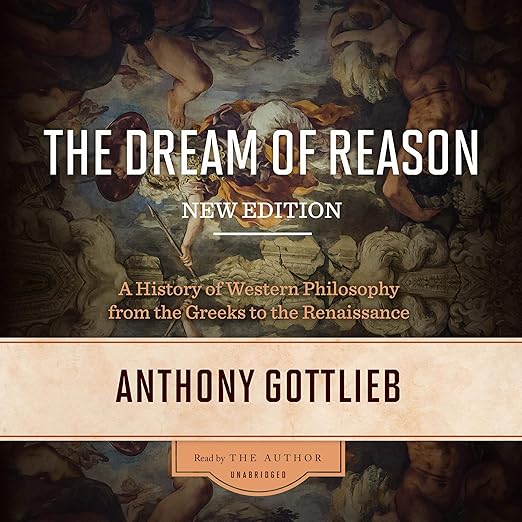
Philosophy is a subject that defeats most popular writers. Either they oversimplify until the ideas disappear, or they preserve complexity at the cost of readability, and readers fall away somewhere between Heraclitus and Parmenides. Anthony Gottlieb is the exception. The Dream of Reason – a survey of Western thought from the pre-Socratics to the Renaissance, now in an expanded new edition with greater coverage of the Middle Ages – manages to be genuinely rigorous and genuinely fun, which is vanishingly rare in this territory. Gottlieb narrates his own work across nearly nineteen hours, and the result is one of the finest introductions to the history of ideas I have encountered in audio form. If you have ever wanted to understand what philosophers were actually arguing about and why it mattered then and matters now, start here. This is the book I wish I had encountered before my first university philosophy seminar.
About the Audiobook
This new edition updates and expands Gottlieb’s landmark study, originally published in 2001 and already regarded as a classic of accessible intellectual history. The book traces the development of Western philosophy from its origins in ancient Greece – the pre-Socratics who were really the first scientists as much as philosophers – through the towering figures of Socrates, Plato and Aristotle, forward through the Stoics and Epicureans, into the long medieval period where Christian theology absorbed and transformed Greek thought, and finally up to the Renaissance humanists like Erasmus and Bacon who began to loosen philosophy’s dependence on received authority.
Gottlieb’s central argument – both elegant and persuasive – is that philosophy has always made progress, but that its greatest advances tend to be colonised by other disciplines. Physics was once a branch of philosophy. So was psychology, economics, mathematics, and much of what we now call cognitive science. What looks like stagnation is often incubation. The book is organised to show how ideas connect across centuries rather than simply accumulating, and the effect is genuinely illuminating for anyone who has wondered why philosophy seems to repeat itself.
The expanded coverage of the Middle Ages in this new edition is particularly welcome. The scholastics – Aquinas, Ockham, Duns Scotus – are often dismissed or ignored in popular histories of thought, but Gottlieb gives them their due as sophisticated and rigorous thinkers working within demanding constraints, and shows how their work made the Renaissance possible. Published March 2019 by Blackstone Audio, running just under nineteen hours.
The Narration
Gottlieb reads his own book with the composed authority of someone who has spent decades teaching and writing about these thinkers for general audiences. His voice is measured and clear, with the occasional flash of dry wit – necessary, given that some of the pre-Socratics were quite barmy, and several of the scholastics were engaged in arguments of almost cosmic absurdity. He handles the Greek and Latin names with appropriate confidence, always a small anxiety in philosophy audiobooks, and manages to convey both the strangeness and the contemporary relevance of ancient thought simultaneously. At nearly nineteen hours, this is a substantial commitment, but his pacing is such that fatigue rarely sets in: each chapter feels purposefully sized.
What Readers Say
The Dream of Reason holds a 4.5 out of 5 from 209 reviews. Readers describe Gottlieb as having “a wonderful command of his subject” and producing a history that treats primary sources with scholarly seriousness while remaining accessible to non-specialists. One particularly thorough Canadian reviewer praised the book’s handling of the relationship between philosophy, science and the arts, noting that Gottlieb is “very good at capturing personalities and key ideas” – crucial in a book that must bring Socrates, Aquinas and Erasmus equally to life across twenty-five centuries. Another called it “a great starting point for someone interested in philosophy,” and that is exactly right. International reviews, in multiple languages, reflect a wide and appreciative readership.
Who Should Listen?
Anyone curious about the history of Western thought but daunted by academic philosophy texts will find this ideal. It rewards both commuters who listen in short daily bursts and dedicated listeners who can give long evenings to it. The new edition’s expanded medieval coverage makes it particularly valuable for anyone interested in the relationship between religion and reason, or in understanding how modern secular thought emerged from centuries of theological debate. Those who enjoyed Simon Critchley’s The Book of Dead Philosophers, Bryan Magee’s television interviews, or Will Durant’s history of philosophy will be very much at home. Listen to The Dream of Reason on Audible UK.