Clara’s Verdict
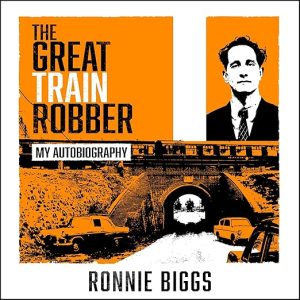
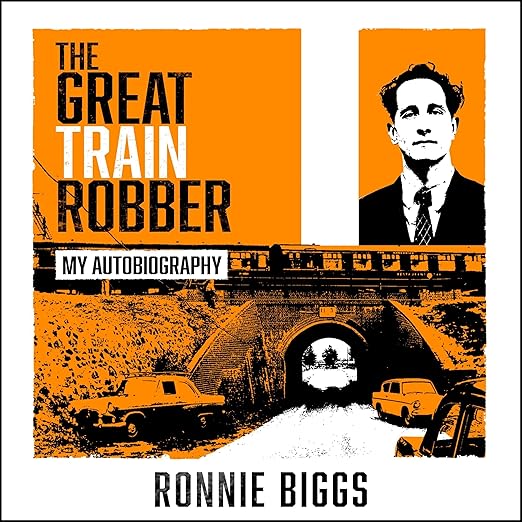
The Great Train Robbery of August 1963 is one of those British crimes that lodged itself permanently in the national imagination – the audacity of stopping a moving mail train and removing £2.6 million in used banknotes (nearly £60 million in today’s values) caught something in the public mood that sixty years of distance has not entirely dissipated. Ronnie Biggs is its most famous participant, not because his operational role was central (it was not particularly) but because of everything that happened afterwards: the escape from Wandsworth Prison, the flight through multiple countries, thirty-five years in exile, the voluntary return at the age of seventy-one, and the death in 2013 that closed the story. At nearly twelve hours narrated by Nick Reynolds, this biography-autobiography is the fullest account of the full arc yet assembled.
What makes it worth the investment is not nostalgia or romanticism – it is the completeness of it. Biggs is not presented as a hero. He does not present himself entirely as one either, though he is not above a certain retrospective showmanship. What emerges is something more interesting: the portrait of an ordinary man whose extraordinary predicament became, almost accidentally, one of the defining British crime narratives of the twentieth century.
About the Audiobook
Attributed to Chris Pickard, who worked with Biggs to produce the definitive account, the book covers the full scope: the robbery itself, with new detail about the planning and execution; the conviction; the escape from Wandsworth and the flight through multiple countries; the years in Australia building a new life before discovery; the 1974 arrest in Brazil and the legal battles over extradition; two separate attempts to kidnap Biggs and return him to Britain; his son Mike’s rise to fame as a musician; and the long twilight years of physical decline, stroke, and the 2001 decision to come home after 13,068 days on the run. A newly written 10,000-word timeline, positioned as the most detailed factual account of the robbery ever published, adds historical context across the whole gang of sixteen rather than focusing solely on Biggs.
The book does not make a strong moral argument either for or against Biggs, which is probably the right approach – it allows readers to form their own conclusions. The passages covering his late-life strokes and physical deterioration are unexpectedly moving, and the question of why this particular man became so culturally famous when others in the gang were equally culpable runs as a useful undercurrent throughout.
The Narration
Nick Reynolds – son of Bruce Reynolds, the robbery’s principal architect – narrates with an authority that is more than professional. He grew up adjacent to this story in the most literal possible sense, and that familiarity is audible in the way he handles the material: engaged rather than detached, and evidently at ease with its moral ambiguities. There is no sense of performance or distance; he sounds like someone recounting events he has spent a lifetime hearing about from multiple angles. The John Blake Audio production is solid throughout the nearly twelve-hour runtime.
What Readers Say
Richard Shaw, long fascinated by the robbery, found it “a rollicking ride from start to finish” and valued Biggs’s apparent candour – “nearing the end of his life, so I assume he had little to hold back truth wise”. Sue, living in Crewe near roads named after two of the robbery’s key figures, said she “could not put it down” and wanted to know more. Frank gave it four stars for being “very interesting and a good read”. Sue offered perhaps the most revealing statement: having seen the films and documentaries, she wanted the depth that only the first-person account provides. Rated 4.6 out of 5 from 63 Audible UK reviews – a broad and consistently enthusiastic audience.
Who Should Listen?
Anyone with an interest in postwar British social history, true crime, or the particular mythology of the Great Train Robbery. The book works for listeners who grew up hearing about Biggs on the news through the 1970s and 1980s, for younger readers discovering the story for the first time, and for those interested in how crime creates celebrity and how celebrity sustains itself across decades and national borders. The 10,000-word timeline is a genuine addition for anyone studying the robbery seriously; this is the most detailed primary source available in audio form.
Listen on Audible UK: Get The Great Train Robber: My Autobiography on Audible UK