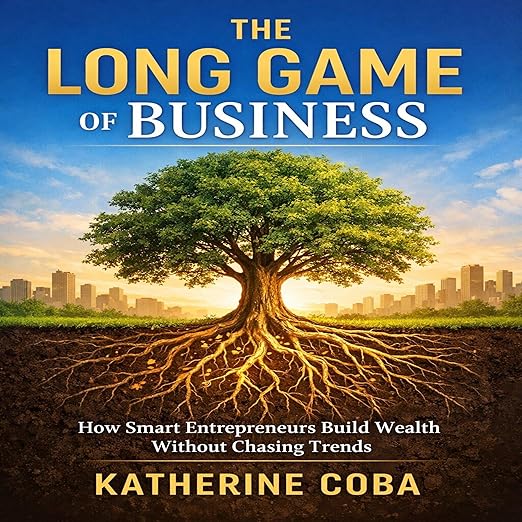
Clara’s Verdict
At one hour and twenty-six minutes, The Long Game of Business is barely a pamphlet in audio form. Katherine Coba has packed a business philosophy into a space that most authors would use for an introduction, and the result is concentrated enough to be useful and short enough to be genuinely actionable rather than merely aspirational. In a market saturated with ten-hour business audiobooks that contain about forty-five minutes of actual content padded with repetition, anecdote, and what publishers call “breathing room,” Coba’s concision is, itself, a kind of argument for the very principles she’s advocating: focus on what matters, cut the rest.
There is something almost refreshing about a business book that finishes before it outstays its welcome. I found myself wishing more authors in this genre had the confidence to stop when they’d said their piece.
About the Audiobook
The book’s title is its argument: the long game. This is a phrase that gets deployed frequently in business and self-help contexts, often with insufficient attention to what “long” actually means in practice. Coba is reasonably specific: she’s talking about years of consistent effort, compounding small improvements, resisting the pressure to pivot or abandon before systems have had time to prove themselves. The time horizon she implies is five to ten years, not months – which, in a culture of quarterly results and viral overnight success stories, is itself a counter-cultural claim. Whether you find that claim liberating or merely realistic says something about where you currently are in your business journey.
Coba’s core argument is simple, correct, and chronically undervalued in business culture: most failures stem not from bad ideas but from an excessive orientation towards short-term results. The “long game” she advocates is a framework of patient system-building, compounding improvement, and the development of genuinely valuable skills over time rather than the perpetual chase for quick wins, viral moments, or whatever trend is currently promising effortless wealth.
The book covers seven areas in sequence: building businesses that strengthen over time rather than merely growing faster; converting daily incremental progress into long-term results through compounding; developing durable, transferable skills rather than platform-specific tricks; creating systems that function without constant motivational reinforcement; money management oriented toward wealth-building rather than income maximisation; focus and resistance to distraction in an environment specifically engineered to prevent it; and the conversion of patience itself into financial freedom.
This is a familiar framework – similar arguments appear in Morgan Housel’s The Psychology of Money, in Annie Duke’s work on decision-making, and in various iterations of the “slow and steady” business philosophy. What Coba adds is the accessible brevity: ninety minutes to cover principles that longer books bury in anecdote. The tone is calm and direct, without the aggressive hustle-culture energy that taints many books in this space, which alone makes it worth the time.
Published by Katherine Coba in March 2026, narrated by Scott LeCote.
The Narration
Scott LeCote narrates, delivering the material in a measured, businesslike tone that complements Coba’s writing. The brevity of the book means the narration doesn’t have time to outstay its welcome, and LeCote makes efficient use of the runtime. Nothing flashy, but entirely competent – and for instructional material of this kind, competence and clarity are exactly the right virtues.
What Readers Say
No reviews have yet accumulated on Audible UK for this March 2026 release. As a self-published short-form business audiobook, this will find its audience through direct marketing rather than editorial discovery or bookshop placement. For listeners who want a quick, clearly structured argument for long-term thinking rather than a comprehensive manual, the brevity may well be a feature rather than a bug. Whether the ideas resonate depends heavily on where the individual listener is in their business journey.
Who Should Listen?
The honest caveat about a book this short is that brevity and depth are in tension. Ninety minutes is enough to articulate a philosophy; it is not enough to develop it, test it against objections, or populate it with the case studies and concrete examples that allow abstract principles to stick in the memory. Coba is aware of this – the book’s recommendations include building skills, creating systems, and managing money, each of which could sustain its own book. What she offers is the architecture; the detail must come from elsewhere. Think of it as a highly compressed map rather than a detailed guide.
Entrepreneurs feeling burned out by short-term pressure and the relentless churn of trend-chasing; side-hustlers wanting a philosophical framework before diving into tactics; anyone who has read numerous business books and wants the core argument in its simplest, most portable form. Best suited to commuters who want a focused, dense listen that can be absorbed in a single journey and returned to periodically as a reminder. For those who find the principles compelling, follow up with a longer treatment – Housel, Duke, or James Clear – for the depth that ninety minutes can only gesture toward.
Find The Long Game of Business on Audible UK. Also available on Kobo, Scribd, and Storytel.