Clara’s Verdict
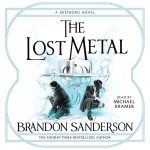
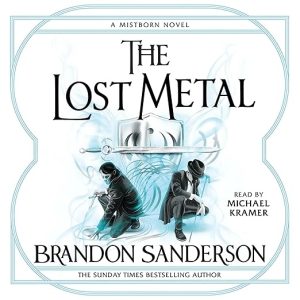
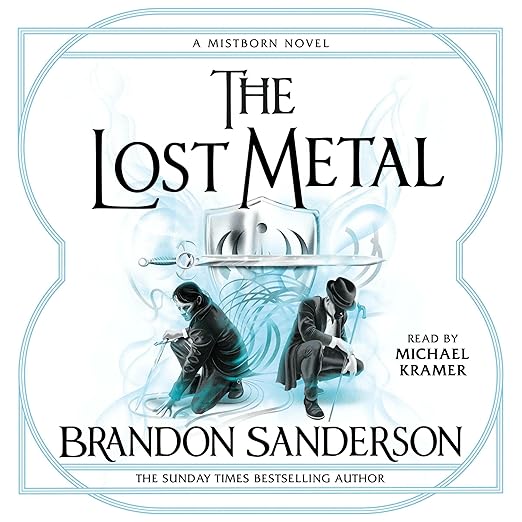
Finishing a Brandon Sanderson series is always a strange experience. You spend half the time marvelling at how many threads he has been juggling across thousands of pages, and the other half dreading the moment it ends. The Lost Metal – the seventh and concluding book in the Mistborn sequence and the final volume of the Wax and Wayne era – is the payoff for that investment. It earns it. Sanderson is not a writer who does things by halves, and this is not a conclusion that skimps on either action or emotional resolution. At 4.7 stars from UK listeners and just under nineteen hours of narration by Michael Kramer, it is a proper literary event – one that rewards loyalty with uncommon generosity.
About the Audiobook
The second Mistborn era began with The Alloy of Law, transplanting the elemental magic of the original trilogy into something closer to the Victorian frontier: steam-powered cities, gunfights on rooftops, the laws of Allomancy and Feruchemy operating in a more industrialised world where the old legends have become religion and the old heroes have become saints. Waxillium Ladrian started as a frontier lawman turned reluctant nobleman; by The Lost Metal, he is a senator attempting to root out the corruption embedded in Elendel’s institutions, while the shadowy organisation known as the Set pursues ambitions that threaten the entire planet of Scadrial.
Detective Marasi Colms and her partner Wayne – reliably funny, reliably catastrophic, reliably essential to the books’ humanity – are tracking shipments of weaponry to the Outer City of Bilming, which turns out to be the least of anyone’s problems. New explosive technology that could cause unprecedented destruction has apparently been developed, and the Set already possesses it. An immortal kandra serving Scadrial’s god, Harmony, reveals that Bilming has come under the influence of another god entirely: Trell, worshipped by the Set, whose ambitions reach well beyond one city or one political conflict. And from the broader Cosmere – Sanderson’s interlocking universe of worlds – Marasi is approached by offworlders with strange abilities who claim their goal is to protect Scadrial at any cost.
Sanderson escalates with his customary controlled ferocity, and the scale of the climax is genuinely staggering. The Cosmere connections, for those who have followed Sanderson’s broader literary project, land with accumulated weight. One UK reviewer was candid about the book being “very Cosmere heavy,” which is fair warning for the uninitiated – if you haven’t read beyond the Mistborn sequence, some late revelations will feel opaque. If you have, they will be extraordinary. Either way, the emotional core of the story – Wax’s complicated relationship with faith, with duty, and with a god who refuses to be either comforting or comprehensible – holds up entirely independently. Steris, Wax’s wife, receives her most substantial role yet, and she earns every page of it.
The Narration
Michael Kramer has been narrating Sanderson’s work for years, and his performance here reflects the deep familiarity of a long collaboration. He has the vocal architecture of this world thoroughly memorised: Wax’s stoic determination and its occasional cracks, Wayne’s mercurial volatility and surprising tenderness, Steris’s precise and endearing literalism, Marasi’s principled urgency. Kramer is particularly effective in high-stakes action sequences, maintaining momentum without sacrificing the clarity that Sanderson’s intricately plotted climaxes require. The final act runs at considerable velocity, and Kramer handles it with a control that keeps the complexity legible throughout. At nearly nineteen hours, this is a sustained performance of real quality.
What Readers Say
UK listeners are enthusiastic to a degree that approaches evangelical. “This has spoiled most other reading material for me,” wrote one reviewer, citing the science-fiction elements threaded through the fantasy as especially impressive and expressing sadness at finishing. Another observed that they had been waiting a long time for the book, expected answers, and received them – describing the novel as “both bigger and smaller than expected,” which is a perceptive summary of how Sanderson’s conclusions tend to work: more intimate than anticipated in their human core, more cosmic than anticipated in their scope. Several reviewers simply write “Brilliant” and “Great end to Era 2,” which is the sound of a readership that has been patient and feels genuinely well-served. One reader positions Sanderson among the finest fantasy authors of his era, which is not an unreasonable claim.
Who Should Listen?
The audience is anyone who has read the preceding six Mistborn books. If you haven’t started the series, this is emphatically not the place to begin – start with the original trilogy (The Final Empire, The Well of Ascension, The Hero of Ages), then proceed through the Wax and Wayne books in order. For the loyal Sanderson reader, this is essential. Fans of epic fantasy with genuine intellectual heft, intricate magic systems that reward close attention, and long-form storytelling that actually pays off its setup will find everything they came for. The conclusion closes the second era definitively while leaving the broader Cosmere very much open.
Listen to The Lost Metal (Mistborn, Book 7) on Audible UK – narrated by Michael Kramer, running 18 hours and 46 minutes.