Clara’s Verdict
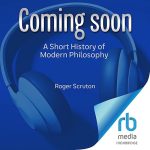
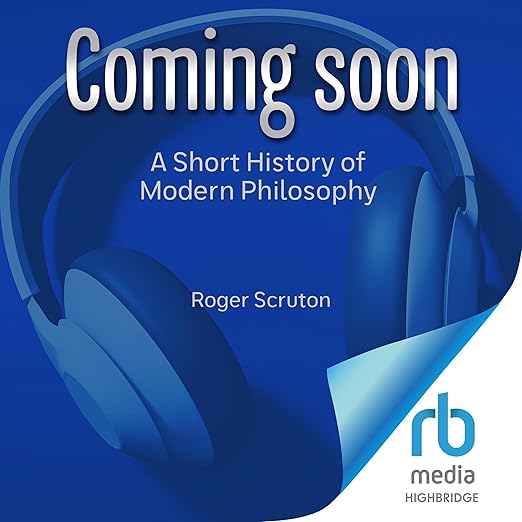
Roger Scruton had a gift that is rarer than it sounds: the ability to explain difficult ideas clearly without making them simple. A Short History of Modern Philosophy is one of the best introductions to the subject I know, and after more than two decades in print it has aged remarkably well. Beginning with Descartes and arriving at Wittgenstein – via Spinoza, Leibniz, Locke, Hume, Kant, Hegel, and the rest of the canon – it never talks down to the reader while remaining genuinely accessible to anyone approaching the material for the first time. As an audiobook narrated by Toby Longworth, it becomes something you can listen to on a morning commute and arrive feeling as though you have actually used the time for something. That is not a small achievement for a philosophy text.
About the Audiobook
Scruton’s survey covers roughly four centuries of Western philosophy, from the Cartesian revolution of the seventeenth century through the empiricists and rationalists, into German Idealism, and on through the Anglo-American analytic tradition of the twentieth century. The organising idea is that modern philosophy represents an ongoing attempt to understand the relationship between mind and world following the collapse of the medieval synthesis – and Scruton shows, with admirable economy, how each major thinker both inherited and transformed the problems left by his predecessors.
The portrait of Kant is particularly lucid: Scruton wrote an entire separate book on Kant, and that depth of knowledge informs the summary here without overwhelming it. The discussion of transcendental idealism – usually considered a nearly impenetrable subject – is as clear as I have encountered in any introductory text. His handling of Hegel is characteristically bold; Scruton doesn’t shy away from Hegel’s genuine difficulty, but he provides enough of a framework that the listener can follow the argument without getting entirely lost. The sections on logical positivism, Wittgenstein’s early and later work, and the ordinary language philosophy of the mid-twentieth century are models of clear, confident exposition.
Scruton’s own philosophical sympathies are not concealed – he is a conservative thinker, and this occasionally colours his emphases and characterisations. That bias is sufficiently well-known that it functions as useful critical context rather than distortion, and readers who are aware of it can apply appropriate scrutiny. The introduction and closing material on recent debates updates the classic text helpfully.
The Narration
Toby Longworth brings considerable authority to the material. His delivery is measured and precise – exactly what philosophy demands, where the difference between a stressed and an unstressed word can alter the meaning of a sentence entirely. He handles the parade of proper names and technical vocabulary without stumbling, and his pacing gives the listener time to absorb each argument before moving on. This is narration that serves the text rather than performing it, and for intellectual nonfiction that is the only appropriate approach. The production quality from Highbridge Audio is excellent throughout the full ten hours and thirty-one minutes.
What Readers Say
Beyond its use as a teaching tool, the book has also attracted a readership of general intellectually curious adults who simply want to understand how Western philosophy arrived at the positions it currently holds. Scruton’s gift is for making the arguments feel alive rather than archival – these are not historical curiosities but live problems that still structure our assumptions about knowledge, ethics, and the self. That quality is what has kept the book in print for decades and what makes it so well-suited to the audiobook format, where it can accompany a walk, a commute, or a period of quiet in a way that reading cannot.
Reviewers consistently describe this as the book that finally made philosophy make sense. Several mention using it to support university study, and one UK reader noted it helped their daughter to a strong degree result – which speaks to the book’s utility as a foundation for more advanced engagement with primary texts. The clarity of Scruton’s writing style attracts particular and repeated praise: readers who had previously struggled with Kant or Wittgenstein directly found that the historical narrative gave them the context to approach those thinkers with a fighting chance of understanding them. One reviewer describes Scruton as “transcendentally lucid, informative, witty, and penetrating” – a generous judgement that nonetheless captures something real about the book’s qualities. Some note that Scruton’s biases are evident; the majority view this as a feature rather than a flaw, on the reasonable grounds that a thinker with a clear perspective is more useful as a guide than one hiding behind false neutrality. The audiobook holds a 4.4 out of 5 rating from 92 listeners on Audible UK.
Who Should Listen?
Essential listening for anyone beginning to study philosophy, returning to it after years away, or simply wanting to understand what Kant was actually on about. Equally valuable for readers of intellectual history, political theory, or the history of science who want the philosophical background to the period running from the seventeenth to the twentieth century. If you’ve ever picked up a primary philosophy text and felt immediately lost, this is where to start. Listen to A Short History of Modern Philosophy on Audible UK and give yourself the grounding this remarkable subject deserves.