Clara’s Verdict
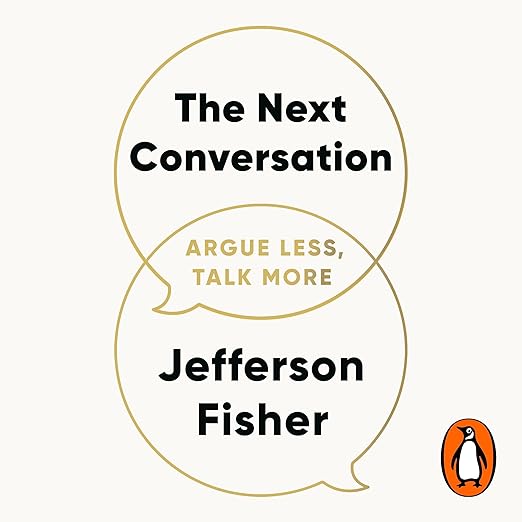
I came to this sceptical, and I will explain why. Jefferson Fisher built his audience on short videos, and books grown from that soil are usually thin: a handful of ideas stretched thin and padded with anecdote. The Next Conversation is not that. It has an actual framework, the advice is specific enough to act on, and at six hours and thirty-five minutes it stops when it has finished saying what it came to say.
The central proposition is counterintuitive and does a great deal of work: you should never win an argument. Fisher’s case, made by a trial lawyer who has spent a career doing precisely that professionally, is that winning and resolving are different objectives, and that pursuing the first reliably costs you the second. Everything else descends from there, including the material on setting boundaries, on framing a conversation before it has properly begun, and on saying considerably less than you want to.
About the Audiobook
Fisher organises the book around three questions most of us have asked at some point: what to do with a heated conversation, how to stand your ground with confidence, and whether there is an effective way to work with difficult personalities. The answers are practical rather than therapeutic. He is interested in what you say and how you say it, not in diagnosing why the other person is the way they are.
The strongest sections are on framing and on restraint. Fisher makes a persuasive case that most conversations are decided in their opening seconds by how the subject is introduced, and he supplies concrete language for doing that well. His material on why saying less is often more is the part I have caught myself using since, and it is the sort of advice that sounds obvious until you notice how rarely anyone actually follows it. He closes on overcoming conflict with connection, which is where the courtroom framing gives way to something warmer.
Penguin Audio’s production is plain and unfussy, which is right for the genre. Chapters are short, the structure is clearly signposted, and six and a half hours can be absorbed across a fortnight of commutes without losing the thread. Chris Voss, whose Never Split the Difference occupies neighbouring shelf space, supplied a cover endorsement: “If you are a student of what makes people tick, you need this book.” The comparison is reasonable, though Fisher’s scope is domestic and workplace conversation rather than negotiation under extreme pressure.
The Narration
Fisher reads it himself, and this is one of the better self-narrated performances I have heard in the communication category. The reason has little to do with vocal quality. A book about how to speak is judged, fairly or not, on whether its author can actually do the thing. He can. The delivery is measured, the pauses are placed deliberately, and he demonstrates the restraint he is recommending simply by declining to fill every silence.
The courtroom training is audible in the best way. He builds towards a point rather than announcing it, lets an example do its own work, and drops his volume rather than raising it when something matters. Hearing him model a difficult exchange aloud is more instructive than any written description of the same exchange could be, which is a genuine argument for the audio edition over the printed one.
If I have a reservation, it is that the register stays fairly even throughout. Fisher is warm and steady from the first minute to the last, and across six and a half hours a little more variation would help the individual chapters stand apart in memory afterwards. This is a minor complaint about a performance that otherwise serves the material with real precision.
What Readers Say
An average of 4.8 stars sits on this listing, though from only a handful of ratings so far, so the score should be treated as encouraging rather than settled. The written reviews are more useful, and they converge on the same quality: usability.
This is one of the most informative books that I have ever read on conversational and interpersonal skills. It is clearly written and easy to apply the lessons and advice given by the author.
Iain, who gave five stars, went on to describe the book prompting him to reflect on how he approaches his daily interactions and to change some of his assumptions, and noted that he had already begun a selective second read. Ali A., also five stars, recommended it to anyone struggling to navigate relationships with family, friends or colleagues, and thought it suited readers of any age. A third reviewer, Ilkyaz, was considerably briefer and wrote entirely in capitals, but the sentiment matched: strong advice, easily absorbed, and a purchase they were happy with.
Who Should Listen?
This suits anyone who leaves difficult conversations replaying them for hours afterwards, anyone who works with a colleague they cannot seem to reach, and anyone who has noticed that being right has stopped helping. It is particularly good for people who dislike the faintly manipulative edge of some negotiation writing, because Fisher’s method rests on lowering the temperature rather than on gaining an advantage.
It will frustrate readers who want research. Fisher writes from professional experience and observation rather than from studies, and if you want citations and evidence you should look to the academic end of the field instead. Anyone already well read in this territory may also find the first hour covers familiar ground before the book locates its own material.
Taken on its own terms, though, this is a short, well-made and genuinely applicable book, and the author’s own reading is the version to choose.