Clara’s Verdict
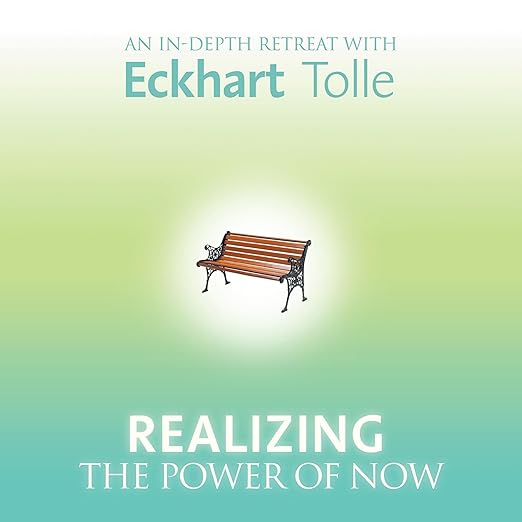
I have a complicated relationship with Eckhart Tolle. I spent a good portion of my twenties mildly suspicious of anyone who pressed The Power of Now into my hands with that particular expression of serene certainty. And then, somewhere around my mid-thirties, exhausted and running on three deadlines and one cancelled holiday, I actually listened. Not to the book, as it happens, but to this recording: a five-day live retreat captured on audio, more than seven hours of Tolle in a room with real people asking real questions. The difference matters. This is not an audiobook in the conventional sense. It is a document of presence, which is precisely the subject at hand.
What surprised me was how little it felt like self-help. Tolle does not offer a programme. He offers something closer to a slowing-down, a sustained invitation to notice the gap between thought and awareness. For listeners who already know the book, this recording fills in the spaces the written text cannot: the pauses, the gentle laughter, the moments where Tolle visibly sits in the silence he is describing. That texture is not incidental. It is the argument. I found myself replaying sections not to capture information but simply to inhabit the mood they created, which is a peculiar thing to say about an audio programme and is probably the highest compliment I can offer.
About the Audiobook
Published in 2003 by Macmillan Audio from Sounds True, this recording captures a five-day in-person retreat led by Tolle, running just over seven hours. It is not a reading of The Power of Now but a live extended seminar, covering ground that presupposes some familiarity with Tolle’s core ideas: the pain-body, presence, the distinction between your life situation and your life itself. Listener OregonBeaches flagged this clearly: you would not want to begin here if you are just discovering Tolle’s work. The concepts are assumed rather than introduced from scratch, and Tolle does not define his terms for newcomers.
The material is structured around practical anchors: using the inner body as a point of return to the present moment, the role of nature and laughter as bridges to awareness, and a long and particularly useful section on acceptance that several reviewers singled out. There is also an extended treatment of what Tolle calls the pain-body, that accumulated emotional residue that drives reactive thinking, and how consciousness itself can dissolve it. These are not easy ideas to explain, and hearing them delivered in a live setting, with the natural pauses and audience responses that a studio recording cannot reproduce, gives them a different quality of landing.
The recording quality is consistent with its era and origin, functional rather than studio-polished, which in this context actually adds to the sense of genuine occasion rather than detracting from it. This is not a produced performance. It is a preserved event.
The Narration
Tolle narrates his own material here, though narration is perhaps the wrong word for what he does. He speaks the way someone speaks who genuinely believes that the words are less important than the space between them. His delivery is measured to the point of stillness, laced with a dry, almost accidental humour that catches you off guard. Reviewer Lisette describes the experience of simply enjoying his company, and that is accurate: there is a quality to his voice that functions as its own kind of argument for the ideas he is advancing. Whether that reads as profound or as overly studied will depend entirely on where you are when you listen.
The live format means there are audience sounds, session transitions, and the slight unevenness of a recorded event rather than a controlled studio session. For some listeners this will add warmth and authenticity. For others it may feel less polished than they expect from a modern audiobook production. It is worth knowing in advance that this is not a tight studio recording but a document of a real gathering.
What Readers Say
The Audible audience here is small, at 22 reviews, and skews strongly positive at 4.7 out of 5. Reviewer Scott is explicit about why: he wanted not a word-for-word reading of the book but deeper, extended insights that only Tolle in person can bring. He describes the CDs as something he absolutely loves, which reflects the particular kind of loyalty Tolle’s work generates. Robert Eberling praises the soothing manner and the humour; Colleen Brit describes hearing confirmed through this recording what she already knows from her own experience. The most measured note comes from OregonBeaches, who gives four stars and notes that Tolle’s discussion of acceptance is particularly well developed here, adding considerable depth to what the book covers more briefly. The advice to approach the retreat only after familiarising yourself with the foundational text is the most useful practical guidance in the review pool.
Who Should Listen?
Listen to this if you have already read or listened to The Power of Now and want to go further into the material. It works well for anyone curious about what Tolle is actually like in a live setting, or for those who find that ideas about presence land more effectively when delivered by a human voice in a real room. This is also worth considering for long-term practitioners of mindfulness or meditation who want a different register of teaching: not a script but a process, not a manual but a session. It is not for complete newcomers to this material, and it is not for listeners who want a tidy, forward-moving narrative structure. Approach this as audio to sit with, not to absorb on the go.