Clara’s Verdict
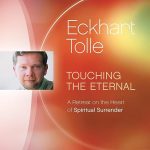
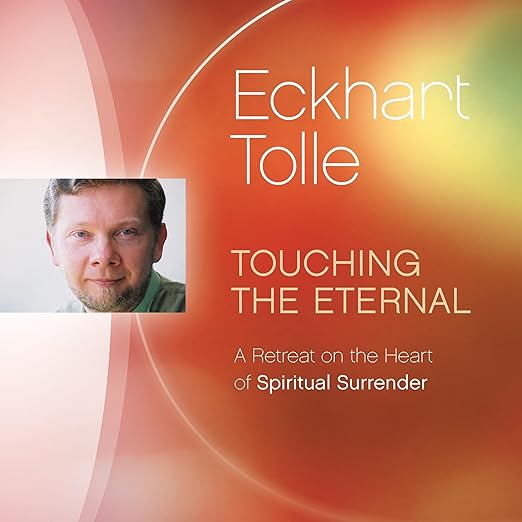
There are very few audiobooks I’d describe as requiring genuine stillness to appreciate, but Touching the Eternal is one of them. Eckhart Tolle recorded this programme during a retreat in India, and you can feel the quality of that atmosphere from the opening minutes – unhurried, spacious, and entirely unconcerned with selling you anything. At 15 hours and 22 minutes, it asks for patience, and rewards it.
What distinguishes this from Tolle’s more polished studio productions is its rawness. He is responding to questions, feeling his way into ideas in real time, and occasionally circling back to something he said twenty minutes earlier because it wasn’t quite right the first time. That kind of intellectual honesty is vanishingly rare in the self-help space, and it’s what earns this programme my genuine attention rather than polite tolerance.
This is not a gentle introduction to Tolle’s ideas. If you’ve never read The Power of Now, start there. But if you already have some grounding in presence-based practice, Touching the Eternal offers something deeper and more demanding – a sustained inquiry into what the world’s wisdom traditions actually share at their core.
About the Audiobook
The programme is framed around a central question that Tolle has been circling for his entire career: what existed before time, space, and form? His answer – stillness, or what he calls the eternal – is not so much a philosophical position as an experiential pointer. He is less interested in convincing you of anything than in guiding you towards a direct encounter with something that, he insists, is already present within you.
Across the retreat sessions, Tolle works through several interconnected themes. He examines conventional ideas about time and the self, showing how most of our suffering arises from the compulsive habit of identifying with a story about who we are rather than with the awareness in which that story appears. He discusses the relationship between ego, surrender, and compulsive thinking – not as abstract concepts but as observable features of moment-to-moment experience.
Particularly striking are his reflections on death and dying. Tolle approaches mortality not as a problem to be managed but as a doorway – perhaps the most reliable one available – into the recognition of what we truly are beneath the biographical self. It is challenging material, delivered with great care.
The programme also addresses what Tolle calls our “addiction to suffering”: the strange preference many people have for familiar unhappiness over unfamiliar freedom. He traces this to the ego’s need for a problem to maintain its sense of identity, and offers practical guidance – grounded in inner observation – for working with this resistance rather than fighting it.
The Narration
Tolle reads – or rather speaks – this himself, and that matters enormously. This is a live retreat recording rather than a studio production, which means you are genuinely in the room. His distinctive German-accented English, with its characteristic long pauses and occasional quiet laughter, carries a quality that no professional narrator could replicate. The pauses are not empty; they are, in a very real sense, the point.
The audio quality is good enough to forget about – clean recording, no distracting ambient noise. Purists who prefer Tolle’s more formally produced works may find the looser format takes some adjustment, but I found it entirely appropriate for material of this kind. The intimacy of the retreat setting comes through clearly, and by the second session you are simply present with the teacher, which is exactly where you want to be.
What Readers Say
Listeners who connected with this programme tend to describe it in ways that resist the usual review vocabulary. “WONDERFUL,” wrote one listener from Canada – brevity that, for this particular material, feels entirely apt. The rating stands at a perfect 5.0 from those who have reviewed it, which is consistent with Tolle’s broader catalogue: his work tends to produce either profound resonance or complete bafflement, with very little in between.
The small number of formal reviews is somewhat misleading – this is a programme that circulates through communities of practitioners and long-term Tolle listeners, people who may not leave Amazon ratings but who return to recordings like this repeatedly over years. It functions less as a book to be consumed and more as a resource to be revisited.
Who Should Listen?
If you have a meditation practice, have read Tolle before, or are drawn to the contemplative traditions of Advaita Vedanta, Zen Buddhism, or Christian mysticism, this will feel immediately at home. It is not, to be clear, a comfortable listen – Tolle asks you to question assumptions about your own existence that most of us would rather leave undisturbed. But for those ready to do that work, it is exceptional.
Those coming to Tolle for the first time would be better served starting elsewhere. And if you’re looking for actionable productivity tools or psychological techniques, this is emphatically not that kind of programme. What it offers instead is something rarer: an invitation to encounter the stillness that, according to Tolle, has been present beneath every moment of your life, waiting to be recognised.
Available to stream on Audible UK, Kobo, Scribd, and Storytel. Listen to Touching the Eternal on Audible UK and give yourself the unhurried hours it deserves.