Clara’s Verdict
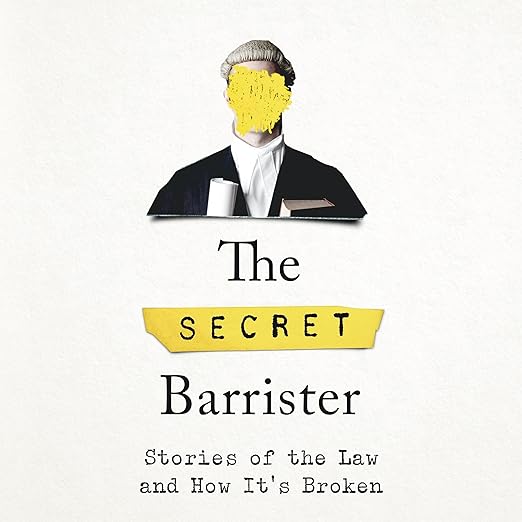
The Secret Barrister is one of the most important books published in Britain in the last decade, and I mean that in a precise and specific sense: it is important not because it is brilliant – though it is – but because it concerns something that affects every person living under this legal system and is understood by almost none of them. The criminal justice system of England and Wales is broken in ways that are not incidental or correctable at the margins, and the anonymous barrister who wrote this book demonstrates that with methodical, at times genuinely shocking, and occasionally very funny clarity.
Winner of the Books Are My Bag Non-Fiction Award, shortlisted for the Waterstones Book of the Year, and apparently crowdfunded into the hands of every MP in Parliament – the book changed a great deal of public discussion about the courts and changed very little in practice. Which is itself part of the story. Read by Jack Hawkins across 11 hours and 51 minutes, it is essential listening for anyone who lives here.
About the Audiobook
The book’s opening is direct and deliberately unsettling: one day you or someone you love will almost certainly appear in a criminal courtroom, in any role – juror, victim, witness, or defendant – and when that happens you will expect a fair trial. The Secret Barrister’s experience, accumulated across years of daily practice, is that fairness is not guaranteed. That the innocent are wronged, the guilty sometimes walk free, and the system fails precisely the people it is most urgently designed to protect.
What follows is a comprehensive and documented tour through the architecture of failure: the magistrates’ courts, the Crown Court, the appeals system, the treatment of victims and witnesses, the collapse of legal aid, the destruction of the solicitors’ profession through poverty wages, the consequences of chronic underfunding for every stage of the process. The author writes in a mode the Observer accurately described as “eye-opening, funny and horrifying” – the dark comedy is structural, arising from the gap between what the system is theoretically designed to be and what it actually is in practice. The political choices that have produced the current situation are examined without partisan favour: successive governments of all parties have contributed to what now exists.
One of the book’s most striking qualities is its resistance to partisan comfort. The author is not interested in letting any political party use this as ammunition – the failure documented here belongs to a sustained multi-decade political consensus about the low priority of criminal justice funding, and the book makes that attribution carefully and honestly. This is both intellectually honest and, paradoxically, one of the reasons the book has not produced more political change than it has: when everyone is responsible, no single political actor faces specific accountability.
The Narration
Jack Hawkins reads with the measured authority the material demands. This is serious, documented non-fiction, and the narration respects that without becoming heavy or preachy. He handles the author’s distinctive voice effectively: the barrister writes with legal precision that occasionally erupts into exasperated wit, and Hawkins navigates that tonal range with ease. The anonymous first-person voice – we never learn the author’s identity – creates an interesting dynamic in audio: the anonymity feels appropriate to the subject, as though the institutions being criticised are too powerful for their critic to be publicly named. At nearly 12 hours, the listen is substantial, but it is consistently engaging and never overstays its welcome.
What Readers Say
Rated 4.4 out of 5 from the Audible reviews, though the book’s real reputation rests on its far larger print readership and the public debate it generated. A practising solicitor called it “informative, interesting, entertaining, page-turner of a book.” Another reviewer declared it “required reading for everyone I can think of – there is no reason not to read this book.” An American listener found it both instructive about the English system and unsettlingly relevant to their own country’s courts. A lawyer from India read it for insight into English chambers and courts. The book has found readers across every background and system, because the failure of institutional justice is never a purely local story.
Who Should Listen?
Anyone who lives in England or Wales and is therefore subject to this system. That is not a rhetorical flourish – the book’s central argument is that the failures it documents affect everyone, that the erosion of criminal justice is not a specialist concern but a fundamental democratic one. Legal professionals will find it articulates things they have witnessed but perhaps struggled to convey to others. Non-lawyers will find it both revelatory and deeply concerning. Start here. Listen on Audible UK: get The Secret Barrister on Audible UK. The book is also available on Kobo and Scribd for those who prefer those platforms – though in this case, the investment of whatever time it takes to acquire and listen to it is, I would argue, a civic obligation as much as a personal pleasure.