Clara’s Verdict
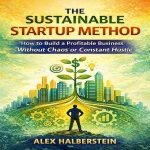
I’ll be candid: the self-help shelf for entrepreneurs is groaning under the weight of titles promising to fix your chaos in thirty days. Most of them recycle the same hustle gospel dressed up in fresh fonts. The Sustainable Startup Method by Alex Halberstein is something a little different. At under ninety minutes, Halberstein makes a focused argument for building a business around your energy rather than burning yourself out trying to fill every waking hour with productivity theatre.
The relentless glorification of hustle culture has done genuine damage to a generation of founders who were led to believe that exhaustion was evidence of commitment, and that rest was for people who weren’t serious. Halberstein’s counter-argument – that calm is a competitive advantage, not a luxury – is precisely the reframe that many overwhelmed business owners need to hear. Whether the book delivers on its promise in sufficient depth is a separate question, and the answer is: partly. But the direction of travel is entirely right.
If you’re in the thick of startup overwhelm right now and need a quick reset, this could be exactly the clarity jolt you’re after.
About the Audiobook
The premise of The Sustainable Startup Method is refreshingly honest: working nonstop doesn’t mean working smart, and the chaotic growth model so many founders glorify is quietly destroying them. Halberstein’s framework lays out a structured approach for replacing reactive firefighting with calm, deliberate systems. The book addresses what he calls the “chaos cycle” – that exhausting loop of urgent tasks, poor decisions made under pressure, and mounting self-doubt – and offers practical tools for breaking out of it.
The core ideas include designing your working day around your natural energy peaks rather than fighting them, building lightweight systems that scale without adding complexity, and tackling the psychological barriers – particularly the self-doubt that silently throttles income and progress. Halberstein argues that consistency, not intensity, is the engine of sustainable profit. It’s a philosophy familiar from writers like Cal Newport and Greg McKeown, but applied specifically to early-stage business owners who feel like they’re perpetually sprinting and getting nowhere.
The book’s practical framework covers eliminating the chaos cycle, using calm strategically in decision-making, designing operations around energy rather than expectation, building systems that scale without administrative overhead, confronting the internal stories of inadequacy that sabotage revenue, and creating what Halberstein calls “consistent progress” – the kind that compounds over time rather than burning out in intense bursts.
At under ninety minutes, this is necessarily a summary rather than an exhaustive deep dive. You won’t finish it with a fully mapped operational playbook. What you will finish with is a reorientation of priorities and a set of principles clear enough to act on immediately. The trade-off is accessibility: the entire framework fits into a single commute, which is either limiting or brilliantly efficient depending on your starting point.
The Narration
Scott LeCote handles the narration with a clean, measured delivery that suits the material well. There’s no unnecessary dramatics – this isn’t that kind of book – and LeCote keeps things moving at a sensible pace without rushing through sections that benefit from a moment of reflection. His voice is calm and authoritative without tipping into the flat monotone that plagues a lot of business audiobooks. He sounds like someone who actually believes what he’s reading, which helps the practical sections land with conviction.
What Readers Say
This is a recent release without a substantial review base yet, so there’s limited listener opinion to report. What I can say is that the audience Halberstein is writing for – founders and freelancers who are exhausted by their own ambition – tend to respond well to no-nonsense, system-focused frameworks delivered without condescension. The seven-day challenge structure embedded in the book is the sort of feature that generates either devoted fans or polite indifference depending on how prescriptive you find that approach to building new habits. Those who’ve tried and abandoned more elaborate productivity systems will likely find the stripped-back framework here a welcome relief.
Who Should Listen?
If you run your own business and the phrase “I’m overwhelmed but I can’t slow down” describes your average Tuesday, this audiobook is worth ninety minutes of your time. It’s particularly suited to solo founders and small-team leaders who’ve tried productivity systems before and watched them collapse within a fortnight – not because they lacked discipline, but because the systems weren’t designed for how they actually work. The short format also makes it ideal for a re-listen whenever you feel yourself sliding back into chaos mode; it functions as a reset rather than a reference tome.
It’s worth tempering expectations slightly. The format is a strength and a limitation simultaneously. Halberstein covers the territory at pace, which means some ideas that deserve more development – particularly the systems-building framework – are introduced but not fully elaborated. Readers who want the complete operational playbook will need to supplement this with longer works. But as an orientation and a mindset shift, it delivers exactly what it promises, and sometimes ninety minutes of the right idea at the right time is worth more than ten hours of the almost-right idea.
Find it on Audible UK and available across Kobo, Scribd, and Storytel for those with subscription access.