Clara’s Verdict
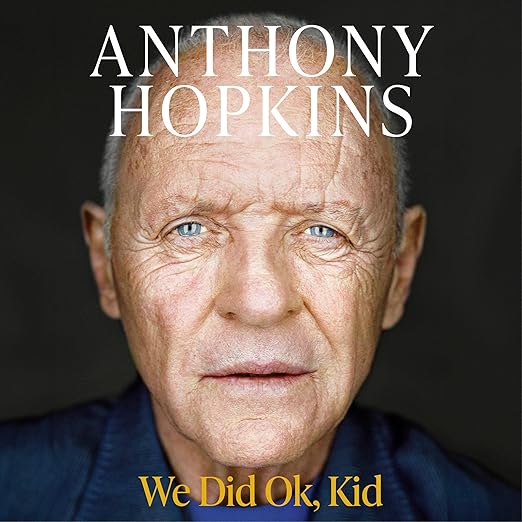
The casting of Kenneth Branagh to narrate Anthony Hopkins’ memoir is so obviously correct that it feels almost inevitable in retrospect – and yet it required someone to have the wisdom to make it happen. Two great theatrical knights: one telling the story, the other giving it voice. The result is extraordinary. Branagh understands Hopkins’ rhythms from the inside, in a way that no outside narrator however skilled could manage, and his reading brings the book alive in ways that go beyond technical excellence.
Hopkins’ memoir is not a glamorous account of red carpets and Oscar nights. It is a searching, honest, sometimes uncomfortable examination of a man who spent decades trying to escape himself – his Welsh origins, his difficult early family life, the alcoholism that nearly destroyed everything, and the sobriety he found in his late thirties and has maintained for nearly half a century. The sections on addiction are among the most clear-eyed and unsentimental I have encountered in any celebrity memoir, and the passages on his Welsh inheritance – the men who shaped him through their emotional unavailability and their particular variety of working-class stoicism – are quietly devastating.
About the Audiobook
Narrated by Kenneth Branagh, with poetry readings from Sir Anthony Hopkins himself. Academy Award-winning actor Sir Anthony Hopkins delves into his illustrious film and theatre career, difficult childhood and long path to sobriety in this honest, moving and long-awaited memoir. Born and raised in Port Talbot – a small Welsh steelworks town – amid war and depression, Hopkins grew up around men who were tough and who eschewed all forms of emotional vulnerability in favour of hard work and, for too many, alcoholism. A struggling student, deemed a failure with no future by teachers and peers alike, his trajectory changed on a fateful Saturday night when the disregarded Welsh boy watched the 1948 adaptation of Hamlet.
With candour and a voice that is both arresting and vulnerable, Sir Anthony recounts his various career milestones – his Iago gets him admitted to RADA and places him under the wing of Laurence Olivier; he meets Richard Burton by chance as a young boy, and later backstage at Equus as an established actor meeting his hero; his portrayal of Hannibal Lecter was informed by Bela Lugosi’s creepiness and his acting teacher’s razor-sharp precision. He pulls raw emotion from the stoicism of his father and grandfather for King Lear. The audiobook runs to 9 hours and 5 minutes. Published by Simon & Schuster Audio UK.
The Narration
Kenneth Branagh’s narration of We Did Ok, Kid is a performance in its own right, not merely a reading. He has the measure of Hopkins’ rhythms – the Welsh cadences, the characteristic tendency to pause and then press forward with sudden force – and he respects them rather than imposing his own. The passages in which Hopkins reads his own poetry are preserved as written, and the contrast between Branagh’s polished delivery and Hopkins’ rougher, more urgent voice reading verse gives the audiobook a dimension that the printed page cannot replicate. For a memoir that is partly about the relationship between interior life and performed exterior, having Branagh as the exterior voice and Hopkins emerging in the poetry is a genuinely intelligent production choice.
What Readers Say
Across 405 ratings on Audible, the memoir holds a score of 4.6 out of 5 – a strong result for a celebrity memoir, a genre that tends to attract scepticism. One reviewer called it “an incredibly honest and insightful account – a warts-and-all perspective from childhood through the challenges of being written off, and then to what he became.” Another wrote: “An unforgettable, rhythmic memoir. Insightful, brutally honest and inspiring. As I read I could hear the actor’s unmistakable voice, his quick rhythmic way of speaking. I especially enjoyed his use of poetry.” A third, who lives in the same Welsh town as Hopkins, found it “shows you can achieve anything if you put your mind to it” – a response that speaks to the memoir’s broader emotional reach beyond literary appreciation.
One of the book’s most interesting threads is Hopkins’ account of his relationship to learning. He describes himself as dyslexic, or at least as profoundly unsuited to the conventional academic environment of his Welsh schooling, and traces the way that his method of memorising lines – writing them out repeatedly, over and over, until they become physical as much as intellectual – developed directly from his experience of struggling with text in school. The things we adapt to survive become, sometimes, the things that make us extraordinary. Hopkins’ memoir makes that argument quietly and without self-congratulation, and it is more persuasive for it.
Who Should Listen?
Anyone interested in Hopkins as an actor, certainly. But equally: anyone who has ever read a recovery memoir and wanted something more from the genre than motivational platitudes. This is intelligent, unsentimental, and lit from within by Branagh’s exceptional performance. Hopkins’ own poetry readings, interspersed throughout, add a dimension that makes this audiobook format experience genuinely superior to the printed page. Available on Audible UK, Kobo, and Scribd.