Clara’s Verdict
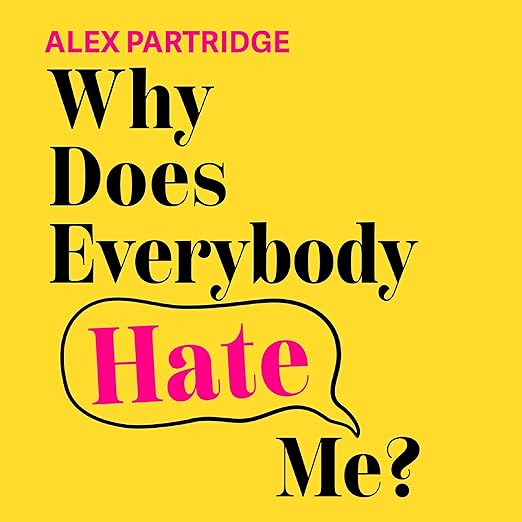
Alex Partridge founded UniLad and LadBible, built global content brands worth tens of millions, and spent years convinced that his crushing fear of rejection was a personal failing – evidence of weakness in someone who, by every external measure, was thriving. Why Does Everybody Hate Me? is his account of discovering Rejection Sensitive Dysphoria (RSD) – the intense, dysregulating emotional pain triggered by perceived or actual rejection that affects almost everyone with ADHD – and what happened when he stopped fighting that pain and started understanding its source. Rated 4.7 from fourteen listeners, all recently published and all five-star, this audiobook has already generated responses that are among the most genuinely moved I have read in this genre. It came out in March 2026 and is, I think, going to matter to a very large number of people.
About the Audiobook
The book opens with a series of scenarios that will be immediately, uncomfortably recognisable to anyone with ADHD or anyone who loves someone with it: your boss asks for a chat and you immediately, completely know you are about to be fired; someone replies to your message with a thumbs-up emoji and you spend a day convinced they hate you; a friend goes to the bathroom mid-film and you interpret it as silent judgment of your taste. Partridge’s point is that these reactions are not irrational or disproportionate to some underlying weakness of character. By the time a person with ADHD reaches age twelve, they have typically received around twenty thousand more negative messages about their behaviour and their fundamental way of being than their neurotypical peers. That accumulated weight reshapes the nervous system’s response to anything that might constitute rejection.
The book draws on conversations with leading ADHD researchers and clinicians while anchoring the science firmly in Partridge’s own experience: his years building LadBible from nothing, his adult relationships and their recurring patterns, his mental health crises and hospitalisations, his imposter syndrome despite enormous external success. He writes about people-pleasing as a survival mechanism developed in childhood, and about the particular cruelty of being repeatedly labelled “over-sensitive” for responding to real pain in an entirely understandable way.
The final section offers practical, grounded steps for managing RSD – not eliminating it, which is not realistic, but understanding it well enough to reduce its power over daily life. At just under six hours, it is a measured and generous listen throughout.
The Narration
Partridge reading his own book is the only version of this that could work as well as it does. He has a natural, unpretentious delivery – warm, occasionally self-deprecating, and completely without the polished gloss that sometimes makes author-narrated self-help feel like a TED talk rather than a conversation. The moments of real vulnerability land exactly as they should: not as performance but as evidence. His ADHD Chatter podcast has built him an audience of hundreds of thousands of listeners who already know and trust his voice; this audiobook will satisfy that existing audience and introduce him to a much wider one who need to hear exactly this.
The book is also carefully structured to be readable – or listenable – by someone in the middle of an ADHD episode, not just when they are feeling focused and organised. Short sections, clear signposting, and a consistent emotional thread make it accessible even to the audience it is most trying to reach, which is a form of consideration that is not common enough in this space.
What Readers Say
Rated 4.7 from fourteen listeners on Audible UK. One reviewer, newly diagnosed with ADHD at nearly fifty, called it “so enlightening – I feel so understood. It’s put together in a very clear and easily digestible way, even for someone with ADHD, which is not a coincidence.” Another wrote: “RSD is crippling. Reading you aren’t alone is life changing. Alex has made me feel totally seen.” A third described crying through the entire book: “It made me feel seen in a way I’ve never felt before. I never knew ADHD girls hear 20,000 extra criticisms simply for being them.” For a book about rejection sensitivity, this quality of connection between author and reader is its own argument for why it needed to exist.
Who Should Listen?
Anyone with ADHD; anyone who has been labelled “too sensitive,” “over-dramatic,” or “too much”; anyone who has lived with the constant background noise of fearing rejection. It is equally valuable for partners, parents, friends, and colleagues who want to understand what RSD actually feels like from the inside – not as abstract explanation but as lived empathy. Mental health professionals will find it a useful complement to clinical literature on ADHD and emotional dysregulation. And anyone who has followed Partridge’s ADHD Chatter podcast will want this; it takes everything he has been discussing in that space and roots it in one cohesive, personal, properly researched, and genuinely moving account of a life shaped by a condition that nobody explained.