Clara’s Verdict
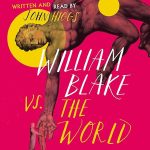
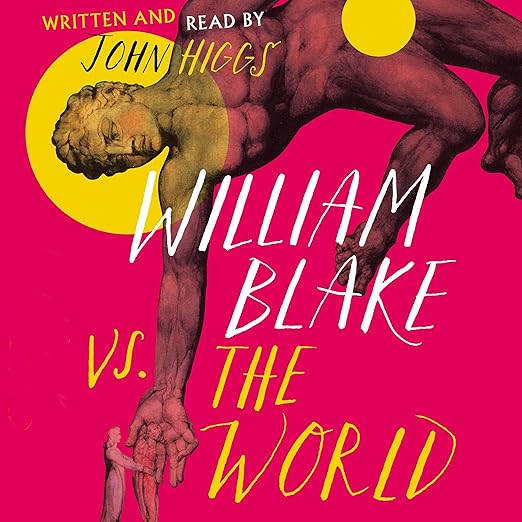
I first encountered William Blake properly at university, and I spent years feeling vaguely embarrassed that I found him simultaneously electrifying and completely baffling. John Higgs’ William Blake vs the World is the book I needed then and didn’t have. It is not a conventional biography – it is something more adventurous: a genuine attempt to enter Blake’s world view from the inside, to understand what he was actually seeing when he saw his visions, rather than simply cataloguing them as symptoms of eccentricity or genius.
Higgs is one of the most bracingly original writers working in British non-fiction, and this is his best book. It takes Blake seriously in the way Blake deserves to be taken seriously – as a thinker, a visionary, and a man who was genuinely centuries ahead of his time.
About the Audiobook
Published by Weidenfeld and Nicolson, this radical biography spans eleven hours and twelve minutes. Higgs situates Blake – poet, artist, engraver, and author of what became the unofficial English national anthem – in the context of riots, revolution, and radical thought that characterised his era, while simultaneously drawing connections to the psychedelic counterculture of the 1960s, contemporary neurobiology, quantum physics, and comparative religious thought.
This might sound like an impossibly eclectic mash-up, but Higgs has the intellectual confidence to hold it together. His central argument is that Blake’s apparently bizarre visions and mythological system were not the ravings of a madman but a coherent response to the limitations of Enlightenment rationalism – what Blake called “single vision,” the reduction of all reality to what can be measured and quantified. Blake spent his life insisting that reality was richer than that, and Higgs argues that modern neuroscience and physics are beginning to catch up with him.
The book comes with a PDF companion available in the Audible library for those who wish to follow up the visual material – essential if you want to engage with Blake’s illustrated works.
The Narration
Higgs reads his own book, and this is entirely the right decision. His voice has the quality of a brilliant, slightly manic friend who has just discovered something wonderful and cannot wait to tell you about it. He conveys genuine enthusiasm without losing precision. Eleven hours in his company passes quickly. The passages where he quotes from Blake’s prophetic books – some of the most syntactically challenging poetry in the English language – are handled with care and clarity.
What Readers Say
The book holds a 4.6 rating from 388 reviews. One reviewer described it as making them “look afresh” at their entire understanding, adding that Higgs helps readers make sense of Blake’s world view in its historical context. Another called it “simply superb,” praising Higgs’ ability to weave popular science, Eastern philosophy, and social commentary into a coherent argument. The Times called it “fascinating,” the New Statesman “Blakeian in its singularity,” and the Irish Times “a wonderful adventure.” Multiple readers who admitted knowing nothing about Blake before starting reported being transformed by the end.
Who Should Listen?
Everyone, frankly, but especially those who have tried and bounced off Blake’s poetry, those interested in the history of visionary and mystical thought, and anyone curious about the intersections between art, spirituality, and science. Readers of Iain McGilchrist’s The Master and His Emissary, Rob Macfarlane’s explorations of landscape and perception, or any of Higgs’ other work (Stranger Than We Can Imagine is the obvious companion) will find this essential. It is one of the best popular intellectual biographies I have read in recent years.
Available now on Audible UK: Listen to William Blake vs the World on Audible UK.