Clara’s Verdict
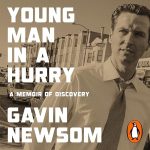
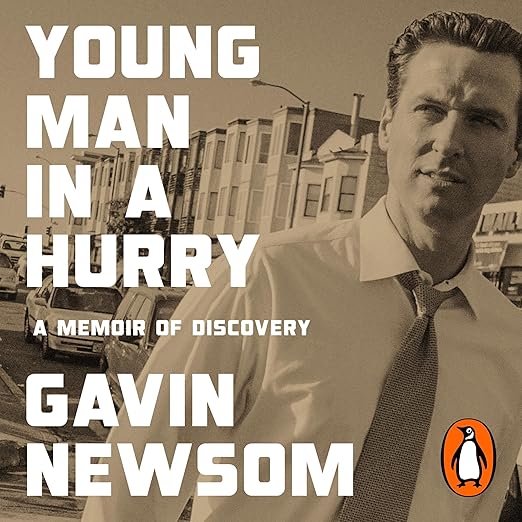
Political memoirs have a nasty habit of being either hagiographies dressed up as candour, or score-settling exercises wrapped in the language of reflection. Gavin Newsom’s Young Man in a Hurry manages, pleasingly, to sidestep both traps. Narrated by the Governor himself – and that choice matters enormously here – this is an account of a life shaped by contradiction: the son of a working mother who held down three jobs simultaneously, and a father who moved comfortably in the rarefied orbit of the Getty family. That tension between striving and privilege is the engine of the book, and Newsom is surprisingly honest about how it formed him, and occasionally deformed him.
I came to this expecting the usual political self-promotion – the sort of audiobook that sounds like a campaign manifesto read aloud with carefully managed pauses. What I found instead was something considerably more personal. There are moments of genuine rawness here, particularly around his childhood instability and his dyslexia, that feel hard-won rather than strategically deployed. Whether you follow American politics closely or not, there is something genuinely compelling about a public figure willing to say: this is where I came from, this is what it cost me, and this is why I keep going anyway.
About the Audiobook
The book traces Newsom’s story from the California of his ancestors – his great-great-grandfather walked a San Francisco beat as a policeman – through to his own trajectory as mayor of that same city and eventually as Governor of California. It is, at its core, a book about identity and belonging: what it means to be shaped by a place, and what it means to fight for it across an entire political career.
Newsom is candid about the decisions that made national headlines, including his choice as mayor to issue same-sex marriage licences in defiance of state law. He frames these not as acts of calculated grandstanding but as moments when conscience outweighed political calculation. Whether you find that persuasive will depend partly on your political priors, but the account is given with enough specificity – the arguments, the doubts, the immediate aftermath, the legal consequences – that it feels earned rather than burnished in retrospect.
The book also covers his governorship, the relentless partisan pressure that has defined it, and his vision for California as a model for progressive governance in an era of national polarisation. What saves these sections from becoming dry political autobiography is the thread running throughout: the California Dream as something real, fragile, and worth defending at considerable personal cost. Named a Most Anticipated Book of 2026 by the New York Times and published by Penguin/Vintage Digital in March 2026, it arrives at exactly the moment when Newsom is one of the most prominent political figures in American public life.
The Narration
Newsom reads his own book, and it is the right call. His voice carries a natural cadence that no professional narrator could replicate: the slight hesitations when he arrives at the difficult passages, the unmistakeable warmth when he speaks about California and what it represents, the controlled anger when he describes the forces arrayed against the things he has tried to build. At seven hours and fifty-seven minutes, it is a comfortable listening length – enough to develop ideas properly without overstaying its welcome.
The self-narration also adds a layer of authenticity that is particularly important for the childhood sections. When Newsom describes navigating his dyslexia, or the strange dual worlds of his parents’ respective social circles, you hear something that reads less like performance and more like honest recollection. There is the occasional roughness of delivery in the more formal policy sections, but that, paradoxically, only adds to the sense that this is a real person speaking rather than a polished media product assembled by a communications team.
What Readers Say
With a rating of 4.5 out of 5 from 288 reviews, the response has been strongly positive across multiple countries. British listeners have been particularly engaged: one UK reviewer described being struck by how Newsom overcame “a dysfunctional family, dyslexia, and the constant barrage of criticism,” finding the book “fascinating” and genuinely moving in its account of persistence. A US listener praised its sincerity, noting that Newsom “owns his mistakes and regrets” and shares lessons learned with rare directness, calling it “a page-turner once it found its rhythm.” An Australian reader highlighted the historical dimension, noting it illuminated aspects of American political history they had been unaware of. Several reviewers came to the book sceptical and left considerably more engaged – which is, frankly, the best advertisement a political memoir can have.
Who Should Listen?
If you have any interest in American politics, the mechanics of progressive governance, or simply in how a person’s origins shape their convictions and their courage, this is well worth your time. It will resonate particularly with listeners who enjoy political biography that operates at the human level rather than the purely procedural – think of Obama’s A Promised Land in spirit, though Newsom’s California focus gives it a distinctive and more intimate texture. Even those with no particular warmth for Newsom’s politics are likely to find the childhood and early career sections genuinely absorbing, as the forces that made him are more universal than his particular positions.
Listen to Young Man in a Hurry on Audible UK – available now via the link below. Also worth checking on Kobo, Scribd, and Storytel if you prefer a subscription model.