Clara’s Verdict
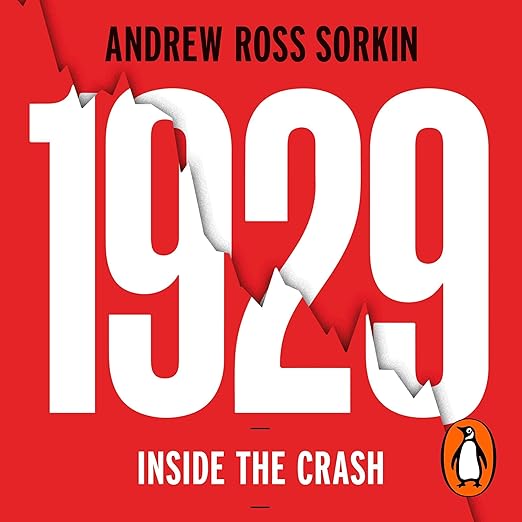
Andrew Ross Sorkin made his reputation with Too Big to Fail, his authoritative account of the 2008 financial crisis, praised by his publisher as “the definitive history of the banking crisis.” With 1929, published by Penguin in October 2025, he turns to an earlier catastrophe – the Wall Street crash that triggered the Great Depression – and applies the same formidable narrative intelligence to make it feel urgent, dramatic, and deeply contemporary. At 13 hours and 30 minutes, read by Sorkin himself, this is a production that carries the authority of genuine scholarly commitment. It holds a 4.5 out of 5 rating from 6 listeners at time of writing.
About the audiobook
Sorkin’s great gift is narrative non-fiction that reads with the propulsion of a thriller without sacrificing analytical rigour. 1929 uses newly uncovered documents and historical records to reconstruct the crash from the inside: not from the retrospective calm of economic analysis, but from within the chaos itself – the panicked trading floors, the desperate telephone calls between financiers, the private conversations of regulators who could see what was happening and lacked the tools, the authority, or in some cases the will to stop it.
The book is peopled with characters whose ambition and naivety shaped the most consequential financial event of the twentieth century. Visionaries and fraudsters share space in Sorkin’s narrative; there are genuine believers in the endless bull market and there are those who knew the game was rigged and played it anyway. The battle between Wall Street and Washington – familiar from any era of financial excess – is rendered here with historical specificity and contemporary resonance.
Sorkin is interested not just in the mechanics of the crash but in its psychology. The “irrational exuberance,” the alarm bells that were raised and dismissed, the conviction – universal among those who profited most – that this time was genuinely different: these are the conditions that make crashes inevitable, and Sorkin’s account of how those conditions developed in the 1920s feels uncomfortably recognisable to anyone paying attention to the present day.
The closing argument, quoted in one review, is worth preserving: “The enduring lesson is not that booms can be prevented or that busts can be fully averted. It is that we need to remember how easily we forget. The antidote to irrational exuberance is not regulation by itself, nor skepticism, but humility – the humility to know that no system is foolproof, no market fully rational.” That is not a comfortable conclusion. It is, however, probably a true one.
The book has been praised by the Wall Street Journal as “one of the best narrative histories I’ve read,” by the Financial Times as “a work of true scholarship,” and endorsed by Bill Gates as an automatic priority read. These are not routine promotional gestures; Sorkin has earned that level of response through consistent excellence in a demanding genre.
The narration
Sorkin reads his own work, which is a distinctive choice. The risk with author-narrators is that they lack the technical range of professional readers; the reward is an intimacy with the material that cannot be replicated. Sorkin reads as a journalist – brisk, engaged, unembellished – which suits a book about financial catastrophe considerably better than theatrical delivery would. He knows which passages to slow down for and which to drive through, and that editorial sense makes the 13 hours feel purposeful rather than padded.
What readers say
MICHAEL J ESSEX gives four stars and quotes the final lesson at length, suggesting he found it the most resonant element of the book. Sam Theodore, who had previously read Galbraith’s classic 1954 account of the same crash, recommends Sorkin for the “more detailed and fascinating narrative with details on the main characters – a few heroes and many villains.” nopenname calls it “very well written and easy to read – very interesting to see how things unfolded behind the scenes.” Prof Regan is economical in the best way: “scintillating and captivating, a compelling story.” Adrian and Jenni Gill give five stars and say simply: “Excellent book.”
Who should listen?
Anyone interested in financial history, economic cycles, or the psychology of speculation. The book is particularly apt for anyone who has found the market turbulence of recent years confusing and would benefit from historical context for why crashes happen and why, almost universally, they are not adequately anticipated. It is also excellent for students of American political and social history, and for anyone who simply wants a well-constructed narrative about human beings under conditions of financial extremity.
Sorkin requires no specialist financial knowledge from his listeners; he is a storyteller first. Approach this as narrative history that happens to be about money, and you will not be disappointed.
Listen to 1929 on Audible UK and understand the crash that still shapes the world we live in.