Clara’s Verdict
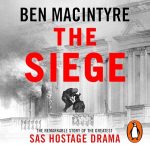
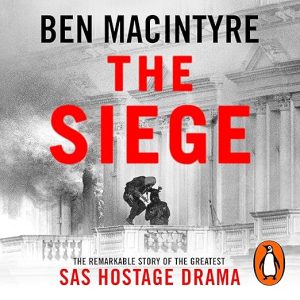
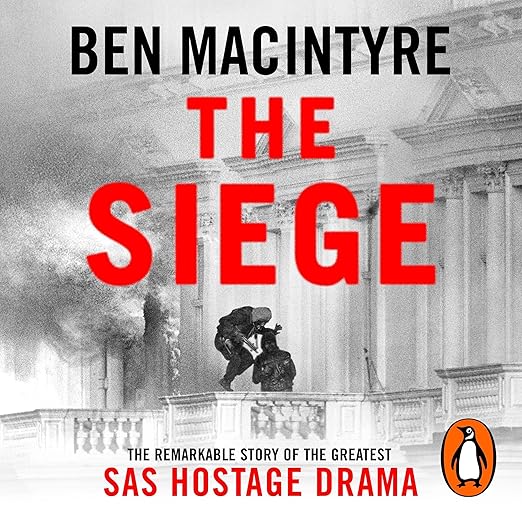
On the afternoon of 30 April 1980, six heavily armed men stormed the Iranian Embassy on Princes Gate in Knightsbridge and took twenty-six hostages. Six days later, the SAS – an organisation known almost exclusively within military circles – rappelled down the building’s exterior in full view of television cameras broadcasting live to millions of British homes. Operation Nimrod lasted eleven minutes. It killed five of the six gunmen, freed the remaining hostages, and changed British culture’s understanding of its special forces forever. Ben Macintyre has spent his career telling stories like this, and The Siege is among the very best things he has written.
About the Audiobook
Drawing on unpublished source material, exclusive interviews with the SAS soldiers who carried out Operation Nimrod, and testimony from hostages, police negotiators, intelligence officers, and the on-site psychiatrist, Macintyre reconstructs the six-day siege with the meticulous precision and narrative drive that characterises his finest work. He doesn’t begin at the storming of the embassy; he begins months earlier, tracing the build-up of tensions in Iran, the political context of the hostage-takers’ grievances, and the intelligence picture that preceded the attack. The depth of this backstory transforms the assault from a dramatic set-piece into the conclusion of a coherent human drama with fully realised participants on every side.
What’s remarkable is how many perspectives Macintyre holds simultaneously and how equitably he distributes his attention. The hostages, living in sustained terror and forced intimacy, developing relationships with their captors that would haunt them for years. The police negotiators, playing for time, reading personalities, managing a media feeding frenzy while trying to prevent bloodshed. The intelligence services, working in the background with information they couldn’t always share. The SAS, training in a nearby building, waiting, planning Operation Nimrod with the methodical focus that defines them. The gunmen themselves, increasingly desperate and fractured. And the media circus on the pavement outside, turning a hostage crisis into the longest continuous news broadcast in British television history.
Part of what makes this account definitive is the access Macintyre obtained to sources that have remained silent for decades. The SAS soldiers who participated in Operation Nimrod, the hostages who lived through the siege, the negotiators whose improvised strategies bought the time the operation required – many speaking publicly for the first time. The result is a human document as much as a historical one. Macintyre also makes a broader cultural argument: the siege made the SAS simultaneously famous and mythological, and he traces the consequences of that visibility for the following forty years. The book is about six days; it’s also about how those six days changed what Britain thought of itself.
The Narration
Macintyre narrates his own book, and it’s a significant advantage. He has a natural storytelling cadence – confident, slightly conspiratorial, occasionally wry – that suits the material perfectly. There’s a genuine sense that he has lived with these documents and testimonies, absorbed the reality of those six days into something more than research. The result is a narration that feels like the author telling you the story directly, and the tension of the final hours is sustained with impressive control. Macintyre’s books have been adapted for television – Operation Mincemeat became a film – and The Siege has similar cinematic propulsion. But the audio version, in Macintyre’s own voice, has an intimacy that no adaptation could replicate.
What Readers Say
Rated 4.7 out of 5 from Audible reviews, with consistent praise for both the research and the writing. “A well researched and written account… a real page turner,” wrote one listener. Another placed it alongside Macintyre’s best work, noting how thoroughly “the personalities and characters of all involved are set out.” One thoughtful review observed that the BBC documentary covering the same events makes the physical assault easier to follow visually – which is fair, but misses what this text uniquely provides: the years of preparation, the psychology, and the decades of exclusive testimony that no documentary has accessed.
Who Should Listen?
Essential for anyone interested in modern British history, Cold War geopolitics, hostage negotiation, or the mechanics of special forces operations. Fans of Macintyre’s previous work – Agent Zigzag, Operation Mincemeat, The Spy and the Traitor – will find this every bit as compelling. Mick Herron called his books “heart-pounding.” He’s right.
The Iranian Embassy siege also marks a before-and-after moment in British broadcasting history. The decision to broadcast the assault live – with no editorial delay, no certainty about what would happen – was unprecedented, and Macintyre is excellent on the editorial decisions that were made in real time by producers who had no template for what they were doing. The relationship between the media coverage and the political context, between what was being shown and what it meant for Margaret Thatcher’s young government, is handled with the same rigour Macintyre brings to the military and diplomatic threads.
Listen on Audible UK and on Kobo for ebook subscribers.