Clara’s Verdict
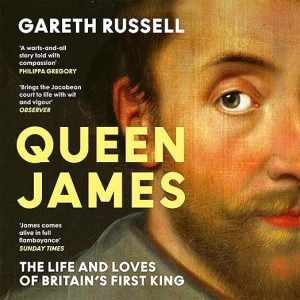
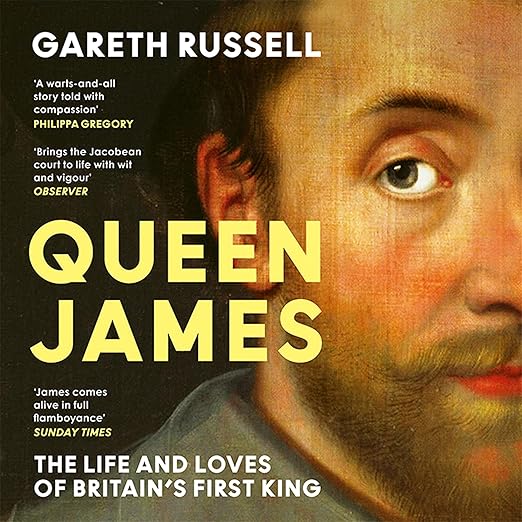
Gareth Russell is one of the few writers working in popular historical biography who manages to be genuinely scholarly and genuinely entertaining in the same sentence – not in the sense of making history accessible by simplifying it, but in the deeper sense of finding the human drama that rigorous scholarship actually produces when it is done properly. Queen James – a biography of James I of England and VI of Scotland, centred on the men he loved – is his most ambitious book yet, and it is extraordinary. A BBC History magazine Book of the Year, a Waterstones History Book of the Year, praised by Philippa Gregory, Tracy Borman, and the Sunday Times. The 4.5 rating from 211 listeners is not a small-sample enthusiasm. This book has found the audience it deserves, and it deserves a large one.
About the Audiobook
James Stuart is one of British history’s most systematically underexamined monarchs – consistently overshadowed by Elizabeth I on one side and the Civil War on the other, and when discussed at all, usually reduced to a handful of well-worn anecdotes about royal favourites and witchcraft trials. Russell’s argument, implicit throughout the book, is that this neglect has caused a genuine distortion in our understanding of early modern British history and that correcting it requires treating James not as a footnote between two more famous reigns but as the complex, brilliant, contradictory, deeply human figure he actually was.
The organising principle is audacious and exactly right. We all know the six wives of Henry VIII with encyclopaedic precision; why not the six loves of James I? Russell traces James’s romantic history in full and in sequence: a Scottish lord, a knight, the young Earl of Somerset, and – most durably and most completely – George Villiers, Duke of Buckingham, “the handsomest man in the whole world,” whose companionship sustained the king through the final decade of his reign and whose eventual assassination left James devastated in ways he never quite recovered from. James loved not always wisely, Russell argues, but always with genuine feeling and notable courage given the context.
But this is not merely romantic biography – it is biography that uses the personal as a key to the political, because in the Jacobean court those two things were never separable. The context Russell provides is genuinely dramatic by any standard: the mysterious murder of James’s father Lord Darnley before James’s own birth; Mary Queen of Scots’ tumultuous reign, imprisonment, and eventual execution; James’s own kidnapping by Scottish lords as a teenager; the Gunpowder Plot; the commissioning of the Bible that still bears his name; the political consolidation of Britain as a unified concept. A reign that encompassed more genuine drama than most monarchs encounter in a lifetime, and one whose personal dimensions have been systematically avoided by previous biographers.
Russell writes with a scholar’s care for evidence and a novelist’s feel for scene and character. The result is a book that feels – as Tracy Borman put it – as though it has been hiding in plain sight for four hundred years.
The Narration
Narrator details for this edition were not confirmed at the time of writing. The book’s prose is written with considerable verve – Russell’s style is witty, analytically precise, and confident in its use of irony – which suggests it would benefit significantly from a narrator with a talent for comic timing and the ability to sustain momentum across dense archival material without losing either the wit or the humanity. William Collins’ audiobook productions are generally well-sourced, and I will update this review with full narration details upon confirmation. At sixteen hours and thirty-three minutes, the narrator’s sustained quality matters considerably.
What Readers Say
Queen James holds a 4.5 out of 5 from 211 listeners, a meaningfully large sample for a work of serious history. Reviewers described it as a truly exceptional biography that illuminates the full arc of James’s life rather than cherry-picking notable episodes. One reader who prefers historical fiction to non-fiction wrote that Russell’s beautifully researched narrative kept them fully engaged throughout, and that there was not a page without something interesting happening – a high standard for a sixteen-hour audiobook. A more critical voice found the book somewhat repetitive on the romantic relationships and wished for more analysis of their political consequences, which is a fair observation about the book’s priorities, if not quite a failing. Tracy Borman called it “a stunning achievement.” The Sunday Times praised the way Russell “expertly weaves the bedchamber gossip into the tapestry of a tumultuous reign.” Both are accurate.
Who Should Listen?
Essential for anyone interested in British royal history, particularly the Jacobean period that rarely receives the biographical attention it deserves. Also strongly recommended for readers who appreciate biography as a form of intellectual and emotional engagement – Russell writes lives rather than chronicles, and the difference is felt on every page. Those who have read Alison Weir, Antonia Fraser, or Tracy Borman on Tudor and Stuart history will find this a natural and deeply satisfying next step. A rare book that changes how you understand a period you thought you already knew.
Find Queen James on Audible UK, or via Kobo, Scribd, and Storytel.