Clara’s Verdict
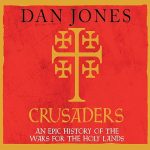
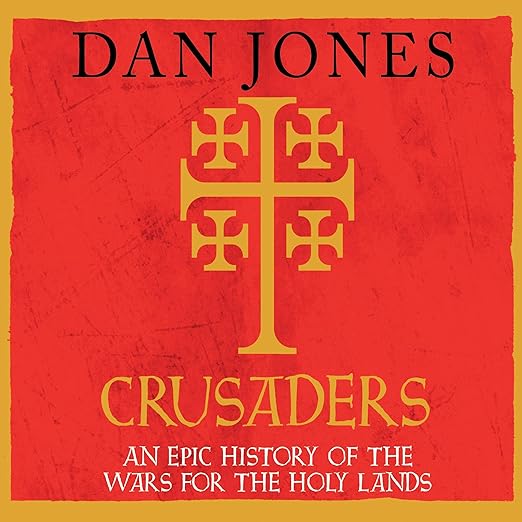
Dan Jones has carved out a distinctive space in popular history: serious scholarship worn lightly, narrative that moves at pace without sacrificing accuracy or complexity. Crusaders is among his finest work. This is a subject that demands careful handling – the Crusades remain contested territory, religiously, politically, and historically – and Jones navigates it with admirable balance, letting the primary sources speak through vivid character portraits while keeping two centuries of religious war coherent and comprehensible. Narrated by Jones himself, this is sixteen hours of some of the most gripping medieval history you’ll encounter in audio form. I’ve reviewed popular history across all periods, and this stands as a model of what the genre can achieve.
About the Audiobook
Jones structures his account around the people caught up in the Crusades rather than the battles and treaties in isolation. Pope Urban II’s preaching of the First Crusade in 1095 sets the scene – the extraordinary, contingent moment at which a speech by a pope set in motion two centuries of conflict. From there, the narrative follows an extraordinary cast across time: crusader knights and Saracen commanders, Jewish merchants caught between Christian and Muslim violence, Byzantine emperors navigating impossible political positions, women who organised logistics and endured sieges, and ordinary pilgrims who set out for Jerusalem with minimal resources and very little idea of what they were walking towards.
The timeline runs from 1095 to the fall of the last crusader outpost in the Levant in 1302-03, encompassing the taking of Jerusalem in 1099 and its eventual reconquest, the entire arc of the crusader states, the Frankish kingdoms established in the Holy Land, and the Muslim powers – Fatimid, Zengid, Ayyubid, Mamluk – that ultimately expelled them. Jones is careful to give the Islamic and Jewish perspectives their due weight alongside the Christian narrative, which means the book functions as a genuine historical account rather than a piece of Western self-congratulation.
The writing is vivid and the scholarship is solid – Jones draws on a wide range of primary sources from all sides of the conflict and weaves them into the narrative without footnote-heavy intrusion. This is popular history at its best: demanding enough to be intellectually satisfying, accessible enough that no prior knowledge of the period is required.
One of the book’s particular strengths is its treatment of the Crusader states – the curious, hybrid polities that European settlers established in the Holy Land and maintained for nearly two centuries. These were not simply outposts of European culture transplanted into an alien environment; they were societies in genuine and complex contact with Islamic and Byzantine civilisation, and Jones documents the cultural exchange, the political compromises, and the social arrangements that resulted with as much care as he gives to the battles. It makes for a richer picture than the straightforward clash-of-civilisations narrative that popular history of the period too often defaults to.
The Narration
Jones reads his own work, which for narrative history of this kind is a significant advantage. He knows the material from years of research and writing, and it shows in his delivery – there is a natural authority to his pacing that a hired narrator could not replicate without equally deep familiarity. He handles the Arabic, French, and Latin names with care, and his enthusiasm for the period comes through without tipping into sensationalism. At sixteen hours and eight minutes, this is a substantial listening commitment, but Jones sustains attention throughout a long and complex story.
What Readers Say
Listeners praise the book as both intellectually rigorous and genuinely exciting – a combination that does not always come together in popular history. Several university students have reported using it as a foundation for academic work on the medieval period, and multiple reviewers highlight Jones’s even-handedness across the religious traditions involved as a notable achievement. One dissenting voice found the author’s sympathies occasionally visible in his characterisation of the different parties – a fair observation, and one worth holding in mind, though most readers find his treatment admirably balanced given the scale of the material. Another reviewer notes the book’s wealth of primary source material from all sides of the conflict, including sources relating to women and civilians often absent from military histories. The audiobook holds a 4.6 out of 5 rating on Audible UK.
Who Should Listen?
Anyone with an interest in medieval history, the origins of the conflict between the Christian West and the Islamic world, or simply in a sweeping narrative driven by extraordinary characters. Jones writes accessibly enough that no prior knowledge of the Crusades is required, making this equally suitable for complete beginners and those who want to deepen an existing interest. Listen to Crusaders on Audible UK and let Dan Jones take you into one of history’s most turbulent and consequential centuries – told with the seriousness and the gusto it deserves.