Clara’s Verdict
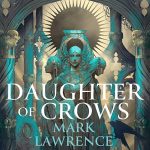
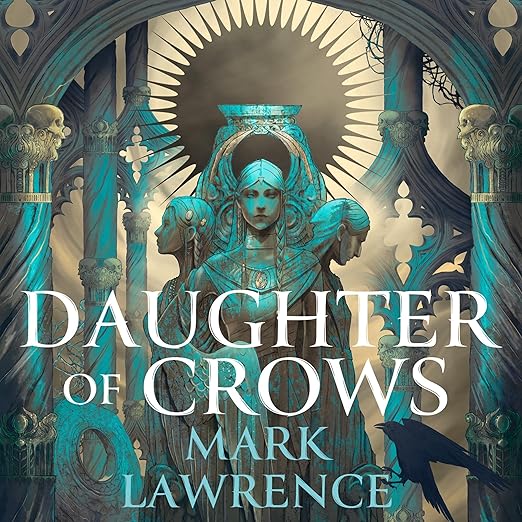
Mark Lawrence is one of the most technically accomplished writers working in dark fantasy, and Daughter of Crows represents him at something close to his absolute best. This is the first volume of The Academy of Kindness series, published by HarperVoyager in March 2026, and it is a book that rewards and demands sustained attention – not because it is unnecessarily obscure, but because Lawrence is doing several things simultaneously at a very high level, and part of the pleasure is discovering how they connect. The central character, Rue, is one of the most fully realised figures I’ve encountered in the genre: complex in her motivations, morally compromised without being simply dark, and impossible to look away from across three different phases of her life.
Robin Hobb’s endorsement – “I never met a Mark Lawrence book that I didn’t love” – and George R.R. Martin’s assessment – “an excellent writer” – are accurate evaluations. Rated 4.8 from its first readers, this has landed well with the audience best placed to judge it.
About the Audiobook
The Academy of Kindness exists to create agents of retribution, designed on the model of the Furies – the Kindly Ones of ancient mythology, before whom even gods hesitate. Each year, a hundred girls are sold to it. A decade later, three emerge. The decade in between involves the Wound Garden, the Bone Garden, and forms of instruction that the word “brutal” does not adequately describe. The few who survive are transformed: not simply skilled, but remade.
Rue sold herself to the Academy. That choice – made for reasons the novel gradually reveals – and what comes of a long and bloody lifetime of living as one of the Kindnesses, is the spine of the story. Lawrence tells it across multiple timelines simultaneously: Rue as a young woman inside the Academy; Rue in middle age operating as a fully realised agent of retribution; and Rue as an old woman who has somehow found peace, which is then violently disturbed. The structural interplay between these three timelines is where the book’s real power lies – each strand illuminates and recontextualises the others, and the moment at which they converge is worth every earlier moment of productive uncertainty.
The mythology underpinning the world is Greek and pre-Hellenic in origin, filtered through Lawrence’s characteristic dark imagination. The Academy itself is the conceptual centrepiece: an institution dedicated to producing a very specific kind of justice, operating outside the laws that govern ordinary people, and the tension between that purpose and the humanity of the women it creates is the book’s moral engine. At 14 hours and 29 minutes, this is an immersive experience that asks for genuine commitment and repays it substantially.
What separates Daughter of Crows from dark fantasy that merely wallows in its own grimness is the clarity of the moral vision beneath the surface. The Academy is not simply evil – it serves a genuine function in Lawrence’s world, one that would not exist if the world did not require it. The tension between institutional purpose and individual humanity is explored with the seriousness it deserves, and Rue’s journey is not simply survival but the gradual, costly accumulation of understanding about what she has become and why.
The Narration
Olivia Dowd narrates, and she rises impressively to a genuinely demanding text. The multiple timelines require distinct vocal registers – Rue at different ages must sound like the same person changed by time, experience, and consequence, not like three different characters who happen to share a name – and Dowd manages this with considerable craft. The darker sequences, of which there are many and they are varied in their nature, are handled without gratuitousness: she conveys violence and grief as Lawrence writes them, which is to say with weight and precision rather than spectacle. Across nearly fifteen hours, maintaining this quality and consistency is a real achievement.
What Readers Say
Early reception has been strongly positive. One reviewer described it as “a slow-paced, dark story about the memories of a character with three paths,” praising the non-linear structure for keeping the connection between those paths genuinely surprising. Another called it “a dark and chaotic ride inspired by the Fates, Morrigan and mythology,” noting that even during passages of deliberate confusion about which timeline was active, the reading experience remained compelling throughout. A third acknowledged that the final sections brought everything into sudden sharp focus in a way that retroactively justified every earlier moment of productive uncertainty. “Epic fantasy” is the accurate genre label, with all the commitment that implies.
Who Should Listen?
Essential for existing Mark Lawrence readers, who will find him at the height of his powers. For newcomers, some familiarity with dark, morally complex fantasy is helpful – this is not a book that softens its edges or provides orientation notes for the uncertain. Fans of Joe Abercrombie, Robin Hobb, and Ursula K. Le Guin’s more uncompromising work will find the register immediately congenial. The mythology-inflected world and the sustained focus on female agency and female experience give it a distinct identity within Lawrence’s catalogue. Book 1 of The Academy of Kindness – start here, and plan for the sequel.
Listen to Daughter of Crows on Audible UK – also available on Kobo, Scribd, and Storytel.