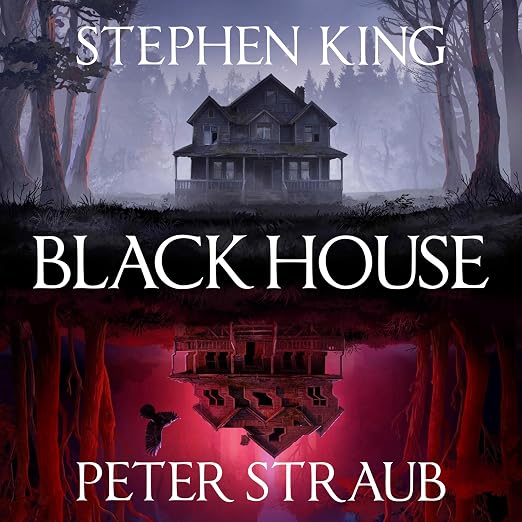
Clara’s Verdict
Twenty years separate The Talisman from Black House, and that gap is the most interesting thing about the book. Jack Sawyer was twelve when he walked across America and into a parallel world to find a talisman that would save his mother. He is a retired Los Angeles homicide detective when we meet him again, living quietly in Wisconsin, and he has forgotten the whole thing. Not repressed it exactly. Sealed it. The novel is about what happens when the seal fails, and it is a stranger, better book than a sequel arriving two decades late has any right to be.
Twenty-six hours and twenty-seven minutes is a serious commitment, and I would not pretend otherwise. What I will say is that the length is used rather than merely occupied. This is a novel with a genuinely unusual narrative voice, a horror plot of real nastiness, and a slow structural revelation that pays off properly. A 4.6 average from 6,289 ratings puts it among the better regarded books in a very large body of work, and it is back in the UK charts on the strength of a July 2026 release.
About the Audiobook
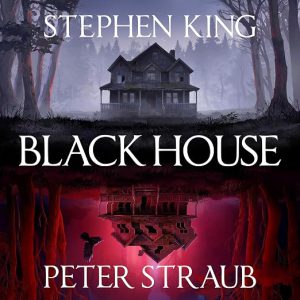
French Landing, Wisconsin is a quiet town until children begin to be taken and killed. Jack Sawyer is retired, is not looking for work, and is drawn back into a case that will require him to retrieve childhood memories he has spent twenty years not having. To save the latest victim he has to return to the one place he swore never to see again, and the Black House of the title is where the two halves of his life meet.
A note on authorship, since the listing may cause confusion. The book is credited here to Stephen King alone, but the promotional material on the same page describes storytelling by two masters of the craft, and readers in the reviews discuss it as a King and Straub collaboration. That is the more accurate description, and it matters to how the novel reads, because the prose voice belongs to neither writer individually. It is a hovering, present-tense, almost aerial narration that drifts over the town and dips into houses at will, and it takes an hour or so to settle into before it becomes one of the book’s chief pleasures.
On reading order: this is the second book of the sequence, following The Talisman, and the series is listed as a trilogy. You can follow Black House without the first book, since the essential backstory is supplied, but you will lose a great deal. The emotional charge of Jack’s recovered memories depends on your having been there when he made them. The other connection worth knowing is to King’s larger Dark Tower mythology, which several readers value highly here and which arrives without warning if you are not expecting it.
The Narration
Frank Muller reads it, and the assignment is a formidable one on three separate counts.
The first is the voice I described above. That drifting, communal, present-tense narration is unlike ordinary third-person storytelling and can very easily become a mannerism in performance. It requires a reader who treats it as a camera rather than as a person, moving without hurrying, describing without commenting. Muller has the patience for it, and the crucial quality he brings is that he does not decorate. The prose is already doing the work, and a narrator competing with it would be intolerable across twenty-six hours.
The second is the cast. French Landing is populated, and the novel spends real time with people other than Jack: police officers, journalists, bikers, elderly residents of a care home. They have to remain distinguishable across a very long book, and they do.
The third is the killer. This is a genuinely repellent antagonist, described by one reader as a decidedly nasty piece of work, and there are passages of considerable cruelty. The temptation for a narrator is to relish them. Muller does not, and his restraint is what makes those sections frightening instead of merely unpleasant. One practical point worth raising: on a recording of this length, listen to the sample with an ear for audio fidelity as well as performance, since that is the variable most likely to differ between editions.
What Readers Say
Those 6,289 ratings settle at 4.6, high even by King’s standards, and the pattern in the reviews is unusually consistent. The comparison people reach for is not to King’s other books but to the first volume in this sequence, and the verdict runs the same way almost every time.
A vast improvement over The Talisman, told from a dynamic perspective that waxes poetic. Reminds this reader of Twin Peaks, in places.
That is Mr B Powell, at four stars, and the Twin Peaks comparison is astute, particularly regarding the small-town surface with something obscene underneath it. Farhad Shawkat went further, calling The Talisman one of his least favourite King books and this a pleasant surprise, praising the characters and the Dark Tower connections, and making a claim I did not expect to see about a King novel: “Black House has one of the best endings he’s possibly ever written!”. For a writer whose endings are perennially contested, that is worth quoting. John T agreed that “If you enjoy King or Straub you will love this book”, noted that references to other King novels lend the story a certain honesty, and singled out how well the supporting characters are developed.
Who Should Listen?
Twenty-six and a half hours is a commitment measured in weeks rather than evenings, so let me be precise about who should make it. Anyone who read The Talisman and wondered what became of Jack Sawyer should start here immediately, since the reviews are near unanimous that this is the stronger novel. Anyone invested in the Dark Tower mythology will find material here that connects outwards, and will enjoy the discovery more than I can describe without spoiling it.
Newcomers to King should not begin with this book. It assumes a reader who has done some of the groundwork, both with The Talisman and with the wider mythology, and starting cold means watching a great deal of significance pass by unnoticed. Read the first volume, then come back.
A caution on content is warranted and I will not soften it. The crimes here involve children, they are described in detail, and there are sequences some listeners will find genuinely distressing. This is among the more brutal things in King’s catalogue rather than among the more atmospheric. Balanced against that, the writing is extraordinary, the ending is one his readers actually defend, and Muller’s reading gives the whole thing the patience it needs. For horror readers with time to spend, few things in the current UK charts offer this much.