Clara’s Verdict
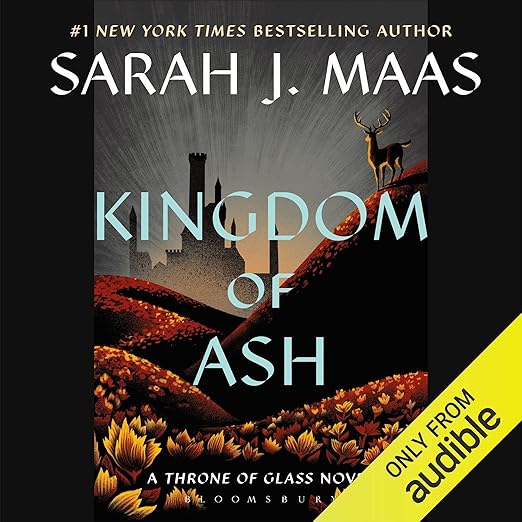
Thirty-three hours and eleven minutes is not a length, it is a season of your life. Kingdom of Ash closes a seven-volume series that has been building for years, and Sarah J. Maas has written it at the scale the ending demands rather than the scale a publisher would prefer. I respect that enormously, and I would also warn you that the opening hours are punishing in a way the earlier books never quite are.
The 4.8 average from one hundred and forty-six UK ratings is among the highest I have seen on a book of this length, and the combination tells you something. Readers who reached volume seven finished volume seven, and they were satisfied by it. As a piece of series construction this is close to a model. Every thread running since the beginning is picked up, and almost nothing is left dangling for the sake of a future spin-off.
About the Audiobook
Aelin Galathynius has risked everything to save her people, and the cost has been tremendous. She begins the book locked within an iron coffin by Maeve, Queen of the Fae, enduring months of torture, held together by the knowledge that yielding would doom everyone she loves. Her resolve unravels a little further with each passing day. Maas does not hurry this section, and it makes for genuinely hard listening.
With Aelin captured, the book distributes its weight across the rest of the cast. Aedion and Lysandra remain the last line of defence protecting Terrasen from utter destruction, and soon realise the many allies they have gathered against Erawan’s hordes may not be enough. Chaol, Manon and Dorian are scattered across the continent and racing against time, each forced to forge a separate path towards a separate fate. Across the sea, his companions unwavering beside him, Rowan hunts for his captured wife. Hanging in the balance is any hope of salvation and a better world.
This is the seventh and final volume in the Throne of Glass series, and it is emphatically not a starting point. The book assumes complete familiarity with everything before it, and opens mid-catastrophe with no recap of any kind. Anyone new should begin at the first volume and expect to spend a good while getting here. For those already in position, the reading order ends exactly where it should.
The Narration
Elizabeth Evans has carried this series from the beginning, and the continuity is a real asset at the finale. Characters who have been present for years arrive with voices the audience already recognises, and reunions land harder because of it. Casting consistency across a seven-book run is not something to take for granted in this industry, and the payoff is plainly audible here.
The structural challenge of this particular book is the sheer number of viewpoints. Maas rotates among several separated groups, often changing perspective from chapter to chapter, and in print that is managed with headers on the page. In audio it has to be managed by the reader. Evans shifts register audibly as the point of view changes, so you know within a sentence whose section you are in, and I would argue this makes the finale easier to follow in audio than on the page. That is a rare advantage for the format on a book this structurally busy.
She is alert to the emotional demands as well, which are considerable and sustained. The captivity sequences are read with restraint rather than intensity, which is the harder and the better choice, and the battle material later on is paced so that thirty-three hours of escalation never flattens into undifferentiated noise. It is a long, disciplined, unglamorous piece of work, and it holds up from beginning to end.
What Readers Say
No individual reviews are attached here, so the score carries the argument. The 4.8 average deserves a moment of interpretation rather than a nod.
Scores at this level usually indicate a self-selecting audience, and that is undoubtedly part of the story. Nobody reaches the seventh volume of a series they dislike. The more meaningful comparison is with length. Long finales tend to attract complaints about pacing and bloat, and a score this high on a thirty-three hour audiobook suggests the running time was accepted as necessary rather than merely endured. On my own listen the middle third does sag a little as the various parties manoeuvre into position, and the final stretch repays it several times over. If you have committed to the series, this is the conclusion it deserved, and the rating reflects readers arriving at the same view.
Who Should Listen?
The audience for this is precise: readers who have finished the previous six volumes and are ready to see it through. If that is you, no further recommendation is required, and you should set aside rather more time than you think you need.
Everyone else should stay away, and I mean that as practical advice rather than as gatekeeping. The book opens with a character already imprisoned and already breaking, and expects you to understand why that matters. Without the novels behind it, thirty-three hours of payoff for events you have not witnessed will be a poor experience. One content consideration is worth naming plainly as well: extended captivity and torture occupy a significant portion of the opening, described in more detail than some listeners will want.
Reach it in the right place in the sequence and it is the strongest thing in the series, with Evans’s reading the version to have.