Clara’s Verdict
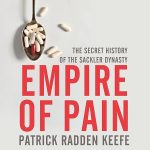
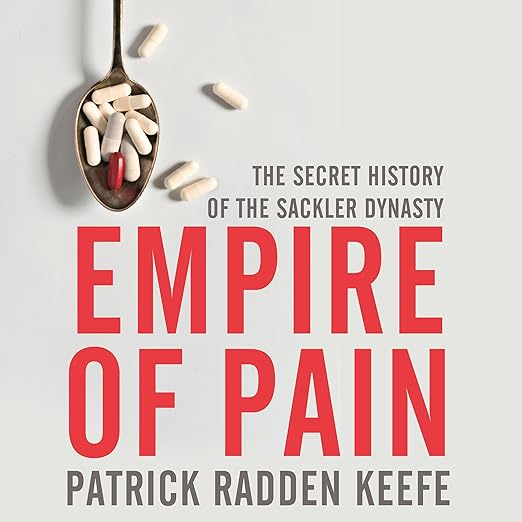
Patrick Radden Keefe is one of the finest narrative non-fiction writers working in English, and Empire of Pain is his masterwork. The story of the Sackler family – from immigrant poverty to art-world philanthropy to the opioid catastrophe that killed nearly half a million people – is the story of American capitalism at its most ruthless and most self-deceiving. The fact that Keefe reads his own book transforms what is already a gripping piece of reporting into something that feels like a personal reckoning, conducted by a writer who has spent years inside this material and clearly felt the weight of what he uncovered.
The Times said you feel almost guilty for enjoying it so much. I understand the sentiment precisely. This is one of those books that leaves you genuinely altered – not because it tells you something you didn’t know in outline, but because it makes you understand how it happened step by step, family member by family member, rationalisation by rationalisation, decision by decision. It reconstructs the logic of catastrophe with a clarity that is both illuminating and deeply uncomfortable. It is essential, full stop.
I rarely use that word without qualification. Here I mean it without reservation.
About the Audiobook
The Sackler name graces the walls of Harvard, the Louvre, the Metropolitan Museum of Art, and Oxford. For decades it signified philanthropy on a grand scale – art galleries, medical schools, scientific institutes. What it concealed was Purdue Pharma and OxyContin: the painkiller that ignited the opioid crisis and created one of the most profitable, and most destructive, pharmaceutical products in modern history.
Keefe structures the book as a dynasty saga across three generations, which is the right decision: it allows the reader to understand how a family convinced itself, incrementally, that what it was doing was acceptable. It begins with Arthur Sackler – the eldest brother, the original marketing genius, the man who essentially invented pharmaceutical advertising as we now know it – and traces how his methods were applied first to Valium and then, catastrophically, to OxyContin. The middle generation inherits both the fortune and the rationalisation machinery. By the third act, as deaths mount into the hundreds of thousands and lawsuits close in from every direction, the gap between the family’s self-image and the reality of what they built becomes the central, damning subject of the book.
The awards are a useful guide to the book’s standing: winner of the Baillie Gifford Prize for Non-Fiction, shortlisted for the FT/McKinsey Business Book of the Year and the CWA Gold Dagger for Non-Fiction, a BBC Radio 4 Book of the Week, cited by Barack Obama among his favourite books. These accolades reflect what the listening experience confirms.
The Narration
Keefe reads his own work, and the result is authoritative without being cold. He has spent years with these people – in court documents, in interviews conducted over that period, in the archive – and that proximity shows in how he inhabits the material. There is no point at which the narration condescends or editorialises beyond what the facts already warrant. He trusts his reporting to carry the moral weight, and it does.
At eighteen hours the pacing is controlled throughout; no section overstays its welcome, which is a genuine achievement for a book of this scope and complexity. The early chapters – establishing Arthur Sackler’s background and methods – are the slowest, but they are building the foundation that makes everything that follows comprehensible. Patience here is rewarded. Once the OxyContin story begins, the pace accelerates naturally, and the final third is almost impossible to pause.
What Readers Say
Reviewer J. Drew described it as “incredible, well researched but also a gripping read,” noting how the book traces the family’s trajectory from poverty through philanthropy to catastrophe with relentless precision. Midlands boy called it “brilliantly researched and written – I couldn’t put it down,” emphasising that the real subject is a family and its choices, not an abstract policy failure. E.W. Sharman offered a more measured take: slow to start in the Arthur Sackler section, but genuinely riveting once the second generation takes the stage. S. Riaz, who had previously read Keefe’s Say Nothing, called this a must-read after it won the Baillie Gifford Prize. The audiobook holds 4.6 stars from 11 ratings.
Who Should Listen?
Anyone with an interest in American history, corporate accountability, the pharmaceutical industry, the opioid crisis, or simply narrative non-fiction of the highest order. Also strongly recommended for listeners who enjoyed Bad Blood by John Carreyrou or Bryan Stevenson’s Just Mercy – books that use a single story to illuminate a systemic failure. This is not comfortable listening, but it is absolutely necessary listening. If you read only one work of narrative non-fiction this year, let it be this one.
Available on Audible UK, Kobo, Scribd, and Storytel. Listen to Empire of Pain on Audible UK.