Clara’s Verdict
I have been reading John Lewis-Stempel for years, and I will say without equivocation: there is no one quite like him in contemporary British nature writing. He has the naturalist’s eye, the farmer’s practical knowledge, and a prose style that is dense with sensory detail without ever becoming precious or self-congratulatory. He has earned the right to write about the English countryside the hard way – not from a study window or a university seminar room, but from years of actual fieldwork, farming, and patient observation in specific places at specific times of year.
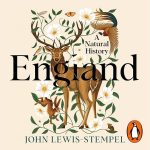
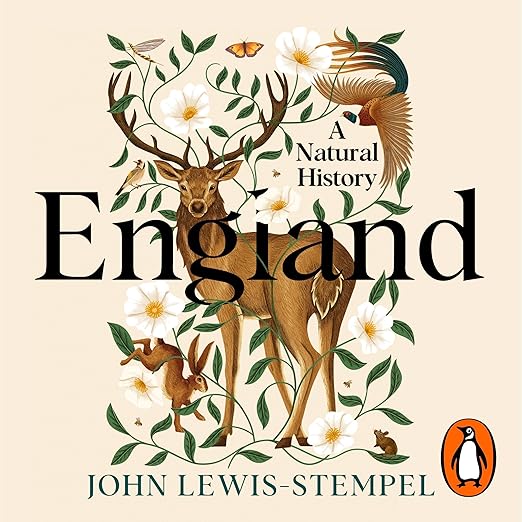
England: A Natural History is his most ambitious project yet – a habitat-by-habitat portrait of the country that manages to be at once encyclopaedic and intensely personal. Joseph Kloska’s narration matches the material beautifully: unhurried, resonant, with the right kind of English understatement that does not impose itself between reader and landscape. Described by critics as “Gilbert White for the twenty-first century,” this is nature writing at the very top of the form.
About the Audiobook
Our countryside is iconic: a series of distinctive habitats that unite to create a landscape unique for the rich diversity of its flora and fauna. In England: A Natural History, John Lewis-Stempel explores each habitat in turn, taking the listener from coast to moor, from downs to field, from park to village to create a vivid, living portrait of our natural history. In his trademark lyrical prose, Lewis-Stempel reveals the hidden workings of each habitat: the clear waters and dragonflies, the bluebells, badgers and stag beetles, wild thyme, granite cliffs, rock pools and sandy beaches, red deer at ancient oaks, the wayside flowers of the lane, hedgehogs and hares, and snow on the high peak.
Each landscape – whether calm green or wild moor, plunging cliff or flatland fen – has shaped our idea of ourselves, our sense of what it is to be in England. Lewis-Stempel has spent years revisiting particular locations to truly understand them, building knowledge of nature layer by layer, and this depth of accumulated attention shows on every page. Published by Transworld Digital and produced by Penguin Audio. The audiobook runs to 16 hours and 16 minutes. Described in advance coverage as the capstone of Lewis-Stempel’s nature writing career.
The Narration
Joseph Kloska narrates England: A Natural History, and the pairing works well. Kloska has a voice with genuine warmth and authority – it carries the weight of Lewis-Stempel’s more lyrical passages without artifice, and handles the more technically specific natural history sections with the clarity they require. For a sixteen-hour audiobook that moves through radically different landscapes and moods – from the spare bleakness of an upland moor in winter to the voluptuous abundance of a bluebell wood in spring – a narrator who can modulate register without losing continuity of character is essential. Kloska provides exactly that. This is a book to listen to slowly, in sections, letting the individual habitats accumulate into the larger portrait Lewis-Stempel is painting.
What Readers Say
Listener response has been enthusiastic across the 163 Audible ratings. One reviewer described Lewis-Stempel as writing “so descriptive in a well-researched and poetic style – just love the way this author writes, creates images in the mind.” Another wrote: “England: A Natural History is a love song to the English countryside – he takes us to a variety of habitats, building up his knowledge layer by layer. This book is the result.” A regular reader of Lewis-Stempel’s work called it “a perfect wildlife book – he is at the top of his game.” A minority found it “slightly less engaging than his earlier, more personal books” – a reasonable view from those who prefer his farm-diary format – but the consensus is one of considerable admiration. The audiobook holds a rating of 4.4 out of 5 on Audible.
What sets Lewis-Stempel apart from the more melancholic register of much contemporary British nature writing – the elegy for vanishing habitats, the lamentation for what has been lost – is his refusal to write from despair. He finds what is still there and renders it with such precision and love that the reader is left with a heightened awareness of the living world rather than a deepened grief for what is gone. That is a gift, and it makes England: A Natural History an energising rather than a depressing read, which cannot be said of all writing in this genre at this historical moment.
Who Should Listen?
Anyone with a love of the English countryside, nature writing, or the tradition of lyrical non-fiction that runs from Gilbert White through Richard Mabey to the present day. Lewis-Stempel is for those who want their natural history rooted in a specific place and season, not abstracted into statistics and generalities. Those who have not previously encountered his work might begin with Meadowland or The Running Hare before coming to this magisterial overview – though it is also a perfectly good entry point for newcomers to the genre. Available on Audible UK, Kobo, and Scribd.