Clara’s Verdict
The Science of Discworld books occupy a genuinely unusual space in the publishing landscape: they are simultaneously authentic Terry Pratchett Discworld fiction and serious, rigorous popular science, and – against all reasonable expectation – they work on both levels at once, reinforcing rather than undermining each other. This revised first edition – a collaboration between Pratchett, mathematician Ian Stewart, and biologist Jack Cohen – remains one of the most inventive popular-science books I have encountered in twenty years of reviewing. The structural conceit is not just a framing device; it is a genuine illuminating perspective. Watching the wizards of Unseen University try to make sense of a universe that operates without magic – where peculiar forces like “gravity” apparently run everything and million-to-one chances happen only once – turns out to be an unexpectedly effective way of making the strangeness of real physics and biology legible. An unusual pleasure, and one that rewards rereading.
About the Audiobook
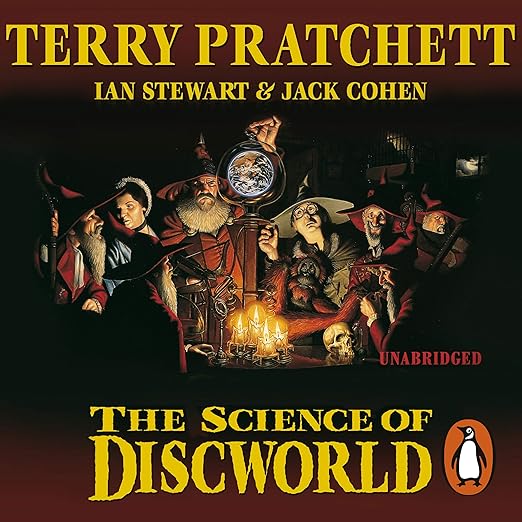
Book 1 in the Science of Discworld Series. A wizardly experiment at Unseen University goes catastrophically wrong, producing a pocket universe – Roundworld – where neither magic nor common sense seems to have any purchase, and where the peculiar and deeply suspect force of logic apparently runs everything. As the wizards of the Disc observe their accidental creation develop, we follow the story of our own universe from the primal singularity of the Big Bang to the Internet and beyond, with Stewart and Cohen’s scientific chapters interspersed between Pratchett’s narrative.
The interweaving works because Pratchett’s passages are not decoration – they are genuine Discworld fiction, with Archchancellor Mustrum Ridcully, Ponder Stibbons, and the Librarian operating at their most entertainingly baffled, and their puzzlement at Roundworld’s reliance on something as fundamentally absurd as “gravity” providing a running comic commentary on the explanatory ambitions of science. Stewart and Cohen, for their part, are rigorous and lucid, taking the opportunity of Pratchett’s frame to make genuinely difficult ideas accessible without condescension.
The result is a journey through cosmology, evolutionary biology, and the history of scientific thinking, carried by one of the warmest and most intelligent comic imaginations the past century produced. Pratchett at his peak, as one reviewer noted – and that is a high bar to meet. The science, under that cover, is both accurate and genuinely illuminating.
The “revised edition” designation refers to updates made to the scientific content to reflect developments since the book’s original publication. Stewart and Cohen’s revisions ensure that the science chapters remain accurate and current, while Pratchett’s narrative sections are unchanged – they are, as one reviewer noted, Pratchett at his peak, and peak Pratchett does not require revision.
The Narration
Michael Fenton Stevens narrates with the dry wit and precise timing that Pratchett’s writing demands and rarely receives from narrators who are not fully attuned to its particular register. He handles the shifts between the comedic Discworld sections and the more explanatory scientific passages smoothly, maintaining a consistent authorial voice across very different material. The Unseen University faculty are as entertaining here as in the main series – the comedy is intact – and the transitions to Stewart and Cohen’s chapters are handled without the jarring gear changes that mark less skilful productions. At thirteen hours and forty-five minutes, this is a substantial listen that rewards full attention.
What Readers Say
Rated 4.5 out of 5 from a small but consistently enthusiastic audience. One reviewer who had no idea the Science of Discworld books contained actual Discworld narrative described the discovery as “a delight – I thought I had run out of Pratchett.” Another praised the non-technical but rigorous scientific discussion as “a very lucid and thoughtful examination of the history of our universe, delivered with all the wit you expect from the Discworld.” A third noted the simple but effective premise – wizards poking at Roundworld while two scientists explain what is actually happening – and the way it makes you see the familiar as strange and the strange as familiar, which is what the best popular science achieves.
Who Should Listen?
Essential for Pratchett fans who have not yet discovered the Science of Discworld spin-offs – this is more Discworld, and it is very good Discworld, with the additional pleasure of learning something substantial about how the universe actually works. Also highly recommended for science readers who want their popular physics and biology delivered with wit rather than reverence. If you have read and enjoyed Bill Bryson’s A Short History of Nearly Everything and also love the Discworld novels, this is one of those rare books designed, almost exactly, for you. Intelligent, funny, and genuinely illuminating – and a reminder, if one were needed, that the best popular science writing and the best comic fiction share more in common than either is usually given credit for. Both are, at their core, about looking at the familiar from an unexpected angle and being surprised by what you see.