Clara’s Verdict
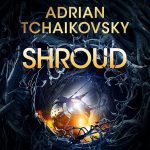
Adrian Tchaikovsky is one of the most reliably interesting science fiction writers working in Britain today, and Shroud – endorsed by Tim Peake and described by Richard Morgan as “crunchy, conceptual SF at its best” – is a demonstration of why. This is a novel about genuinely alien aliens, about survival in conditions hostile to human life, and about the way extreme circumstances strip away the assumptions we carry about intelligence, communication, and what it means to make contact with something utterly unlike ourselves. It is also, beneath that, a novel about the economics of exploitation. Tchaikovsky rarely misses an opportunity to hold a mirror up to something uncomfortable.
About the Audiobook
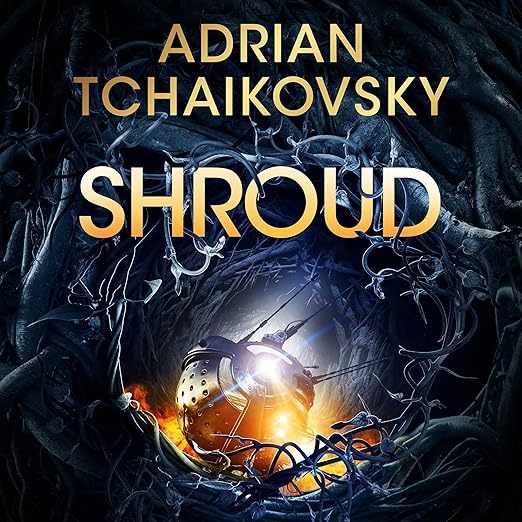
A commercial expedition discovers a pitch-black moon – Shroud – with extraordinarily hostile conditions: high gravity, high pressure, no oxygen. Ideal for resource extraction, lethal for humans. When a catastrophic accident forces Juna Ceelander and Mai Ste Etienne to make an emergency landing on the surface, the two women must survive a journey across alien terrain while being observed by, and slowly beginning to understand, the moon’s indigenous life.
What Tchaikovsky does brilliantly here is make the aliens genuinely alien. This is harder than it sounds. Most science fiction alien life is essentially humanity in a costume – recognisable desires, comprehensible motivations, communicable intentions. The creatures of Shroud operate on entirely different principles, and the novel’s central tension is the slow, uncertain process of each side beginning to parse the other’s existence. The dystopian human society from which the expedition departs is sketched with equal intelligence: a profit-driven structure in which human welfare is subordinated to shareholder value in ways that feel pointed rather than merely futuristic.
At fourteen and a half hours, this is satisfying in its scope without overstaying its welcome – a tight first-contact survival narrative with considerable intellectual ambition.
The Narration
Sophie Aldred – best known to British audiences as Ace from Doctor Who – narrates, and the casting is inspired. Aldred brings warmth and intelligence to Juna, and her voice carries the particular quality of someone who has spent a career navigating imaginative extremes without losing her grounding. She handles the more demanding conceptual passages – where the novel is essentially trying to describe the indescribable – with admirable clarity, and the survival sequences have genuine propulsion under her reading.
What Readers Say
Early UK listeners have awarded this 4.5 stars, with responses that speak to Tchaikovsky’s ability to satisfy multiple kinds of science fiction reader simultaneously. “This is how scifi horror should be,” wrote one listener – “everything about it is alien.” Another praised the “really alien aliens” alongside solid character work and a lively plot. Several reviewers noted the book’s critical dimension: the dystopian human society holds “a critical mirror up to humanity’s thoughtless expansionism,” in one reader’s phrase. The comparison to The Martian – this makes Andy Weir’s Mars look like a Caribbean beach resort – gives some indication of the survival stakes involved.
Who Should Listen?
Hard SF readers who want rigorous world-building and genuine conceptual ambition. Fans of Tchaikovsky’s Children of Time will find the same combination of alien intelligence and human political critique operating here. This is also an excellent choice for readers who find most first-contact stories disappointingly anthropocentric – Shroud commits fully to the difficulty of genuine otherness. If you enjoy Peter Watts, Greg Bear, or Stanislaw Lem at their most uncompromising, this will satisfy. Sophie Aldred fans will find her narration alone worth the listening time.
Listen to Shroud on Audible UK – find it here. Also available on Kobo, Scribd, and Storytel.