Clara’s Verdict
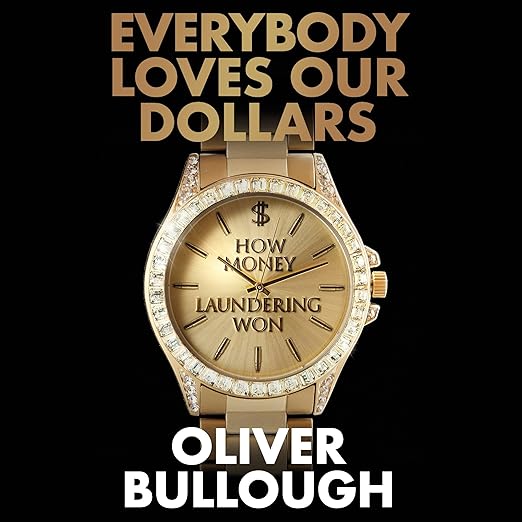
Oliver Bullough has built a career explaining how the global financial system enables kleptocracy and organised crime, and he does it better than almost anyone currently writing in the genre. His earlier books – Moneyland and Butler to the World – established his reputation as an investigative journalist with a gift for making arcane financial structures both accessible and genuinely alarming. Everybody Loves Our Dollars, a Sunday Times bestseller published in January 2026, is his most ambitious and arguably most urgent work to date. It covers money laundering not as a niche compliance problem for financial regulators but as the connective tissue of global criminality – the mechanism that makes everything else possible.
Bullough writes with a journalist’s eye for the telling detail and a satirist’s appreciation for the genuinely absurd, and the combination produces a book that is difficult to set down despite its sobering subject. This is what good investigative non-fiction should do: it should make you feel the weight of what you’re learning without crushing you with it.
About the Audiobook
Published in January 2026 and running nearly eleven hours, this is a wide-ranging investigation into how dirty money moves through the global economy and why every attempt to stop it has so far failed with such consistency. Bullough guides the listener across extraordinary terrain: cash economies where physical currency is still the primary medium of exchange; cryptocurrency ledgers that would look familiar to a fifteenth-century Florentine banker despite their technological novelty; trade-based laundering where goods crossing borders carry phantom values; and the peculiar secondary markets – designer handbags, baby eels, fine art – that allow criminal proceeds to circulate through what looks, on paper, like legitimate commerce.
The range of the research is remarkable. More striking is the connecting thread: that governments broadly understand the problem but have repeatedly demonstrated either insufficient will or, in some cases, insufficient interest in solving it. Apparently respectable institutions appear throughout these pages – law firms, banks, estate agents, and most memorably the US Mint – facilitating the conversion of criminal proceeds into legitimate assets on a scale that strains credibility until Bullough produces the documentation. The argument is not that the system is corrupt by accident, but that it functions precisely as it was designed to, and that changing it would require those with power over it to exercise that power against their own interests.
One of Bullough’s recurring structural moves is to follow the money from its criminal origin – drug revenue in Sinaloa, kleptocratic theft in post-Soviet states, tax evasion by American billionaires – through the layered sequence of transactions, jurisdictions, and institutional intermediaries that renders it clean and usable. The journey in each case involves recognisable, apparently legitimate participants at every stage, and by the time you arrive at the destination – the Mayfair townhouse, the Cayman holding structure, the Delaware shell company – the only remaining surprise is how unremarkable it all looks from the outside.
The Narration
Bullough reads his own work, which is invariably the right decision when the author writes with a distinctive personal voice. His delivery has the dry, slightly weary wit of a man who has spent years documenting a problem that nobody with real power seems particularly motivated to fix. The self-narration adds authority that a professional narrator cannot replicate: you are hearing someone who has done this reporting, who has been in these rooms and spoken to these people and come back with something that changed his understanding of how the world actually operates. At nearly eleven hours, the pacing is consistently engaging; Bullough keeps complex financial mechanisms accessible without dumbing them down, and his oral delivery matches the clarity of his prose at its best.
What Readers Say
Rated 4.4 from 53 early reviews, the response has been strong across both professional and general-interest audiences. A finance professional described it as “an important book” and praised Bullough’s handling of both trade-based laundering and cryptocurrency – areas other publications typically avoid. One reviewer described it as “horrifying but very convincing,” specifically noting the role of apparently respectable people and institutions in what amounts to industrial-scale financial crime. Another called it “a detailed, forensic look at money-laundering on a breathtaking international scale – a brilliant exposé.” The Guardian’s John Simpson described Bullough as “one of Britain’s finest investigative reporters,” which this book fully substantiates.
Who Should Listen?
Essential for anyone working in finance, law, compliance, regulatory policy, or journalism – but equally important for general readers who want to understand how the global economy actually functions beneath its legitimate surface. If you’ve read Moneyland or Butler to the World, this is unmissable: it builds directly on those foundations with fresh research and a sharper structural argument. If you haven’t encountered Bullough before, this is an excellent starting point. It is accessible without being shallow, and it will change how you read financial and political news for years to come.
Listen to Everybody Loves Our Dollars on Audible UK – also available on Kobo, Scribd, and Storytel.