Clara’s Verdict
The Michel Thomas Method has a peculiar effect on people who encounter it for the first time: they cannot quite believe it is working. You are listening to a classroom session, watching two students stumble and self-correct and gradually begin to construct sentences, and somewhere around the second hour you realise that you are also constructing sentences – that the language is assembling itself in your head without any of the rote memorisation you associate with language learning. David Sedaris, who tried the Egyptian Arabic course and wrote about it for the New Yorker, described the experience as “the thrill of actually figuring it out on your own.” That description is exactly right, and it is why this method remains, more than twenty-five years after Michel Thomas first developed it, the most effective audio-based language course I have encountered.
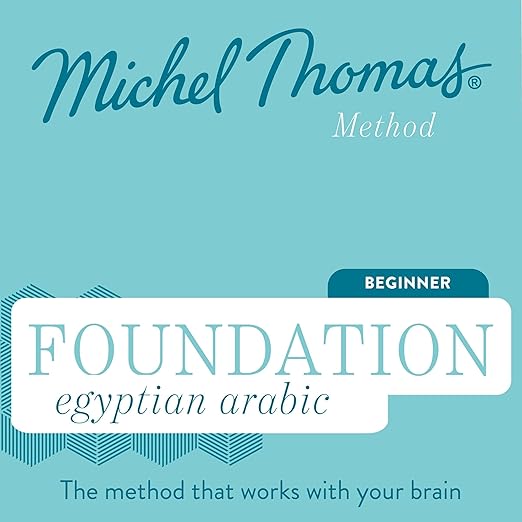
This eleven-hour Foundation course covers Egyptian Arabic – the most widely understood Arabic dialect, owing to Egypt’s historical dominance in Arabic-language film and television. It is an excellent choice for anyone who needs Arabic that works across the Arab world rather than in a single country.
About the Audiobook
The course is structured around a live classroom session with teachers Mahmoud Gaafar and Jane Wightwick, working with two students whose responses you hear in real time. The listener becomes the third student, pausing to formulate answers before the on-tape students respond. This active participation is the method’s central and radical insight: comprehension without active recall does not produce lasting retention. By making you construct every sentence yourself, rather than repeat it after a model or fill in a gap, the course ensures that what you learn is genuinely yours – encoded not as something you were told, but as something you worked out.
The Foundation course covers basic Egyptian Arabic from scratch: building sentences, handling questions, expressing wants and needs, navigating tenses. A 2-hour review course is included within the eleven-hour runtime. The accompanying PDF is available in your Audible Library. Published by Michel Thomas Method (originally recorded in 1999, now remastered and re-released in February 2026), this is a course that has stood the test of time without needing fundamental revision, which is itself a recommendation.
The course is the first step in a designed sequence – Foundation then Intermediate – for those who want to progress from a working foundation to more confident everyday use.
The Narration
Jane Wightwick co-teaches the course and is one of the voices throughout, alongside Mahmoud Gaafar and the two classroom students. The classroom format means this does not function like conventional narration: it is dynamic, occasionally uncertain (deliberately so), and full of the natural hesitations and self-corrections of real learning. This is a feature, not a flaw. Hearing another student struggle with a construction and then arrive at it correctly is more instructive than hearing a polished voice demonstrate mastery without apparent effort. The audio quality is clean and consistent throughout.
What Readers Say
The Michel Thomas Method courses have been reviewed extensively over many years, with consistent praise for their effectiveness with learners who have failed with conventional approaches – classroom tuition, textbooks, language apps. The Egyptian Arabic course specifically benefits from Gaafar and Wightwick’s evident expertise and their rapport with each other and with the students. Learners consistently report that sentences are retained more durably than with any app or classroom course they have previously tried. The course is explicitly designed not to make you fluent – Michel Thomas was refreshingly honest about this – but to give you a solid, usable foundation from which to build with other methods.
Who Should Listen?
Complete beginners to Arabic who want a spoken-first, grammar-implicit introduction that does not require sitting at a desk with a textbook. Travellers planning extended time in Egypt, or professionals who work with Egyptian colleagues and want to build basic conversational confidence. Anyone who has tried and abandoned conventional language learning and is looking for a method with a fundamentally different philosophy and a genuinely different success rate. Also worthwhile for those who already have some Modern Standard Arabic but want to tackle the spoken dialect most widely understood across the Arab world. And if you are simply curious what the fuss is about after Sedaris’s piece in the New Yorker – start here.
A word about Egyptian Arabic specifically: it is the dialect most widely understood across the Arab world because of Egypt’s dominant position in pan-Arab culture throughout the twentieth century. Egyptian films, music, and television have been exported to every Arabic-speaking country for decades, which means that Egyptian Arabic functions as a kind of common tongue even between speakers whose local dialects differ considerably. Learning it opens more doors, in more countries, than learning any other spoken dialect – which makes the choice of this dialect for a flagship introduction to Arabic an excellent one. It is the most useful starting point for a learner without a specific regional focus.
Begin the Foundation Egyptian Arabic course on Audible UK – start listening here.