Clara’s Verdict
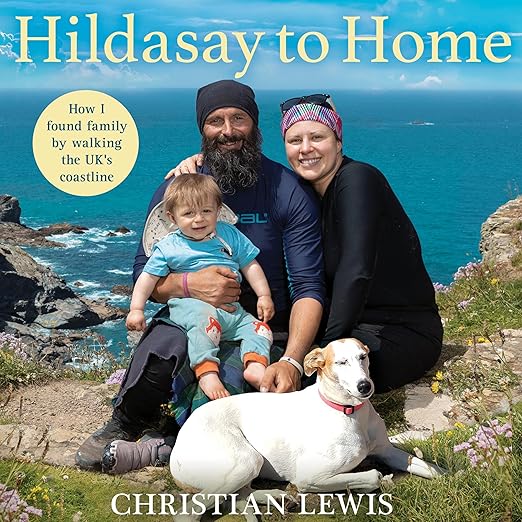
I’ve read a good many walking memoirs over the years, and the majority follow a predictable arc: man goes into wilderness, man finds himself, man returns, perhaps slightly wiser, almost certainly with a beard. Hildasay to Home refuses that template entirely. This is the second book in the Hildasay series, in which former paratrooper Christian Lewis continues his extraordinary coastal circumnavigation of Britain – a challenge that began after his life fell apart, that continued after his mental health returned with a vengeance, and that is completed in this volume with a newborn son strapped to his chest and an ageing dog limping at his side. The fact that it ends in Swansea with nearly half a million pounds raised for charity is almost beside the point. What stays with you is the sheer, stubborn humanness of it all.
Read by Lewis himself over six hours and twenty minutes, this audiobook has a quality that’s increasingly rare: you genuinely feel you’re in the room with someone telling you the unvarnished truth about their life, including the parts they’d clearly rather not have to tell.
About the Audiobook
The Sunday Times number one bestseller picks up directly from Finding Hildasay, beginning after Chris’s months of solitude on a remote Scottish island had done something to steady him. But solitude can’t travel with you, and as Lewis moves south through Scotland, Yorkshire, East Anglia, and eventually the Jurassic Coast with his partner Kate and their infant son Magnus, the familiar darkness returns. Mental health, for Lewis, isn’t something you cure – it is something you manage, imperfectly, day after day, with Jet the dog gradually slowing beside you and a baby growing heavier in the carrier.
The book covers the final stages of a walk that spanned years and thousands of miles. When Kate joins the trek, she brings not just companionship but a different kind of accountability – and Lewis is candid about how that changed him, not always comfortably. The relationship develops with the uncertainty of something real: two people trying to understand each other while simultaneously trying not to miss a coastal path sign in the rain. The Jurassic Coast section, where Lewis says he finally came back into himself after months of unravelling, is genuinely moving without ever becoming sentimental. The ending, when it arrives back in Swansea, earns its emotion.
Ben Fogle’s endorsement – “bursting with positivity and hope” – is generous but not quite complete. There is a great deal of darkness in this book: about mental health, about the difficulty of being known, about the particular exhaustion of putting one foot in front of the other when what you really want is to stop. That Lewis keeps going anyway, and that the walk eventually produces something that looks very much like a life worth living, is what gives the ending its emotional weight.
The Narration
Lewis narrates his own story, and this matters more than it might initially seem. There is no professional polish here – no crisp enunciation or studied actor’s timing – and that is precisely why it works. His voice carries the specific weight of someone recounting something that actually happened to them: the hesitations, the occasional roughness, the moments where emotion is barely held in check. When he speaks about his struggles with mental health or the fear of becoming his worst self again, you hear a man working through something in real time rather than performing a tidied-up version of it for broadcast. I would take this over a professional narrator reading someone else’s memoir any day of the week.
What Readers Say
UK listeners have responded with something close to devotion. One reviewer described it as “a must read for everyone but especially lovers of walking and lovers of dogs” and reported “tears streaming down my face” by the end – not the last person to say so. Another called it “a man of absolute grit and determination who found solace in his travels,” which gets something essential about Lewis exactly right. A more measured reader found it “inspiring and heart warming” but felt the final chapter revisited the same realisations a little too often – a fair observation, though one might argue that repetition is rather true to how actual emotional learning works. The BBC’s Ben Fogle called the first book “bursting with positivity and hope,” a description this sequel more than sustains.
The audiobook carries a high listener rating, and the reviews collectively suggest that Hildasay to Home reaches people who needed it – those dealing with their own mental health challenges, those who have lost someone, those who find meaning in long physical endeavours. It is not merely a feel-good adventure story, and the readers who respond to it most strongly are the ones who understand that.
Who Should Listen?
If you’ve ever been broken by something and had to find a reason to keep walking – literally or otherwise – this audiobook will speak to you directly. It’s essential listening for fans of Finding Hildasay, but it also works for anyone drawn to outdoor memoirs that carry real emotional substance: admirers of Ben Fogle, Cheryl Strayed, or the quieter end of adventure writing. It is particularly well-suited to long walks, commutes, or drives, where Lewis’s unpolished voice becomes something close to company. One important caveat: don’t start here. Listen to or read the first book beforehand, or you will miss the full weight of what the ending means when it finally comes.
Listen to Hildasay to Home on Audible UK – also available on Kobo, Scribd, and Storytel.