Clara’s Verdict
Joe Dispenza is a polarising figure in the wellness world – part neuroscientist, part motivational speaker, with a devoted international following and an equally sceptical community of critics who question his harder scientific claims. I am not in a position to adjudicate the neuroscience, and in any case the audiobook is best assessed on its own terms: does it work as a meditation programme? The honest answer is that it does, more than I expected. The guided sessions are well-constructed, the soundscapes are genuinely immersive without being cloying, and Dispenza’s voice has an unhurried, non-syrupy quality that I find more palatable than much of the guided meditation genre.
This is best understood as a companion to his book Breaking the Habit of Being Yourself rather than a standalone introduction to his ideas. If you have not read or listened to that book first, some of the conceptual framing in these meditations may feel abstract or unexplained. But for those who already have the context, this is a substantive and carefully structured practice programme, not a collection of ambient sounds with motivational phrases attached.
About the Audiobook
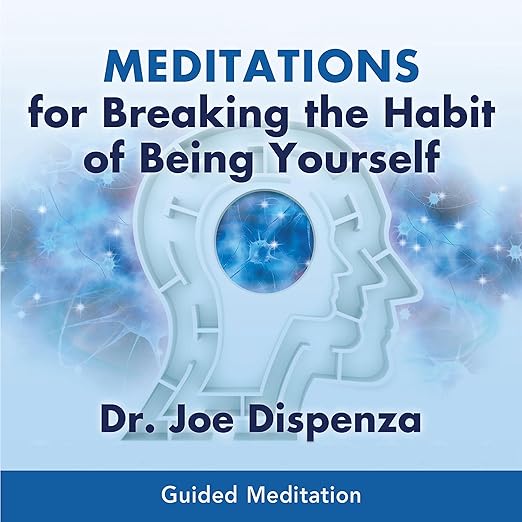
This four-week guided meditation programme teaches listeners how to access the operating system of the subconscious mind, where automatic habits, emotional reactions, and self-limiting beliefs live. Across eight guided meditations set to immersive soundscapes, Dr Joe leads listeners to move from the busy beta brainwave state into a relaxed, receptive alpha state. The body-based awareness and expansive “space” awareness practices are designed to train the brain and nervous system to align with a new future rather than endlessly replaying a familiar past.
The programme can be used as a four-week mental rehearsal intensive – choosing the Water Rising or Space meditation each day – or as a sustained daily practice. Dispenza is explicit about the importance of consistency: these are not techniques that produce results after one session, but cumulative practices designed to create structural change over time. The audiobook runs to 2 hours and 27 minutes – the total runtime of the session content itself, with individual meditations ranging from shorter daily practices to a longer session of up to ninety minutes.
The Narration
Joe Dispenza narrates his own programme, which is the only arrangement that makes sense for guided meditation work. His voice is the instrument, and it is well-suited to the purpose: deep without being artificially dramatic, authoritative without being cold, and with a particular quality of focused calm that makes the longer meditations easier to sustain. Listeners who have encountered his live events will find the same delivery – slightly formal, precision-focused, clearly rehearsed – which provides continuity for returning practitioners. The background soundscapes are woven in smoothly and do not compete with the spoken guidance. Production quality from Hay House is, as usual for their audio titles, reliably high.
What Readers Say
The response from listeners has been strongly positive, with particular appreciation for Dispenza’s voice quality and the practical structure of the programme. One reviewer wrote: “I tried these meditations very sceptical about the Dr Joe phenomenon – but I have been pleasantly surprised. His voice isn’t syrupy like some. There are soothing background sounds and music. Even if nothing changes, at least you’ve relaxed for a while.” Another noted: “With detailed explanations it’s helping me understand my own feelings, thoughts and behaviours – I’m now happy to learn that I’m not condemned to spend my life frustrated with unwanted thoughts.” A committed practitioner who had also attended a live workshop described the meditations as “working for me” alongside the structured practice. The audiobook holds a rating of 4.6 out of 5 on Audible.
It is also worth addressing the scepticism directly, because this is a title that will provoke it. Dispenza’s claims about the neuroscience of meditation are, in places, stated with more certainty than the evidence base strictly supports. Listeners who approach this as scientific fact will find themselves on shakier ground than those who approach it as structured contemplative practice with a contemporary neuroscientific framing. The meditations themselves, stripped of the theoretical apparatus, are competently designed and genuinely relaxing – which is, for many listeners, sufficient justification regardless of the wider claims.
Who Should Listen?
Existing followers of Dispenza’s work will find this the obvious and natural complement to his books. Those new to meditation who want a structured, science-adjacent approach – rather than a purely spiritual or religious framework – may also find it useful, though patience with the explanatory framing is required. Committed sceptics will struggle; the benefits here are for those willing to commit to the four-week practice and evaluate by results rather than prior position. Also available via Kobo and Scribd for those who prefer subscription access.
Listen to Meditations for Breaking the Habit of Being Yourself on Audible UK